


When Democrats in Congress created enhanced Affordable Care Act (ACA) tax credits four years ago to help Americans afford health coverage in the wake of Covid, they came with a built-in drop-off point: if the credits weren’t renewed by the end of 2025, they would expire, jacking many Americans’ health care costs back up. That deadline has nearly arrived, and Congress is torn on what to do.
Acknowledging that letting the credits suddenly expire would increase health care costs for millions of people and could be a political disaster, Democrats and some Republicans in Congress are now strategizing about how to keep them going. Last week, a bipartisan group of swing-district House members, among them Rep. Tom Kean Jr. (R-Westfield), introduced a bill to extend the credits for a single year, thus pushing the deadline until after the 2026 midterm elections.
“If [the credits] expire at the end of the year, families in New Jersey and across the country will face higher costs and risk losing critical coverage,” Kean said in a statement on the bill. “This bipartisan effort will extend the credits for another year as Congress continues working together on long-term solutions to lower health care premiums.”
Rep. Jeff Van Drew (R-Dennis) has since signed onto the bill as a co-sponsor, as has Rep. Josh Gottheimer (D-Tenafly); New Jersey’s other Republican congressman, Rep. Chris Smith (R-Manchester), told the New Jersey Globe that he “hasn’t really studied” the issue yet and has yet to decide whether to support an extension.
Some Democrats, though, are interested in proposals that go much further. One bill that’s gained steam in the Democratic caucus would both make the expanded Obamacare credits permanent and repeal the Medicaid cuts that Republicans passed as part of the Big Beautiful Bill earlier this year; the bill, which likely has no shot of going anywhere in Republican-controlled Washington, counts Gottheimer and Reps. Frank Pallone (D-Long Branch) and Rob Menendez (D-Jersey City) among its co-sponsors.
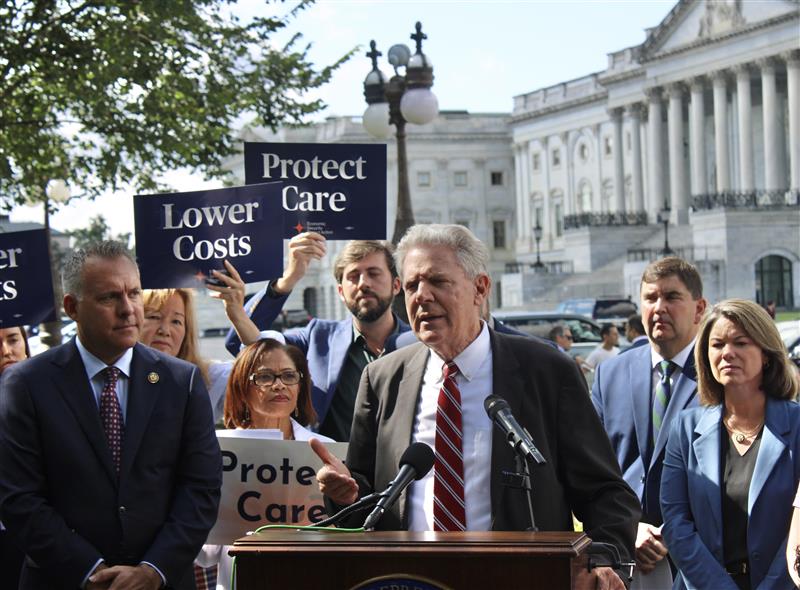
Pallone, moreover, is connecting the fight over the ACA credits to another fraught congressional issue: the government funding deadline looming at the end of the month. In order for a funding proposal to earn his support, Pallone said, Republicans need to find a compromise that averts major health care cuts.
“I’m not voting for any spending bill that does not address this health care crisis in a serious way,” he said at a press conference this morning. “We owe it to the American people to address this.”
Republicans, though, have thrown cold water on the idea of linking an ACA credit extension to a funding deal. Senate Majority Leader John Thune (R-South Dakota) told Bloomberg there’s “no way” the ACA credits will make it into the stopgap funding bill that needs to pass by the end of this month, raising the prospect of a shutdown.
Per the health policy organization KFF, the enhanced ACA subsidies were originally implemented by the 2021 American Rescue Plan as a short-term way to ameliorate Covid’s impacts, and were later extended through the end of this year by the 2022 Inflation Reduction Act. In the four years since their creation, the new and expanded credits helped ACA Marketplace enrollment explode from 11.4 million to 24.3 million.
If the credits were to expire cold-turkey, those who get health coverage via ACA marketplaces would see their premiums increase by 75% on average, KFF found. According to the nonpartisan Congressional Budget Office, the result would be that four million fewer people would have health coverage, adding onto the 11.8 million the CBO estimates will go without coverage thanks to the One Big Beautiful Bill.
In a letter sent to New Jersey’s congressional delegation in May, the New Jersey Department of Banking and Insurance (DOBI) warned of the negative impacts of a subsidy expiration on New Jersey specifically. 454,016 New Jerseyans would see their health care costs go up, DOBI Commissioner Justin Zimmerman said, and those who receive the credits would have to pay an average of $1,260 more per year.
“Congress can prevent increases in health coverage costs for New Jersey residents by renewing or making permanent these vital tax credits as soon as possible on behalf of residents who rely on them for quality, affordable health coverage,” Zimmerman wrote.
Many congressional Republicans, especially those on the more conservative end of the conference, nevertheless argue that Congress should allow the credits to expire rather than continue to spend hundreds of billions of dollars keeping them going. Van Drew, however, argued that those holdouts should acknowledge the political reality of the situation.
“They have to learn what everybody else has to learn in life: you don’t get your way 100% of the time,” he said. “We’ve done a lot of good, conservative, fiscally responsible things, and they have to realize that there are other members in Congress… [Swing-district Republicans] are going to be very vulnerable – we need to help them.”
