


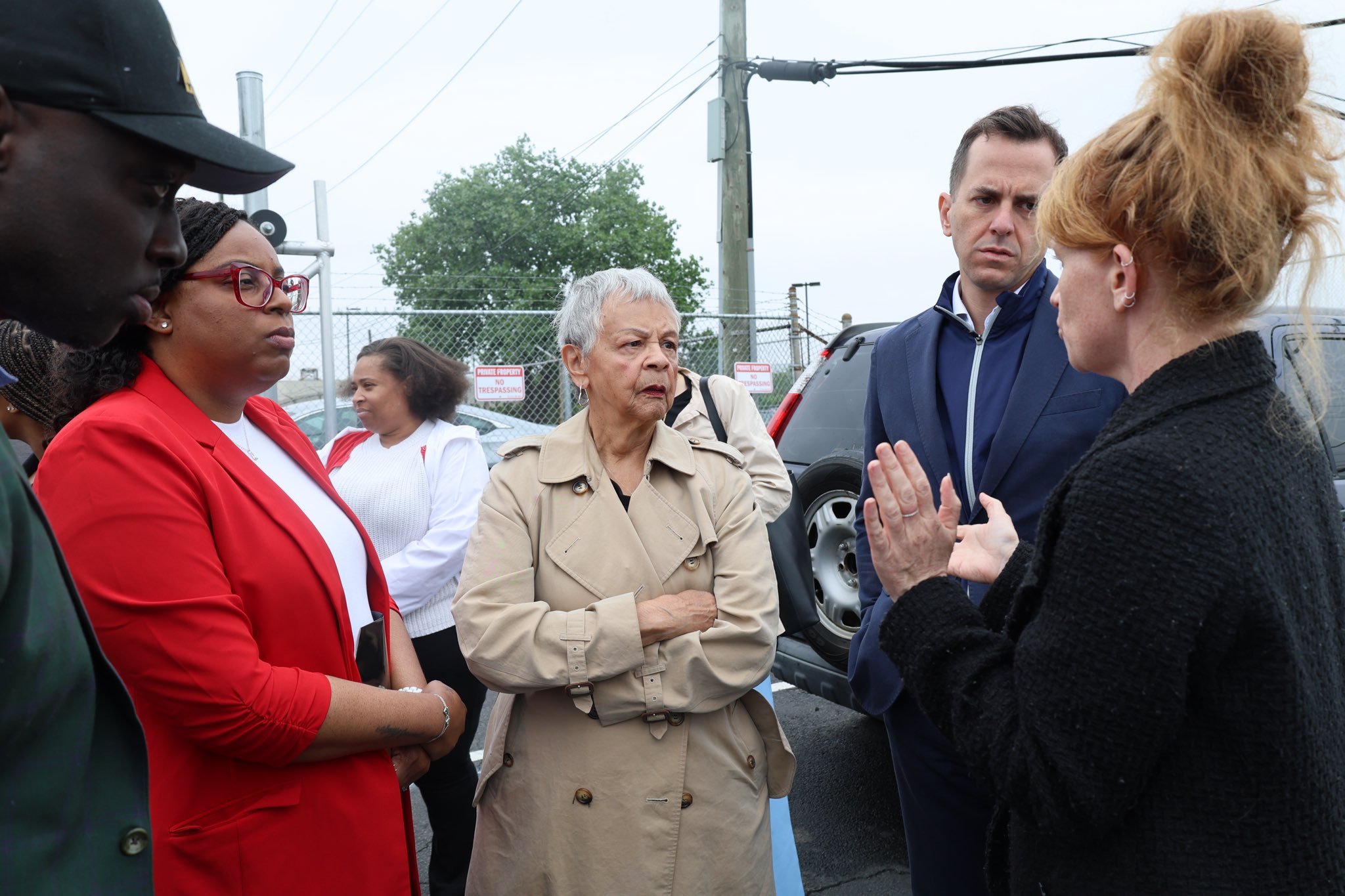
Last month, New Jersey Rep. LaMonica McIver (D-Newark), under indictment for assault, asked a federal judge to throw out the charges against her for containing a number of supposedly fatal defects. In an 80-page brief filed yesterday, the Department of Justice (DOJ) argues that no such dismissal is warranted.
The brief also largely corroborates McIver’s own account of what happened on May 9 at the Delaney Hall immigrant detention center. McIver and two of her congressional colleagues were allowed into the facility for an oversight visit; Newark Mayor Ras Baraka was also let inside the facility’s gates, then told to leave, which he did after a tense interaction with immigration officials who threatened to arrest him; and finally, even after exiting the gates, Baraka was arrested anyways, prompting the scuffle that forms the basis of the charges against McIver.
Another detail confirmed by the brief: Department of Homeland Security (DHS) agents arrested Baraka after “consulting with the Deputy Attorney General,” Todd Blanche, the DOJ’s second-in-command.
In their motions last month, McIver’s defense attorneys put forward two key arguments for why the charges should be dismissed: the prosecution against her is vindictive and politically motivated by her criticism of President Donald Trump’s policies, and the charges center around official legislative business that’s protected by the Constitution’s Speech or Debate clause.
Writing for the DOJ, however, Assistant U.S. Attorneys Mark McCarren and Benjamin Bleiberg work to dismantle those arguments, saying that they are an attempt to obfuscate what is otherwise a straightforward case of assault. A trial in the matter is scheduled for November 10, but the decision about whether the case will continue ultimately rests with U.S. District Judge Jamel Semper.
McIver’s claims of selective prosecution, the DOJ argues, fall apart because she provides no specific evidence that she was treated any differently from another defendant in her situation, or that the prosecution – led by controversial acting U.S. Attorney Alina Habba, whose authority as New Jersey’s top prosecutor remains in limbo – harbors any specific animus against her.
“[McIver’s allegation of discriminatory intent] relies primarily upon a mistaken understanding of DOJ policy, as well as out-of-context statements concerning the Administration’s well-publicized law enforcement policies and priorities,” the brief states. “In the process, McIver omits mention of evidence contradicting her claims from the very sources upon which she relies for her supposed evidence of ‘discriminatory intent.’”
McIver’s motion also rested heavily on a comparison to the rioters who stormed the U.S. Capitol on January 6, 2021, who were subject to blanket pardons and dismissals of charges when Trump retook office this year. If their conduct, which McIver’s attorneys said was “far more egregious” than anything McIver did, has been treated so gently by Trump’s DOJ, then the vigorous prosecution of McIver should be seen as politically motivated.
The DOJ, however, calls that comparison “apples to oranges,” saying the treatment of one cannot be used as a defense of the other. Moreover, the DOJ contends that Trump’s sweeping pardons covered even January 6 defendants who had not yet been prosecuted, and a presidential pardon is “absolute.”
“McIver’s claim faces a threshold, insurmountable defect: the January 6 Defendants cannot be considered similarly situated because they all were pardoned,” the brief states. “As a consequence, their ongoing prosecutions had to be dismissed without regard to the exercise of prosecutorial discretion, and they could not be prosecuted for January 6th related crimes thereafter.”
Another argument McIver put forward, that the DOJ failed to consult with its Public Integrity Section (PIN), is similarly moot, the brief states, because the DOJ had already suspended its own policy requiring consultation with PIN before bringing charges against members of Congress.
Citing a Reuters article, the brief places the suspension of the policy around May 10 – right as DHS began publicly threatening action against McIver and the two other Democratic members of Congress present for the visit and ensuing fracas. Reps. Rob Menendez (D-Jersey City) and Bonnie Watson Coleman (D-Ewing), referred to as “Betsy” at one point in the DOJ’s brief, ultimately were not charged.
As for McIver’s claims that her conduct is protected by the Speech or Debate Clause, the DOJ acknowledges that the Delaney Hall oversight visit falls under the category of McIver’s official actions as a congresswoman, but disputes the idea that an altercation with law enforcement officials is subject to the same protections.
“Imagine, for example, that McIver, while touring Delaney Hall, smuggled in contraband that she surreptitiously slipped to a detainee,” the brief states. “Such conduct would violate a number of federal and state statutes, and it would certainly have no legitimate legislative purpose. But under McIver’s theory of immunity, she would be immune from prosecution because it occurred during an otherwise legitimate legislative act.”
“It defies logic to believe that the Founders envisioned the immunity conferred by the Speech or Debate Clause sweeps so broadly,” it continues.
According to the brief, McIver attempted to impede Baraka’s arrest twice: first when Baraka was confronted while inside the gates, and again during Baraka’s actual arrest outside the gates. The latter incident, when McIver placed her arms around Baraka to prevent the arrest and “barreled after the Mayor and the [Special Agent in Charge], making forcible contact with the SAC and one other ICE officer,” provides the basis for the charges against her.
The trespassing charges against Baraka were later dropped, and earned the U.S. Attorney’s office a scolding from a federal magistrate judge.
The brief’s summary of events appears to concede a key point that McIver has suggested: none of the federal agents involved in the scuffle actually experienced any injuries as a result. The DOJ argues, however, that “the Government does not need to show harm or injury to satisfy the elements of the offenses charged.”
Seemingly contradicted by the brief, meanwhile, are claims from DHS officials in the wake of the incident that McIver and her colleagues had “stormed” and “illegally [broken] into” Delaney Hall, rather than simply walking in for an oversight visit. The brief’s timeline of events states that McIver “entered through the front gate into the secured area of the facility,” and makes no mention of any forcible entry into the facility.
Another motion filed by McIver last month demanded that the Trump administration cease making “extrajudicial statements” about her and withdraw any such prior statements. The DOJ says in its brief that it has asked DHS to remove five of its posts that McIver found objectionable, but all five of the posts remain public on the DHS’s website or social media as of this morning.
Finally, McIver and the DOJ remain at odds on discovery. McIver’s flurry of motions last month insisted that the DOJ has not handed over a raft of important evidence; the DOJ’s brief says it is willing to grant McIver’s request for internal video of McIver’s oversight tour, but called other requests “breathtaking in [their] scope.”
The DOJ also contested McIver’s claim that some relevant body camera footage has not been released; while footage from 11 agents’ body cameras have been provided, the DOJ says other agents present for the incident were not wearing cameras at the time, including the two agents identified as “Victim-1” and “Victim-2.”
DOJ response to McIver motion to dismiss
