


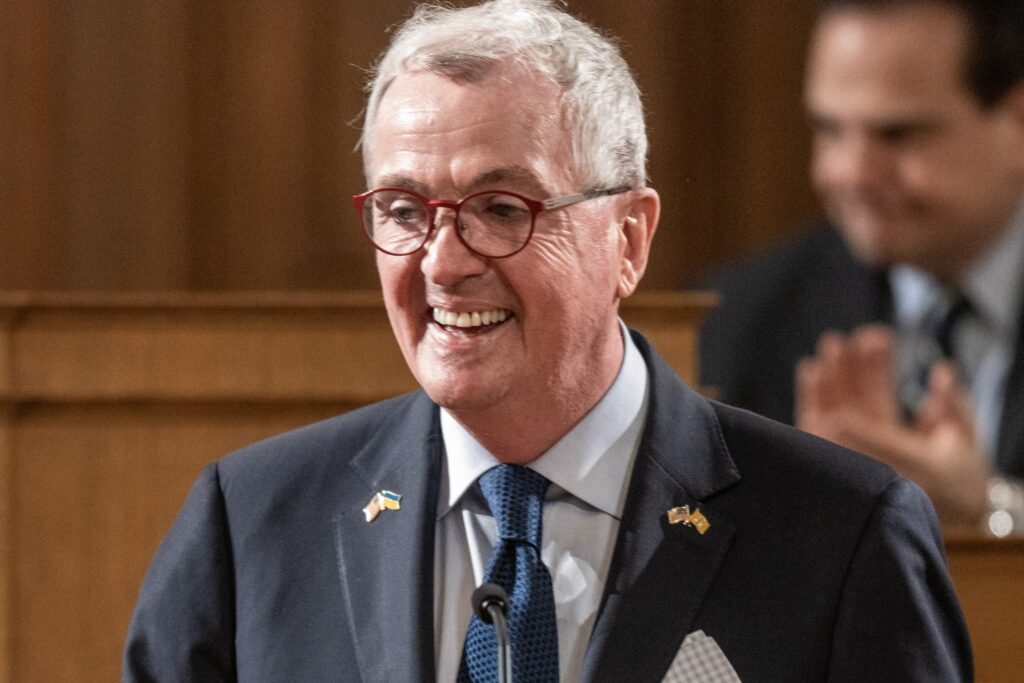
Gov. Phil Murphy’s administration has put more than $42 billion into state pensions since he took office in 2018, putting the funds on a path to recovery. (Hal Brown for New Jersey Monitor)
Pensions are poised to top Gov. Phil Murphy’s list of achievements regardless of what else the term-limited Democrat accomplishes before he leaves office in four months.
Since his initial election as governor in 2017, Murphy has boosted annual pension payments — long ignored by governors of both parties — to record highs, reversing declines in a key metric used to measure the health of the funds that pay retirement benefits to public workers at all levels of New Jersey government.
“I think it’s probably paragraph one or bullet point one under making New Jersey a more responsible state again, a state you can trust,” Murphy, a Democrat, told the New Jersey Monitor in an interview.
New Jersey’s pension problems began their downward trajectory in 1997 under Republican Gov. Christine Todd Whitman, who cut about $590 million from the state’s annual pension payment — a roughly 86% reduction at the time — and borrowed nearly $2.8 billion to cover obligations and balance the state budget, including large income tax cuts.
Subsequent governors of both parties largely did not move to restore pension funding. Gov. Jon Corzine, a Democrat, made pension payments of just over $1 billion in fiscal years 2007 and 2008, but the havoc wrought by the Great Recession on New Jersey’s budget brought pension payments back down to zero for fiscal years 2010 and 2011.
Pension payments edged up under Republican Gov. Chris Christie, their growth aided by changes that placed more retirement costs on workers and delayed some pension-related cost increases. By Christie’s final budgetary year, the state was paying nearly $2.5 billion into its pensions, but even that was only half of what actuaries said was needed to restore the fund.
The disinvestment ballooned pension funds’ debts while denuding their assets and driving funding ratios — a key measure of pension health that compares a pension’s assets to its liabilities — down to among the lowest levels in the nation. Only Illinois had worse-funded pensions, according to researchers from the Pew Charitable Trusts, with that state’s troubles driven by a similar pattern of disinvestment and fallout from the Great Recession.
“Prior administrations, and even the first years of Murphy administration, needed to weigh pension funding versus other policy and moral funding issues such as K-12 aid, property tax relief, health care, support for developmentally disabled and other programs to support vulnerable communities,” said David Rousseau, a former state Treasurer under Corzine.
The level of contributions needed to restore fund health rose alongside debt. Had the disinvestment not occurred, administration officials and Murphy say, the state would only be required to pay about $1 billion annually. Instead, New Jersey actuaries say the state needs to pay roughly $6.9 billion.
New Jersey is expected to pay more than $7.2 billion into its pensions this year, including contributions from the state lottery. That would bring aggregate contributions under Murphy to above $47 billion, more than twice the $22.7 billion paid by other governors since the 1997 fiscal year.
“It’s like paying off a mortgage,” said Charles Steindel, who was the state’s chief economist under Christie from 2010 to 2014. “You’re paying off current unfunded liability.”
I think it’s probably paragraph one or bullet point one under making New Jersey a more responsible state again.
– Gov. Phil Murphy
Still, the health of New Jersey’s pensions remains precarious. Funding ratios across the state’s major pension funds, which, according to Treasury disclosures, cover more than 720,000 state workers, continued to decline until the state made its first full payment in the 2022 fiscal year.
Most of New Jersey’s pensions — and its large funds in particular — remain well below the 80% funding ratio experts consider indicative of a healthy pension fund, and those funds are expected to take a decade or more to reach that level.
Apart from two small pension funds that, combined, covered just 49 workers in the 2024 fiscal year, the state’s pension funds are not expected to reach a 100% funding ratio until about 2050, at which point the state’s annual pension payment would drop dramatically over only a couple of years, according to state actuarial reports.
But whether or not the pensions recover to that point will depend on how future governors treat the state’s pension obligations.
“I think we’ve succeeded in drawing a line in the sand above which we will have good behavior in the years ahead, regardless of Democratic or Republican administrations,” Murphy said. “We will put the sort of bad budget behavior in the past.”
The two major-party nominees vying to succeed Murphy, Rep. Mikie Sherrill (D) and former Assemblyman Jack Ciattarelli (R), have both said they would continue to fund state pensions if elected.
Though reducing pension payments would not immediately imperil benefits, cutting them may be difficult for the same reasons cutting Social Security is difficult at the federal level: Workers have paid into those funds for years or decades.
“A pension, after all, is nothing more than a deferred salary,” Steindel said. “You pay people their salaries.”
Economic shocks, whether from a recession or a more constrained downturn in financial markets, could also delay pensions’ recoveries. Pension funds are invested, and officials set a baseline expectation of 7% annual returns on those investments. Better returns could accelerate the recovery.
“Are the pension problems over? The answer is no,” Steindel said. “But the big deal — this heavy lift of this huge increase of state appropriations for the pension funds — that’s pretty much over.”

Cost-of-living adjustments to pension benefits that have been paused for more than a decade under a bipartisan 2011 bill signed by Christie could also delay pensions’ eventual recovery by increasing the benefits New Jersey is required to pay to retired public workers.
Under the provisions of the 2011 law, pensions are barred from indexing the benefits they pay to workers until their funded ratio reaches at least 80%, a level the funds could reach late next decade.
Cost-of-living adjustments are not required, though the political pressure in their favor from labor unions and retirees who’ve unsuccessfully lobbied for increases is likely to be fierce. A retiree earning a $50,000 pension in 2011 would require $71,450 in benefits this year to maintain the same purchasing power.
It’s not likely future administrations would seek to raise pension benefits by such a degree, if only because doing so would likely strain state coffers and significantly delay pension recovery. How costly any future adjustments end up being would also depend on how the increases themselves are structured.
Reviving annual cost-of-living adjustments would drastically raise aggregate pension costs over the long run, Rousseau said, though other methods could be less costly.
“If it’s a one-time thing that’s then going to stay in the base, it’s expensive but not as expensive as doing it every year,” said Rousseau.
New Jersey’s spending on its pensions could save the state money elsewhere. Credit rating agencies’ view of the state’s ability and will to meet its debt obligations helps determine the interest rates charged on state-issued bonds. Higher ratings allow New Jersey to bond on more favorable terms, though the impact of prior downgrades was limited in New Jersey.
“Even when ratings were going down, New Jersey got decent interest rates since there were usually more bids for bonds than bonds being offered, which allowed rates to be negotiated down,” Rousseau said.
Ratings agencies have, among other things, cited pension payments under Murphy in a series of credit upgrades to the state. Those upgrades could also broaden the pool of potential bond buyers, since some investors are barred from buying lower-rated bonds, Steindel said.
GET THE MORNING HEADLINES.
