


 Listen to this article
The basics:
- Quest hosts 160 Hackensack Meridian Health medical students at Clifton flagship lab
- Partnership builds on Quest’s long-term lab management with HMH
- Students gain hands-on training in microbiology, pathology, hematology
The relationship between Quest Diagnostics and Hackensack Meridian Health is taking another test.
For the last four years, the Secaucus-based lab services provider has managed laboratory operations and performed reference testing for 11 hospitals in the Edison-headquartered health care network.
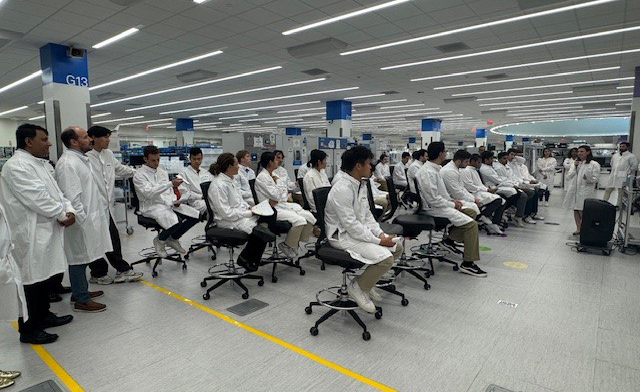
Quest recently deepened that collaboration by opening its 250,000-square-foot next-generation flagship laboratory in Clifton to give students at Hackensack Meridian Health’s School of Medicine a behind-the-scenes look at clinical lab work.
As part of the medical school’s curriculum, Quest hosted more than 160 students, giving them an opportunity to observe the behind-the-scenes work of a clinical lab. Over the course of a six-week period, different cohorts came each week and rotated through specific parts of the lab, learning from on-site experts in areas like microbiology, hematology and pathology.

“This partnership with Quest Diagnostics addresses a critical gap in medical education,” said Dr. Jenny Zepf, an associate professor of medical sciences at HMH’s medical school who oversaw development of the curricular experience. “Over 70% of medical decisions are based on laboratory results, yet students traditionally have limited exposure to how these tests actually work. Our first-year students now rotate through Quest’s core laboratories, learning not just what tests to order, but understanding the science behind these diagnostics — the quality controls, methodology, and limitations that will make them better clinicians,” Zepf said.
Since Quest and the medical school are neighbors at the ON3 campus, the two believe the move is a natural next step.
The 116-acre Prism Capital Partners LLC-owned mixed-used development is also home to HMH’s recently opened $79 million, 80,000-square-foot ambulatory care center, along with its Center for Discovery and Innovation (CDI).
Collaboration opportunities
Announcing the long-term full laboratory management agreement in December 2020, Quest’s then-CEO, president and chairman Steve Rusckowski said, “Being co-located with the Hackensack Meridian School of Medicine provides many opportunities to collaborate and improve patient outcomes.”

Ruth Clements, president of Quest’s east region, said the tie-up between Quest and HMH’s medical school “grew out of that existing partnership.” Given the close proximity, Clements said the organizations felt that medical students “could benefit from exposure to modern laboratory diagnostics.”
“It also just organically makes sense for us to continue to collaborate. They’re one of the largest health systems in New Jersey and we’re the leading laboratory based in New Jersey,” she said.
“We’re always talking with CDI. They, of course, also work closely with the School of Medicine and so they were the ones that originally suggested this and made the introduction with the School of Medicine. And here we are.”
Quest in Clifton:
By the numbers
- Facility handles +300,000 tests per day
- Lab serves +40 million people annually in 7 states
- $250 million, 12-acre site also provides more than 1,000 jobs
Considered one of the largest medical laboratories in the world, the Clifton facility features extensive automation that enables it to handle more than 300,000 tests per day with exceptional accuracy, quality and efficiency, according to Quest. By using barcode tracing solutions to track and store specimens, Quest said it is much easier for health care providers to request follow-up tests or further analysis in real-time.
As a high-volume diagnostic services site, the company said the lab serves more than 40 million people annually in seven states across the Northeast.
The $250 million, 12-acre site also provides more than 1,000 jobs that offer employees “skill-building opportunities” in an automated environment as well as “the ability to laser focus on high-value work providing diagnostic insights.” In 2017, the New Jersey Economic Development Authority approved a 10-year, $55.2 million tax credit award for Quest aimed at supporting that capital investment.
At the time of its grand opening, Gov. Phil Murphy praised the lab as “magnificent” and “first-class,” while Rusckowski said the “inspiring facility” represents Quest’s “continued commitment to our employees, the health care community and the patients we serve.”
Technical issues
Quest has had a footprint in New Jersey since the late 1960s when it began in Teaneck. As it grew over the next several decades, the company established a large laboratory presence in Teterboro. It also had offices in Lyndhurst and Madison. Ahead of its 2017 lease expiration in Madison, Quest considered leaving the state and setting up in Florida. However, the NJEDA offered it a 10-year, $18.5 million award if it chose Secaucus. In September 2018, Quest consolidated operations from Lyndhurst and Madison and officially moved its headquarters to 500 Plaza Drive in Secaucus.

In North America, Quest employs 56,000 workers (3,750 in New Jersey) and processed 217 million tests at its roughly 2,000 regional labs in 2024. Last year, revenue topped $9.87 billion.
This past summer, Quest ranked first on NJBIZ’s latest list of the top life sciences organizations in the state – just ahead of New Jersey Institute of Technology in Newark and PIM Brands Inc., a Park Ridge-based manufacturer of fruit snacks, chocolate, gummi confectionery products, vitamins and supplements.
Clements said, “We are deeply rooted in New Jersey … Previously, we had our main lab in Teterboro but made the move to Clifton in 2021. And this is now where our East Region office is located.”
At the lab, Clements said medical students are able to “get the full breadth of the various types of testing we’re doing from complex to routine, from highly automated to manual so that they get a good broad understanding of the diagnostic world,” Clements said.
After discussions about the program began in early 2024, the medical school developed a curriculum and evaluation for the offering. Then, it provided a draft to Quest, which facilitated the support and the actual hands-on experience in the lab.

Zepf noted, “The clinical laboratory has become a complex ecosystem with an ever-expanding menu of sophisticated tests.”
“When students work directly with laboratorians – the highly trained scientists who oversee this testing – they gain appreciation for both the technical expertise required and the nuances of laboratory medicine that will serve them throughout their careers,” she said.
‘An innovative model’

Dr. Stanley Terlecky, vice dean of research and medical sciences at the medical school and co-developer of the partnership, added, “This collaboration leverages Quest’s clinical expertise with our educational mission. It’s an innovative model that not only enhances our students’ education but could potentially improve how future physicians utilize laboratory services — ultimately benefiting patient care and health care efficiency.”
“Quest right away loved the ability to also teach and showcase the aspects of the lab to prospective future physicians and health care providers,” Clements said, adding, “I hope students come away with an increased understanding of the complexity of the diagnostic industry, but also the beauty of it and what goes on behind the scenes at a huge operation.
“I think educating them on laboratory medicine, in my opinion, can make them more well-rounded and effective in delivering patient care and also understand the diagnostics of the ordering — How does that work? How do I interpret these results? And knowing how the testing is being done and what it’s testing for,” she explained.

“I think making that connection between the lab and the actual patient care is valuable for future positions,” she said. “And I think for us, on one part, if I look at some of our folks in the lab – who just by nature love to teach – it is just the fact that we are able to showcase our lab but also teach students around the importance of diagnosis and the testing that we’re doing.”
Clements went on to highlight the relationship between HMH and Quest, saying, “The fact that you have these two large New Jersey-based companies working together is already unique and the ability to expand that into something as worthwhile as this where we can also help educate the next generation of health care providers, hopefully based in New Jersey, only elevates that existing partnership.”
“At the end of the day, for us, this just fits within our overall purpose, which is working together to create a healthier world, one life at a time, and helping educate and helping people understand the power of diagnostics. It is just key to who we are as a company,” she said. “A lot of the decisions in healthcare are being driven by diagnostic insights, and so to give students a better understanding of how that works and operates I think is important.
