


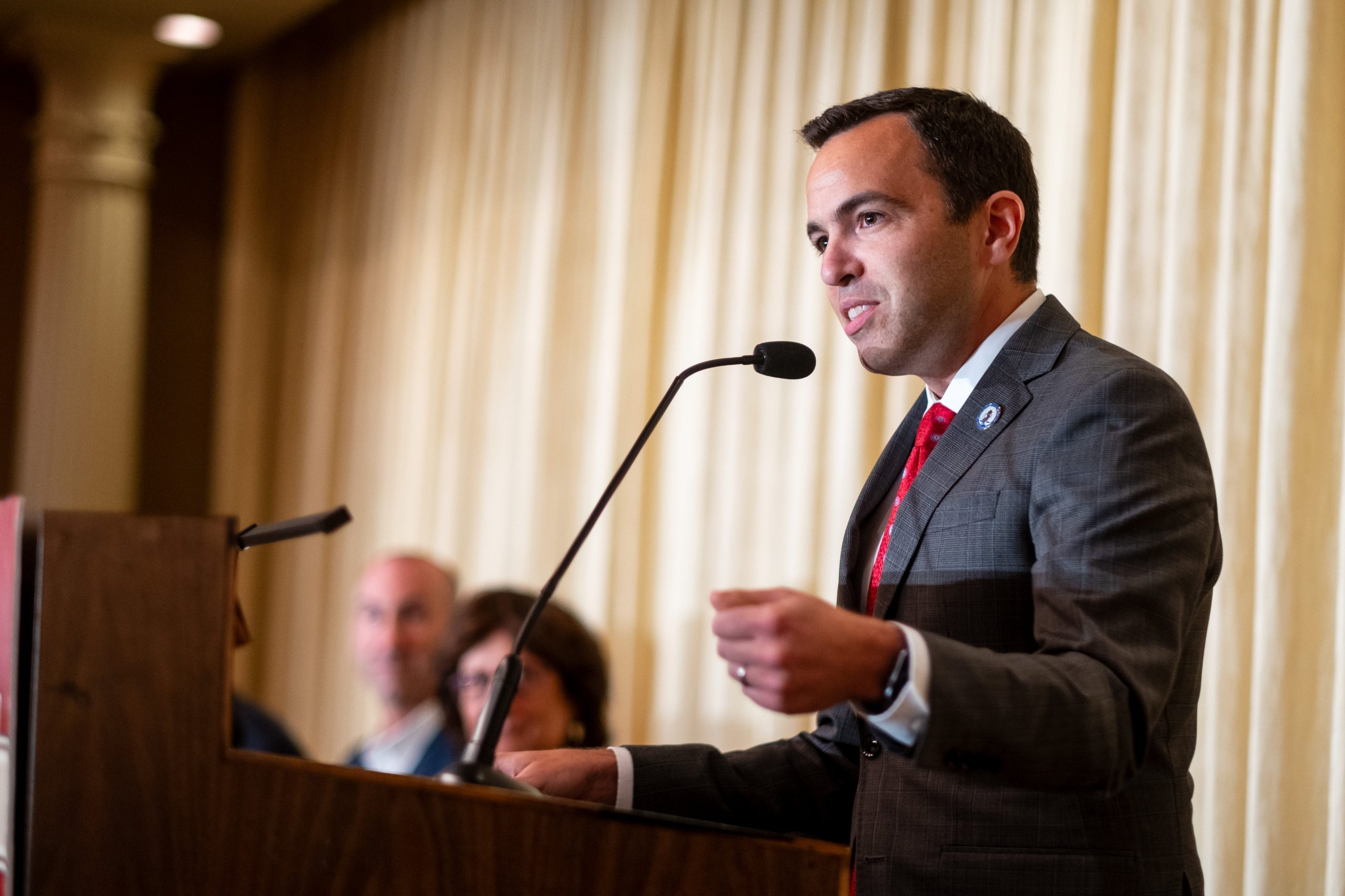
The state’s top law enforcement officer is facing a new legal challenge — not for something he did, but for what he didn’t do.
New Jersey NAACP President Richard T. Smith, New Jersey AFL-CIO President Charles Wowkanech, and Bishop Jethro James, the president of the Newark-North Jersey Committee of Black Churchmen filed an appeal in the Superior Court of New Jersey’s Appellate Division on Tuesday, claiming Attorney General Matt Platkin refused to answer repeated requests for the appointment of an independent monitor to oversee the embattled Office of Public Integrity and Accountability (OPIA).
“When the state’s top law-enforcement officer refuses to answer, the people are left with no remedy but the courts,” they said in a court filing. “Unchecked power corrodes confidence. The OPIA has proven it cannot police itself; it must be policed.”
The appeal, filed by attorneys Gregg Zeff and Lawrence Lustberg, alleges that Platkin ignored two formal letters demanding oversight. They contend that under state law, silence is considered a “final agency action,” and his failure to respond is itself appealable.
“The OPIA has been plagued by an egregious pattern of failed high-profile investigations and criminal prosecutions, often marked by unconstitutional practices and errors, including evidence suppression, discovery violations, and misleading grand jury presentations,” the court filing stated. “Rather than restoring public faith in the rule of law, OPIA has become a symbol of dysfunction.”
They called the OPIA “an embarrassment to the State of New Jersey.”
The court filing cites several failures: in the case of Rabbi Osher Eisemann, convicted in 2019, a Superior Court judge found prosecutors had withheld exculpatory evidence and on retrial, the charges were dismissed entirely at the close of the State’s case; In 2022, a judge dismissed charges against Saddle Brook Police Chief Robert Kugler after finding OPIA had misled the grand jury by failing to disclose that police escorts for funeral homes were a common county practice; charges later that year against a former state corrections officer evaporated when OPIA admitted it had failed to record its own interview with the defendant, as required by state law; and in April 2025, the office conceded in court filings that it had destroyed state-issued cell phones containing text messages in a long-running corruption probe involving ex-Assemblyman Jason O’Donnell. Those phones, the plaintiffs argue, might have contained crucial evidence.
The big fish was the prosecution of South Jersey Democratic leader George E. Norcross III and others on a 112-page racketeering indictment. Seven months later, Superior Court Judge Peter Warshaw also dismissed all of the charges.
Warshaw found that the indictment’s “factual allegations do not constitute extortion or criminal coercion as a matter of law” and found “there was no racketeering enterprise.”
“It follows that if the facts alleged do not, as a matter of law, constitute a crime, the indictment is manifestly deficient and facially and palpably defective,” Warshaw wrote in his decision. “The indictment must be dismissed because its factual allegations do not constitute extortion or criminal coercion as a matter of law.”
The lawsuit also highlights OPIA’s revolving door of leadership. The first director after the unit was formed in 2018 was Thomas Eicher, a former federal prosecutor who retired in 2024 after a string of losses. His replacement, Drew Skinner, resigned after just eighteen months in the post; Skinner’s replacement, Eric Gibson, a recent admittee to the New Jersey Bar, was the lead prosecutor in the Norcross case.
The plaintiffs — Smith, Wowkanech, and James — argue that only a truly independent monitor, such as a retired federal judge or a widely respected prosecutor, can restore credibility. They note that OPIA reports directly to the attorney general, without the usual oversight structures of the Division of Criminal Justice..
“This appeal is not about politics. It is about the fundamental right of New Jerseyans to a justice system that is competent, transparent, and fair,” they said. “Each misstep erodes faith in justice, and each failure left unexamined compounds the harm.”
A spokesperson for the attorney general’s office pushed back on the claims, saying the OPIA “does sensitive work that regularly entails investigating prominent people and holding them accountable for wrongdoing.”
“Allegations about OPIA’s purported failings, and personal attacks against members of this essential office, are unfortunately often driven by those who have a vested interest in smearing the agency—including OPIA’s adversaries in active cases, the spokesperson said. “OPIA is committed to rooting out corruption for the sake of the people of New Jersey, maintaining the public’s trust, and preserving good government. At a time when the federal government is openly enabling corruption and when distrust in government is at an all-time high, this baseless lawsuit is the latest attempt to undermine one of the last remaining prosecution agencies that still takes corruption seriously. It will not succeed.”
