


From the Joint Center for Housing Studies:
HOME PRICES SURGE TO FIVE TIMES MEDIAN INCOME, NEARING HISTORIC HIGHS
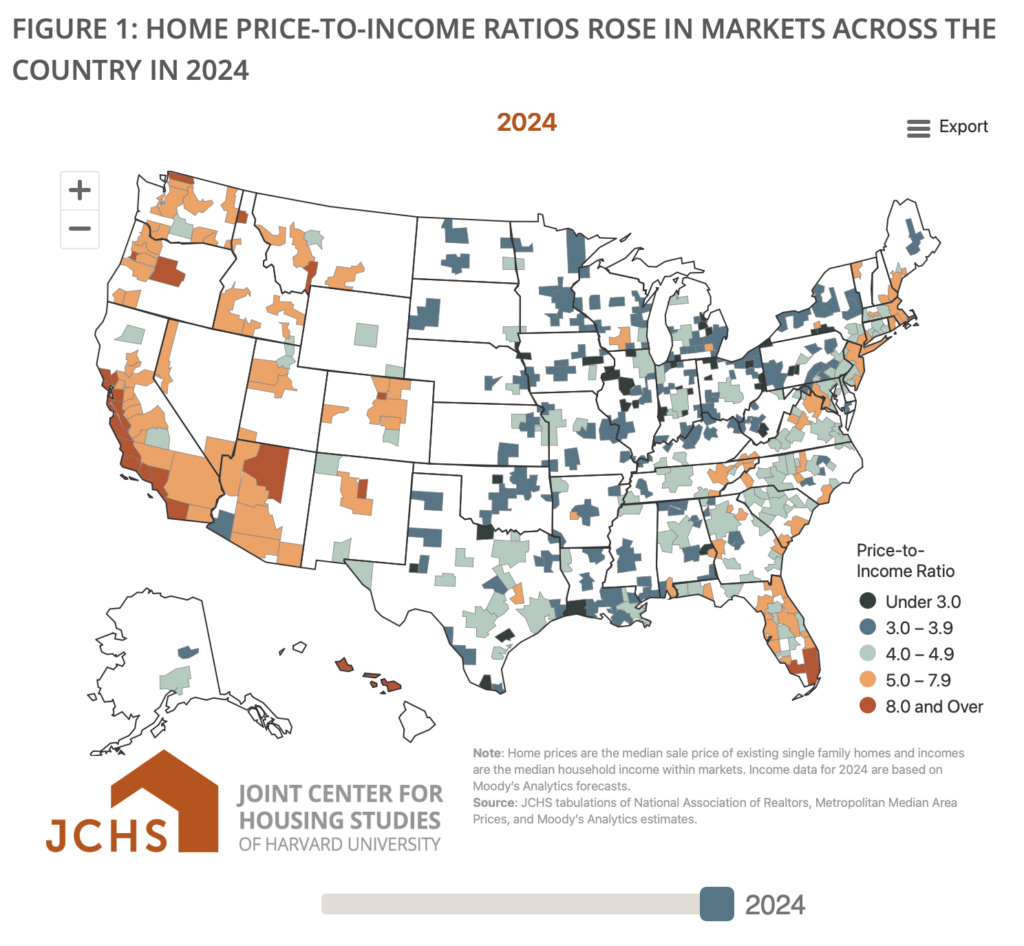
Last year single-family home prices continued to climb steadily back to record-high multiples of household income. In our most recent State of the Nation’s Housing report, we document trends in the national price-to-income ratio and how this measure of homebuyer affordability varies across markets. An interactive map released with the report depicts how price-to-income ratios ticked up last year in markets across the country (Figure 1).
After declining the year prior, the national median single-family home price grew to five times the median household income in 2024, nearly matching previous record highs (Figure 2). Last year’s national home price-to-income ratio remains elevated compared to the 4.1 seen in 2019 following months of record-breaking price growth during the pandemic and dwarfs the far more affordable 3.2 measured throughout the 1990s. As a result, homeownership remains out of reach for many prospective buyers, especially those with moderate or lower incomes.
Prices continued to outpace incomes in many large markets across the country last year. Indeed, home price-to-income ratios rose in over three-quarters of the nation’s 100 largest metros (77 markets). As a result, home prices reached their highest levels relative to incomes in 35 markets.
As price-to-income ratios continued to climb, 39 markets had ratios above 5.0 last year, up from just 15 markets in 2019. And in seven higher-cost markets home prices were at least eight times the median income, the most since 2006. Home prices were highest relative to incomes in Western markets with persistent, severe affordability challenges. For example, the gap was highest in San Jose with prices more than twelve times the median household income (a record high across large markets), followed by Los Angeles (10.8 times), San Francisco (10.5), and Honolulu (10.3). Price-to-income ratios were also high in expensive East Coast markets such as Miami (8.0) and supply-constrained Northeast markets like New York (7.3) and Boston (6.6).
Meanwhile, a record low number of markets had relatively low home price-to-income ratios last year. Indeed, in just one-quarter of large markets home prices were less than four times the median income, a substantial decline from 59 markets in 2019. And only three markets had price-to-income ratios below 3.0 last year: traditionally more affordable places like Toledo (2.8), Akron (2.9), and McAllen (2.9). These affordable homebuying markets have dwindled significantly; in 2019 there were still 20 large markets where prices were less than three times the area median income.
The all-time-high home price-to-income ratios seen last year were mainly driven by rapid home price growth during the pandemic. Nationally, median single-family home prices rose by nearly one-half (48 percent) between 2019 and 2024, at more than twice the rate of median income, which rose by 22 percent. Similarly, in large markets across the country home prices grew by anywhere from 24 to 79 percent since 2019, while incomes only increased by 8 to 36 percent. Additionally, differences in home prices drove differences in price-to-income ratios across markets. Indeed, median single-family home prices ranged from $163,000 in McAllen to 12 times that in San Jose at over $1.9 million. Meanwhile, in the same markets, median income in San Jose was only three times that of McAllen.
