

 Listen to this article
The basics:
- LAND Plan could generate up to $1.9B in non-fare revenue over 30 years
- Potential to create 20,000 residential units, 50,000 jobs, and $14B economic impact
- Revenue sources include transit-oriented development, industrial hubs, retail, parking, and solar
- Plan emphasizes collaboration with municipalities and showcases Metropark project as proof of concept
Against the backdrop of a major transit-oriented development project under construction at Metropark, NJ Transit rolled out a first-of-its-kind strategy the agency says could generate up to $1.9 billion non-farebox revenue over the next 30 years.
Dubbed the LAND Plan – Leveraging Assets for Non-farebox Dollars – the outline provides a comprehensive road map for leveraging the agency’s 8,000-acre real estate portfolio through development and partnerships. Officials say it could deliver an estimated $14 billion in economic impact, $1.6 billion in municipal revenues, as well as up to 50,000 jobs. Additionally, it could create up to 20,000 new residential units, addressing a critical need for more affordable housing in the state.
NJ Transit President and CEO Kris Kolluri described LAND as the single most comprehensive plan for monetizing these assets in the agency’s history.
Exhibit A
“This is the first time in 45 years New Jersey Transit is announcing a plan to bring in a substantial amount of non-fair revenue into the agency,” said Kolluri, who was joined by a slew of government leaders from different levels and key stakeholders. “What it is not – is it is not a mandate. It is not an edict. We live in a home rule state. We live where the Legislature has a very important role to decide the pace with which we’re going to go through this.
“But, what I’m going to suggest is this is a very unique time and a unique opportunity in New Jersey’s history. We have lots of challenges ahead of us financially. If we decide there’s a path forward for this state to bring in revenue without increasing taxes – well, here’s Exhibit A.”
Kolluri noted this study as well as the assessment of NJ Transit’s assets and their potential opportunities was a day-one objective of his. The initiative was borne out of Gov. Phil Murphy’s recommendation to bring non-fare revenue into the agency.
“And that is exactly what we did,” said Kolluri, who took the helm at NJ Transit in January. “Took us a full nine months to get to where we are today, but we are so pleased to announce this plan in front of some of the most thoughtful leaders in the State of New Jersey.”
LAND identifies key revenue opportunities, such as:
- Transit-Oriented Development: $780 million–$1.1 billion in potential revenue through mixed-use, walkable communities
- Industrial Hubs: $150 million–$300 million through warehousing and logistics sites
- Retail Concessions: $80 million–$100 million from leasing space in stations
- Advertising: $40 million–$130 million from digital displays, naming rights and more
- Parking Optimization: $170 million–$230 million through enhanced management of station lots
- Temporary Uses: $15 million–$30 million from filming, events and pop-ups
- Wetland Banking: 150 acres–170 acres restored or preserved to generate ecological credits
- Solar Power: 5 MW in potential generation from canopies and rooftops

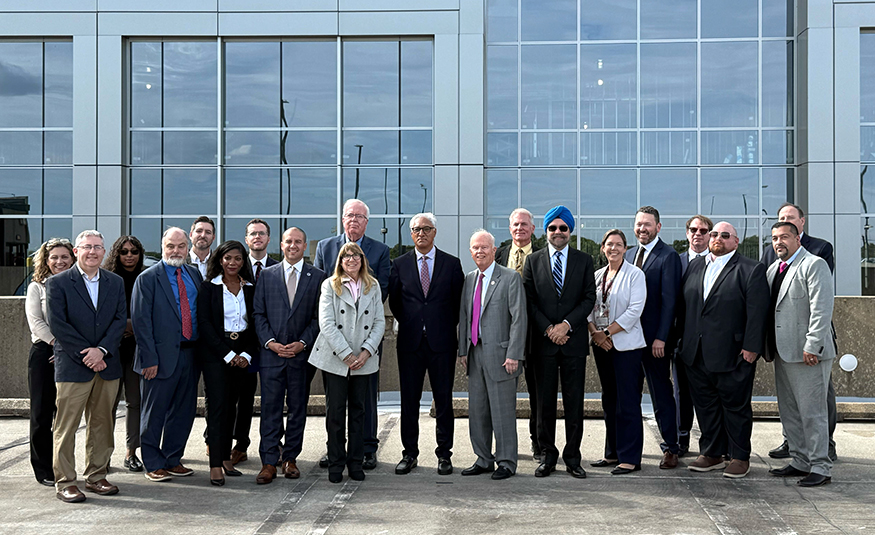
The event took place on the roof of the Metropark parking deck. In the background, construction of a major transit-oriented development project was underway, which NJBIZ has extensively reported on. That mixed-use project includes a Hackensack Meridian Health headquarters hub and wellness center, residential apartments, retail space and more.
And it’s all taking shape within walking distance of Metropark Station.
Collaboration on display
Senate Transportation Committee Chairman Patrick Diegnan, D-18th District, lauded the work of NJ Transit for projects such as this, as well as this new analysis to identify other opportunities.
“They are not only addressing the present needs, but looking to the future – and this embodies this,” said Diegnan. “Thank you for making New Jersey the model for other states to follow.
“This analysis provides a self-sufficient way to help keep NJ Transit funded and is a major boost for New Jersey’s economy.”
HMH tops out $200M health & wellness hub (📷 photos)

A one-of-a kind health and wellness center driven by Hackensack Meridian Health is nearing arrival at Metropark Station. Take a closer look here.
“We chose this location today on purpose,” said Kolluri. “There are two people [Woodbridge Mayor John McCormac and HMH Executive Vice President and Chief Growth Officer Jose Lozano] who are going to speak now who were not only instrumental in having New Jersey Transit move this – what I would call a parking lot and a train station – into what you see as a modern, mixed-use development. But it wouldn’t have happened without their collaboration, their cooperation, and vision.”
“This project ought to be a case study in how to do a transit village – how to do a development at a train station,” said McCormac. “When it first came up, I was skittish about it. Because I didn’t want this to be an apartment complex that had an office building. What we got is an office building with some apartments.
“And what we have is not an office building. We have the headquarters of Hackensack Meridian Health, the largest health care provider in the State of New Jersey. And their headquarters are now here in Woodbridge Township. I can’t tell you what that means to us. We all know what Robert Wood Johnson means to New Brunswick. Hackensack Meridian to Woodbridge is going to be the same image – the same relationship. And I don’t think they’re even done.”
Lozano credited Kolluri and the NJ Transit team for putting a plan together that he says is not only impressive, but visionary in addressing the needs of a state as densely populated as New Jersey. He also credited the stakeholder collaboration for the Metropark project.
We all know what Robert Wood Johnson means to New Brunswick. Hackensack Meridian to Woodbridge is going to be the same image – the same relationship. And I don’t think they’re even done.
— Woodbridge Mayor John McCormac
“Hackensack Meridian Health made this decision – and it wasn’t an easy decision because we knew it was a significant investment,” said Lozano. “But we were trying to solve so many issues that health care is seeing across the country. The No. 1 reason why people aren’t seeking health care is because of accessibility and mobility.
“To be able to build a health care facility on one of the busiest train lines in the State of New Jersey and in the Northeast Corridor was something that we needed to achieve. And it hopefully will serve as a model for health care across the country.
“I applaud the work that you guys have done. I hope that developers and municipalities across the state will look at our project behind us and be able to put a vision toward it together.”
From park-and-ride to live-and-ride
The finances of NJ Transit have been a hot-button issue in the state, coming to a head during last year’s budget battle with the establishment of the corporate transit fee. The business community has vehemently opposed the CTF, which aims to help stabilize the agency’s budget. NJ Transit also increased fares 15% in 2024, followed now by annual 3% increases that began this past July 1.

Those factors, coupled with a more challenging and expensive operating environment for transit agencies in these post-pandemic times, has made initiatives such as these even more critical to raise revenue without further raising fares or taxes.
After the presser, Kolluri (who credited his staff for the extensive work putting the LAND Plan together) spoke to reporters.
NJBIZ asked, “Obviously, NJ Transit’s finances have been a big subject of debate and conversation. How critical is this plan to the future? And how important is this project behind us as a proof of concept as you engage with local stakeholders and municipalities?”
Kolluri said, “The second question first – I think this is a perfect case study, and Hoboken is another, of how you can basically take projects that are nothing but parking lots and convert them from park-and-rides to live-and-ride places. That’s what this shows. On the issue of how important it is to transit – it is not only important to transit. I think it’s important to the State of New Jersey.
“What we are presenting today is a roadmap for how the state can address its finances in a meaningful way by taking property that taxpayers currently own – and use them for their benefit. Which is exactly what this plan does. And we think we have a proof of concept already. It’s now a question of – how fast can we go?”
A win-win
Kolluri was asked about how a new gubernatorial administration could factor into the ambitions of this plan.
“Our objective is, by the time the new governor is sworn in – we will basically give them, in addition to the GIS database that is already live today, a profile page of each project that the next governor can consider. And make a decision on what’s appropriate and not,” said Kolluri. He noted that the candidates have spoken about affordability and using some of the properties the state owns already.
Kolluri stressed that the agency has a role in this, pointing to the two-to-three projects already underway annually on its own. He thinks the opportunity exists to increase that pace.
The plan serves as a roadmap that identifies potential opportunities to deliver recurring non-fare revenue, housing, and jobs – while improving customer experience and reliability – by leveraging assets within NJ TRANSIT’s real estate portfolio. pic.twitter.com/PbVegykLYp
— NJ TRANSIT (@NJTRANSIT) October 15, 2025
“What we are saying is it’s a win-win for the entire state – and I don’t see a single reason why we shouldn’t at least consider this idea, from a legislative standpoint,” said Kolluri. “And if you’re a mayor, from a municipal standpoint. You have a mayor (McCormac) who was skeptical. As he himself said, he was skeptical about this the very first time he was briefed on it.
“But he understood intuitively why this is important – and how a public-private partnership can help move the state.”
Local vision
NJBIZ asked, “You mentioned the breadth of opportunities as well as the importance of respecting home rule. It seems then as an open-ended, evolving situation. Can you speak to the collaboration NJ Transit is interested in with municipalities?”
Kolluri said, “Interestingly enough, even though this is a state-owned property – our approach always has been to say, let’s not say we’re going to do what we want to do. We think the best use of our time and our resources and, frankly, our land is to work with the township and see how it fits within the mayor’s vision and the council’s vision.
“Look, we are good partners. These train stations are there to serve a community. And we think the opportunity when you build development is to serve the community. We happen to be beneficiaries – we, meaning the riders, will be the beneficiaries. But our first and highest priority is to see, how can we fit a development in the community?
“And that’s why we will never move away from this collaborative model.”
More details on The LAND Plan are available here.
