


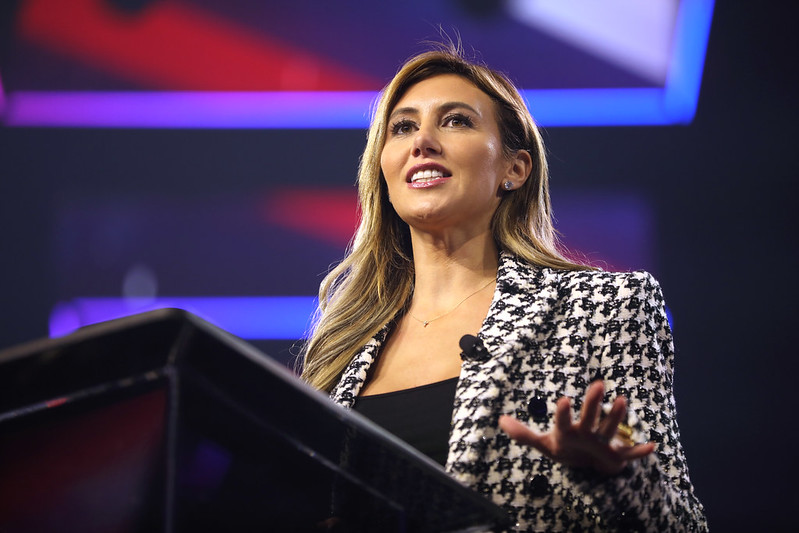
Three appellate judges on Monday heard the Trump administration’s appeal of an August order disqualifying Alina Habba as acting U.S. attorney for New Jersey. (Photo by Gage Skidmore)
PHILADELPHIA — A Department of Justice attorney on Monday urged a federal appeals panel to allow Alina Habba to remain New Jersey’s top federal prosecutor in a case likely to determine whether President Donald Trump can appoint U.S. attorneys without Senate approval.
Henry C. Whitaker, counselor to Attorney General Pamela Bondi, squared off with two attorneys challenging Habba’s legitimacy during nearly 90 minutes of arguments before three U.S. 3rd Circuit Court of Appeals judges at the James A. Byrne federal courthouse.
Whitaker defended the unprecedented series of moves Trump officials took in July to keep Habba, Trump’s former personal lawyer, in the post after the Senate did not act on her nomination within the required 120-day time period set by statute.
Thousands protest Donald Trump at New Jersey No Kings rallies
Attorney Abbe Lowell, representing a criminal defendant who says Habba lacked authority to indict him, accused Trump officials of using “a jerry-rigged way” to maintain Habba in the role and implored the judges to uphold a lower court’s August ruling disqualifying her and banning her from further prosecutions (that ruling was stayed pending appeal).
Whitaker argued his case first, but barely a minute after he started speaking, a judge interrupted with a pointed question that set the tone for the rest of the hearing. Judge D. Brooks Smith noted the two titles Habba now has after the Trump administration’s maneuvers — acting U.S. attorney and special attorney.
“Which, what, who is this person, what actual position are they serving, and when?” Smith asked.
Whitaker explained that Habba became acting U.S. attorney by default after a head-spinning few July days during which New Jersey’s federal judges, in response to the Senate’s inaction, voted to replace Habba with her second-in-command, Desiree Leigh Grace, over the objections of the Trump administration. In response, Bondi fired Grace, named Habba special prosecutor, and delegated to her the authority to supervise all pending prosecutions. Habba resigned as interim U.S. attorney, and Bondi appointed Habba first assistant U.S. attorney. Under the Federal Vacancies Reform Act, the first assistant U.S. attorney automatically becomes the acting U.S. attorney when the top job becomes vacant.
The timeline as described by Whitaker spawned a slew of questions from the jurists.
“Isn’t that a redundancy?” Smith asked.
“So she has full power as acting U.S. attorney?” Judge D. Michael Fisher chimed in.
“Are there any functional differences between those two positions, or are they just titles?” Smith followed up.
Lowell capitalized on the judges’ perplexity about both Habba’s string of job titles and the various statutes Whitaker cited to defend them.
“The government cites a chimera of seven different statutes that they alternate depending on what they are trying to accomplish, to call her,” Lowell said, ticking off Habba’s various job titles since she was first appointed in March.
He added: “She’s now asking the court to affirm she’s two things at one time.”
Lowell and James Pearce, representing the Association of Criminal Defense Lawyers of New Jersey, renewed their concerns that the Trump administration’s moves to reinstall Habba unconstitutionally bypassed checks and balances meant to protect the post’s independence.
“Executive branch practice must yield in the face of clear law,” Pearce told the judges. “At the core of this case, the government has thwarted Congress’s attempt and its constitutional obligation to regulate the filling of U.S. attorneys’ positions.”
The judges asked questions about Habba’s lack of prosecutorial experience, with Fisher noting language in the Federal Vacancies Reform Act that allows the president to appoint someone as acting officer of an agency if that person has served 90 days in the agency during the prior year.
“It’s not the best and most clearest statute I’ve ever read, I’ll grant you that,” Fisher said. “It does say to me that Congress had a very specific intent – they wanted an experienced person.”
Whitaker responded: “There is no categorical requirement that there be any level of experience.”
The judges also pushed back on Whitaker’s claims that first assistant U.S. attorneys are political positions.
“First assistants are overwhelmingly political appointees,” Whitaker said.
Smith cut in, asking: “What do you consider a political appointee? Because all I can tell you, in my experience, is that the appointment of, selection of a first assistant in a U.S. attorney’s office is anything but a political appointee.”
Whitaker responded that first assistants serve at the will of the attorney general, making them “something akin to political appointees.”
The judges also mused whether Trump officials would continue to extend Habba’s term through successive appointments and asked whether her current titles have any time limits. Neither side offered a clear answer.
“We are not asking for a limitless power to appoint acting officials,” Whitaker said. “We color within the lines here.”
Smith called the sequence of events surrounding Habba’s appointment “unusual.”
“Can you come up with an example of any time that such a concatenation of events has occurred with respect to the appointment of a United States attorney?” he asked Whitaker.
“Well, I guess I cannot,” he responded.
Blue slips
Habba did not attend the four-hour August hearing in Pennsylvania after which U.S. District Judge Matthew Brann ruled that she has served as the state’s top federal prosecutor “without lawful authority” since July 1 and voided all actions she has taken in that role since then.
But she showed up to Monday’s hearing with a broad smile, hugging various members of her large legal team before arguments started and asking them: “Ready to rock and roll?”
She did not speak during the hearing and declined to answer reporters’ questions afterward. Instead, she used social media to blast the “blue slip” tradition, in which a nominee’s home-state senators can block their confirmation. Sens. Cory Booker and Andy Kim, both Democrats, have objected to Habba continuing in the role permanently, accusing her of using the office to pursue “frivolous and politically motivated prosecutions.”
“The continued invocation of blue slips, a tradition not a rule, demonstrates a politically motivated effort to impede the President’s constitutional authority to appoint U.S. Attorneys,” Habba wrote. “The President appoints individuals to carry out the mission of this administration and that mandate should be respected. When millions of Americans voted for a change in leadership in November, they voted for a new direction. That choice should not be undermined by political obstruction in Congress or by criminal defendants.”
Federal prosecutions have largely ground to a halt in New Jersey, as the challenge to Habba’s authority makes its way through the courts. The government shutdown, now in its third week, added to the courts’ paralysis, with Chief U.S. District Judge Renée Marie Bumb earlier this month ordering most civil litigation suspended until at least November or until the shutdown ends.
The appellate judges now mulling Monday’s arguments did not say when they expect to issue a decision.
Fisher and Smith are both senior judges and Bush appointees, while the third judge on the panel, L. Felipe Restrepo, is an Obama appointee. Observers expect the case could end up before the U.S. Supreme Court.
GET THE MORNING HEADLINES.
