

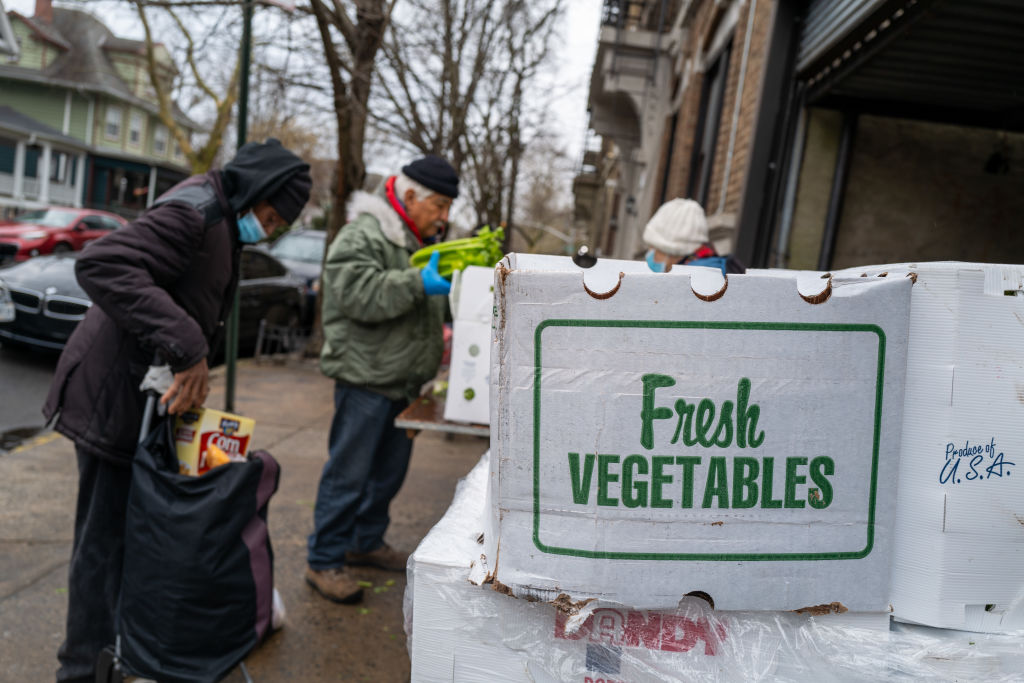
The federal government has threatened to stop paying food assistance starting Nov. 1, impacting 42 millions Americans and over 800,000 New Jerseyans. (Photo by Spencer Platt/Getty Images)
Nearly a million New Jersey residents who rely on federal food assistance are poised to lose those benefits this weekend when President Donald Trump’s administration is expected to suspend the Supplemental Nutrition Assistance Program.
The Trump administration has held a hard line on SNAP during its fight with Democrats over the federal government shutdown, which is now in its fifth week. Administration officials have also refused to release available contingency funding from the U.S. Department of Agriculture that’s meant to cover food assistance during government shutdowns.
“It’s so unfortunate that so many people are going to be put in the crosshairs of this conflict at the federal level. It’s just unprecedented,” said Amy Flynn, CEO of the Trenton Area Soup Kitchen.
About 813,000 New Jersey residents across more than 436,000 households rely on SNAP benefits, representing about 1 in 8 households, state data shows. Children, senior citizens, and people with disabilities are disproportionately represented.
New Jersey residents got more than $1.9 billion in SNAP assistance in the 2024 fiscal year, putting the state 13th nationally in such aid, according to data compiled by the health research nonprofit KFF.
SNAP benefits vary widely because they’re based on household size, income, and other circumstances. But the Center on Budget and Policy Priorities estimated the average monthly benefit per person last year in New Jersey was $194, and noted that most recipients have incomes below the poverty line.
LaPreya Cooper, 32, of Trenton, began receiving SNAP benefits in February after she lost her job and became homeless. The benefits helped her get back on her feet, and she now has an apartment and is studying to become a chef at a culinary program through the Trenton Area Soup Kitchen.
“It definitely has been a big help,” said Cooper, who estimated that she gets about $500 in SNAP benefits monthly. “Not getting it this month is going to be a wringer.”
As fears began circulating last month that SNAP could end, Cooper said she reserved some benefits to carry her through November. She also relies on food pantries and soup kitchen meals.
She’s especially anxious about losing assistance because she’s pregnant, and friends who similarly struggle share her stress, she said.
“A lot of my peers and people who are going through what I’m going through are not taking it well,” Cooper said. “They are planning on going into stores and just walking out with food, if it comes to it.”
Lawmakers in some states, including Connecticut, Vermont, New Mexico, and Louisiana, have agreed to provide at least partial funding for SNAP benefits if the feds follow through on suspending benefits.

New Jersey officials have not. Assembly Speaker Craig Coughlin (D-Middlesex), a frequent sponsor and champion of legislation to combat hunger, said state officials likely “don’t have $85 million set aside” to cover a SNAP lapse.
“We’re going to have to continue to evaluate where we’re at and what we do,” Coughlin told the New Jersey Monitor.
The Murphy administration announced Thursday that it would give $42 million in state funding to six food banks across New Jersey on Friday to strengthen the safety net protecting people who struggle with food insecurity.
The money isn’t new funding. It was already in the state budget to support food banks through the current fiscal year, but officials are distributing it “ahead of schedule” because they expect people to turn to food pantries in the absence of SNAP benefits, said Maggie Garbarino, a spokeswoman for the governor’s office.
A coalition of states, including New Jersey, sued Trump administration officials Tuesday for the looming “illegal” SNAP suspension, which New Jersey Attorney General Matt Platkin called “a clear attempt at subverting the authority of Congress.”
“New Jersey families are being used as political pawns by the Trump Administration,” Platkin said Tuesday in a statement.
Congressional leaders failed to agree this week on a bill that would have extended SNAP funding for 42 million Americans, as well as the Special Supplemental Nutrition Program for Women, Infants, and Children, or WIC.
Peter Chen, a senior policy analyst with progressive think tank New Jersey Policy Perspective, agreed SNAP is a critically important program for keeping families fed in a state where 1 in 10 households grapples with food insecurity.
“SNAP is not some sort of luxury,” Chen said. “The average SNAP benefit per person is less than $200, which averages out to, like, $2 a meal, which is not affording anyone groceries these days, especially given overall food prices. This threat of losing SNAP benefits on November 1 is dire for many families.”
Food insecurity already was growing even before the SNAP threats emerged, Flynn noted.

The Trenton Area Soup Kitchen served 59,000 meals last month — a record high since it was founded in 1982, she said. Staffers ramped up food purchases and added a second shift in the kitchen to accommodate the surge they expect next month if SNAP assistance ends, she added.
Flynn encouraged people to support hunger-fighting nonprofits like hers by donating money or food and volunteering their time.
“We know that the need is just going to be great. There’s a lot of anxiety in the community,” she said.
David Ireland is founder of the Care Center of New Jersey, which runs a food pantry in Rockaway.
The threat to SNAP benefits comes as food pantries are preparing for Thanksgiving food distribution, one of the busiest times for antihunger groups, Ireland noted. His group expects to distribute more than 100,000 pounds of food to 2,500 families this year, up from 80,000 pounds for nearly 2,000 families last year.
“More families are coming in who’ve never needed help before,” Ireland said. “With federal aid going on pause, we anticipate the lines will grow, the shelves will empty faster, and the needs will become urgent. We’re ready to respond — but we need the community alongside us.”
State officials said people who receive supplemental state aid will continue to get it. About 32,000 households that get less than $95 in SNAP benefits now get state assistance to cover the difference from the federal minimum of $23, said Tom Hester, a spokesman for the state Department of Human Services. That totals about $2 million a month, Hester said.
The federal government pays close to $160 million a month to New Jersey SNAP recipients. The state has a surplus of over $6 billion. It’s unclear whether and when officials could decide to tap that to cover SNAP benefits.
Coughlin encouraged New Jersey residents to donate to food banks, volunteer, and “stick up for people, particularly at this time of Thanksgiving.” He called the looming SNAP suspension and the Trump administration’s refusal to release contingency funding “a cruel choice” and “mean-spirited.”
Expediting state funds to food banks will help because they’re “the first line of defense,” Coughlin added.
“It’s a crisis, and swift action is appropriate,” he said.
Chen agreed many states can’t afford to — and shouldn’t have to — foot the bill for the feds’ failure to pay SNAP benefits.
“This is an entirely federal program that has entirely been paid by the feds, that in every previous government shutdown has been paid out through the USDA contingency fund, including in the first Trump administration,” Chen said. “The position that the feds can’t pay this out is a totally absurd one which jeopardizes the lives of millions of Americans and hundreds of thousands of New Jerseyans for what amounts to total bureaucratic game-playing.”

GET THE MORNING HEADLINES.
