


Republican gubernatorial nominee Jack Ciattarelli said he wants to add more conservatives to the New Jersey Supreme Court. (Dana DiFilippo | New Jersey Monitor)
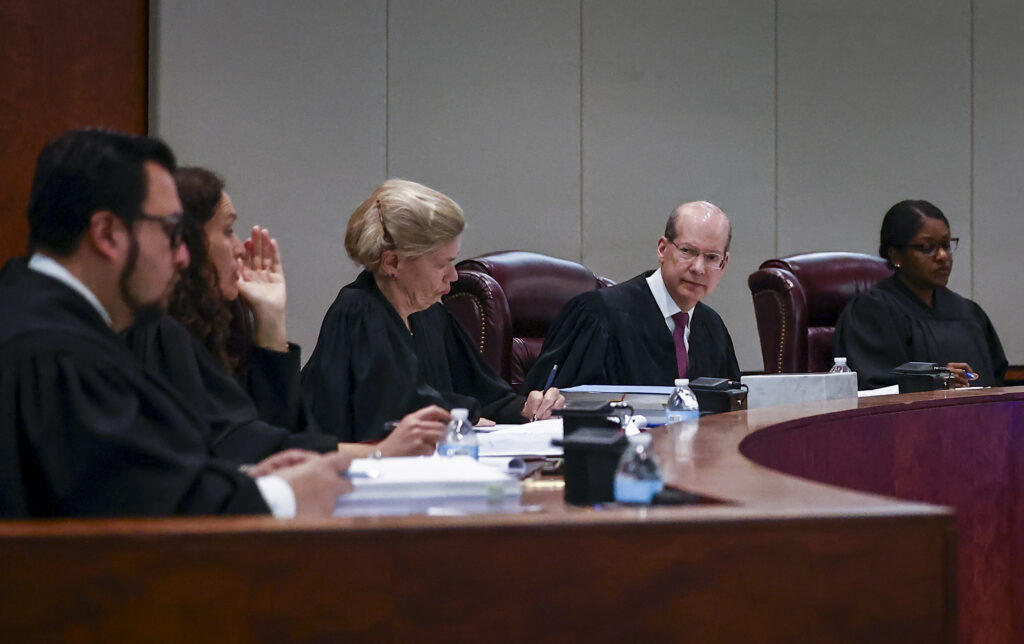
Republican gubernatorial hopeful Jack Ciattarelli has said he wants to remake New Jersey’s high court, moving away from a tradition of partisan balance that has persisted on the seven-seat bench for nearly 80 years.
Ciattarelli, a former state assemblyman, has called the court’s partisan balance — an unwritten convention that broadly says no party shall have more than four of the high court’s seven seats — a “failed tradition” and pledged to nominate conservative justices.

“I will appoint Supreme Court justices that agree with me on issues like high-density housing and suburban districts where there’s no infrastructure and who agree with me on school funding,” Ciattarelli said during a debate in early October.
The current state Supreme Court has four Democrats, two Republicans, and one who is unaffiliated but worked in the administration of Republican Gov. Chris Christie.
Ciattarelli’s pledge to do away with the court’s tradition of partisan balance, one that has persisted uninterrupted since the state adopted its 1947 constitution, has some court observers worried that New Jersey’s high court could come to mirror the U.S. Supreme Court.
“We don’t have the situation, alas, that we have down in Washington where there’s such obvious bitter divides that it’s almost getting to the point where the justices apparently are being uncollegial to each other,” said Ron Chen, a former New Jersey public advocate who teaches law at Rutgers Law School.
The U.S. Supreme Court, where conservatives have a 6-3 majority, rarely issues unanimous decisions, and those justices now regularly snipe at each other in dissents and concurrences, questioning not only whether the court has overstepped its authority but also whether justices are consulting law when making their rulings.
Only four of the 38 decisions New Jersey’s Supreme Court has meted out this year included a dissent. All others were ruled unanimously.
Rep. Mikie Sherrill, who is Ciattarelli’s Democratic opponent in the Nov. 4 election, during a primary debate said she would maintain the court’s partisan balance.
The state high court’s current membership provides Ciattarelli with no grand opportunities to remake the bench. New Jersey’s Supreme Court justices are appointed, with Senate confirmation, to an initial seven-year term and can be renominated and confirmed to remain on the court until they reach the mandatory retirement age of 70.
Three justices will turn 70 over the next two gubernatorial terms. Two of them are Republicans.
Only Justice Anne Patterson, a Republican, turns 70 during the next governor’s term, in 2029. The next-oldest member of the Supreme Court, Chief Justice Stuart Rabner, a Democrat, doesn’t turn 70 until the gubernatorial term after that, in June 2030.
A victorious Ciattarelli could have other avenues to remake the court, though they’re likely to be substantially more controversial.
Members of the court are typically renominated absent major controversy, but Ciattarelli could gain two seats for Republicans in his first term by moving to replace Democratic justices instead of renominating them, and he could gain a third by the same means if reelected to a second term.
Justices Fabiana Pierre-Louis, Rachel Wainer Apter, and Douglas Fasciale will see their initial seven-year terms expire under the next governor, and Ciattarelli is not required to nominate them for tenure (Fasciale is Republican).
Wainer Apter and Pierre-Louis are Democrats, and nominating Republicans in their place could give Republicans a 5-2 majority on the high court. But that path is perilous.
“We saw 10 years ago what happened when Gov. Christie tried that,” Chen said.
When Christie declined to nominate Justice John Wallace for tenure in 2010, Democrats who controlled the Senate ground his judicial confirmations to a halt, rejecting two of Christie’s Supreme Court nominees and refusing to hear two others. Wallace’s seat was not filled until 2016.
The Legislature could blunt a push to stack the high court with conservatives with little difficulty.
Democrats hold 25 of the state Senate’s 40 seats, and members of the upper chamber are not up for election this year, so the next governor will have a Democratic-controlled Senate for at least two years. If Ciattarelli becomes governor in January, Senate leaders can simply refuse to bring his Supreme Court nominations to committee or indefinitely withhold floor votes on their nominations.
Even if Republicans take control of the upper chamber after legislative elections in 2027, Democratic senators could still block broad swaths of his nominees under an unwritten rule, called senatorial courtesy, that allows senators to unilaterally and indefinitely block nominations from their home county or legislative district.
Sen. Holly Schepisi’s (R-Bergen) invocation of courtesy froze Wainer Apter’s nomination for 18 months.
The pains inflicted by courtesy can stretch past the judiciary. Prior to his retirement, former Sen. Michael Doherty (R-Warren) for a time blocked all gubernatorial nominations in Warren County.
There’s little indication the Senate would back eliminating courtesy, regardless of who controls the chamber. With few exceptions, the unwritten rule is a senator’s greatest source of individual power.
GET THE MORNING HEADLINES.
