


Spoiler alert: if you’re a candidate with a running mate in a tough race in next week’s election, don’t read this. It could fu*k with your head.
It’s entirely possible that New Jersey’s modern-day founding fathers were a little sadistic when they opted for dual-member State Assembly districts where running mates frequently find themselves in hostile, toxic relationships.
But the worst nightmare for any Assembly candidate – and their campaign managers – is when two running mates find themselves competing for just one seat. That happens when one candidate is strong enough to have a lock on the first seat and then it leaves his or her running mate in a two or three-way race for the second seat.
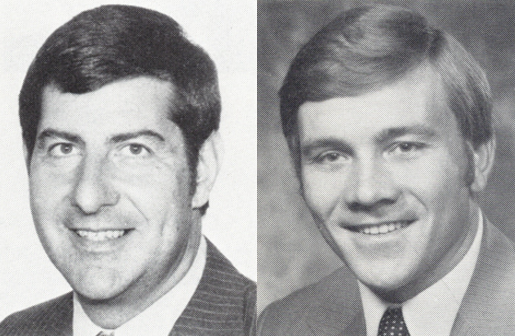
The most painful and rarest form of that kind of torture involves a 46-year-old Longport man named Howard Kupperman. He’s the last incumbent to lose a general election to his running mate.
Democrats had toppled Atlantic County GOP boss Hap Farley’s political machine – the one once headed by Nucky Johnson — in 1971; Farley lost the Senate seat he’d held for 30 years, and Democrats flipped two Republican Assembly seats. The winners were Steven Perskie, the 26-year-old brainy scion of an influential family of judges, and James Colasurdo, 27, an attorney from Hammonton.
They held on to everything in the 1973 Watergate wave election, although not easily. The closeness of that race despite the trends everywhere else in New Jersey shows just how Republican Atlantic County was.
Perskie easily won a second term; he finished 4,613 votes ahead of the second place candidate, Democrat Charles Worthington, a high school guidance counselor.
The relationship between Colasurdo and State Sen. Joseph McGahn (D-Absecon), who beat Farley, became so strained that Colasurdo preferred retirement to running on a slate with his senator. (He was too young to run for Senate, or he would have taken on McGahn in the primary.)
Worthington won the second seat, defeating Kupperman, then a Longport commissioner, by 237 votes. The other Republican, Samuel Curcio, a former two-term assemblyman from Hammonton ousted by Perskie and Colasurdo in 1971, finished fourth; he ran just 98 votes behind Kupperman and came within 335 votes of winning.
In 1975, Worthington gave up his Assembly seat to become the first Atlantic County Executive.
Kupperman ran again, this time on a ticket with Freeholder F. Frederick Perone, a former Atlantic City municipal court judge. Perskie teamed up with Lois Hughes Finifter, a 30-year-old attorney and political newcomer.
This time, Kupperman was the top vote-getter, running 331 votes in front of Perskie. Perone finished third, 725 votes behind Perskie and 1,056 behind Kupperman. Finifter was in fourth, 5,124 votes out of third place. Kupperman and Perskie sponsored legislation to legalize casino gambling in Atlantic City.
Perskie ran for Senate in 1977 after Democrats refused to back McGahn for a third term; McGahn ran as an independent instead.
Kupperman ran for a second term on a ticket with 31-year-old attorney Bill Gormley, a Marine Corps veteran and the son of a longtime Atlantic County sheriff. The Democrats ran Michael Matthews, a former Atlantic County freeholder (he won in the 1971 Farley upset year) and Linwood councilman, and Rocco Carri, an NJEA contract negotiator from Egg Harbor Township.
Matthews had come within 50 votes of beating McGahn in the 1973 Senate primary, 50.4% to 49.6%; the following year, he ran for Congress in a bid to take out four-term Rep. Charles Sandman (R-Erma), the unsuccessful 1973 GOP gubernatorial candidate, but Democrat Wiilliam J. Hughes beat him in the primary by a massive 55%-22% margin (and 54%-40% in Atlantic County.)
Perskie won the Senate seat by 11,552 votes (48%-30%) against Perone, with McGahn finishing third with 22%.
Matthews finished first in the Assembly race, running 1,930 votes ahead of Gormley. Kupperman came in third, losing his seat to his running mate by just 345 votes.
Matthews was easily re-elected in 1979 and 1981, although Gormley was the top vote-getter; the 2nd legislative district elected a split Assembly delegation four times between 1975 and 1981.
He moved to Atlantic City and successfully ran for city commissioner in 1980; after a form of government change, Matthews ran for mayor in 1982 and won. Voters recalled him two years later in advance of his indictment on federal bribery charges after the Justice Department alleged that he was close to “Little Nicky” Scarfo, the head of Philadelphia’s organized crime family. Matthews served five years in prison.
Gormley’s fate was different: he moved to the Senate in 1982 after Perskie left to become a judge, and became one of the most consequential legislators of his generation.
Kupperman returned to local politics and was Longport’s mayor from 1983 to 1992 – he was responsible for painting a smiley face on the town’s water tower. Gov. Jim Florio gave him a Workers’ Compensation Court judgeship in 1992; he retired four years later and moved to the Virgin Islands, where he sailed his boat and taught Caribbean government officials about casinos.
Could another district pull a Kupperman in 2023?
No incumbent has lost to a non-incumbent running mate since 1977, but there have been some close calls.
In 2005, Jennifer Beck (R-Red Bank) finished first in a Monmouth County Assembly race, 952 votes ahead of freshman Democrat Michael Panter (D-Shrewsbury); the other incumbent, Dr. Bob Morgan (D-Little Silver) came in just 238 votes behind Panter. In between the two Democratic assemblymen was Republican Declan O’Scanlon, a Little Silver councilman who came within 65 votes of ousting Panter. (O’Scanlon unseated Panter in 2007.)
“Given how divided our electorate is, it should not surprise anyone if we wind up with some split results,” said Micah Rasmussen, the director of the Rebovich Institute of New Jersey Politics at Rider University. “Traditionally, what holds down that possibility is that if a campaign turns out its voters for one candidate, it does for all. So a rising tide lifts all boats.”
Rasmussen added that “it’s also not unusual to see differences of a couple of hundred votes between running mates, which goes largely unnoticed by pretty much everyone except the running mates themselves.”
“So if the elections are close, then we could wind up with more than the single split district we have now,” he said.
That’s got to be on the minds of some legislative candidates this year.
