

 Listen to this article
The basics:
- NJ National Guard mobilized to assist food banks statewide
- Refrigerated storage units deployed to Community FoodBank NJ, Fulfill
- Murphy releases $42.5M in food and hunger grants to 6 major food banks
- RWJBarnabas Health contributes $1M to support 14 local feeding organizations
As food banks across the U.S. face increased demand caused by a lapse in federal Supplemental Nutrition Assistance Program benefits, Gov. Phil Murphy is activating the New Jersey National Guard to support response efforts statewide.
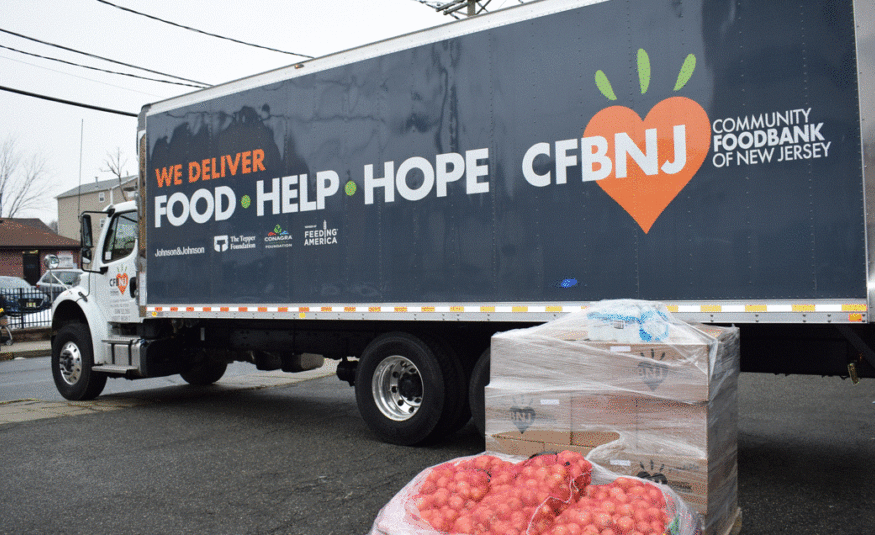
In a Nov. 3 press release, Murphy said the state deployed four refrigerated storage containers to emergency feeding organizations Community FoodBank of New Jersey and Fulfill. The move aims to assist in making fresh foods available. Members of the New Jersey National Guard are also mobilizing to support CFBNJ with food distribution at its Hillside headquarters.
The move comes as the 800,000-plus New Jerseyans who rely on SNAP may go hungry as food aid remains unavailable. According to the New Jersey Department of Health, of that 800,000:
- Almost half are children
- 1 in 3 are individuals with a disability
- 1 in 5 are over the age of 60 years
Support measures
In a statement, Murphy said, “The Trump Administration‘s failure to fund SNAP benefits has left hundreds of thousands of New Jersey residents feeling scared and unsure of where their next meal will come from. New Jersey is deploying members of the National Guard to support the state’s whole-of-government response to this unprecedented crisis and offer aid to our food banks at a time of heightened need.”
Late last week, the Democratic governor declared a state of emergency in New Jersey as part of a coordinated response effort to ensure food access for those who use SNAP.
He also released $42.5 million in food and hunger grants to the state’s six largest food banks in anticipation of a lapse in food assistance benefits.
After two federal judges ordered the Trump administration to continue supporting SNAP during the ongoing federal government shutdown, the U.S. Department of Agriculture said Nov. 3 it will partially fund the program through the end of the month.
The USDA plans to tap approximately $4.65 billion of contingency funds to cover only about half of the usual monthly benefits for the nearly 42 million Americans in the program. However, because program systems must be recalibrated for reduced payouts, the USDA warned that some states may experience delays of several weeks or even months before recipients see funds, Reuters reported.
‘Not enough’
New Jersey is among a coalition of 26 jurisdictions that sued the USDA for unlawfully suspending SNAP.

In a Nov. 3 statement, New Jersey Attorney General Matthew Platkin said, “While this is good progress, it is not enough, especially as further action is needed to make these benefits available to families and at a time when food insecurity is already high and in a month when families are gathering at the Thanksgiving table. … We are working with Gov. Murphy and our state agencies to do everything in the State’s power to ensure New Jerseyans do not go hungry.”
To shore up local support amid delays in federal benefits, the New Jersey Economic Development Authority announced Nov. 3 a $900,000 funding package to help six emergency feeding organizations in the state expand capacity and meet rising demand.
Help is available
- For updates on the status of their benefits, SNAP food assistance recipients may:
- A number of pantries offer fresh produce in addition to stable, non-perishable foods and shopping appointments. Residents are encouraged to locate food pantries and community kitchens via NJ 211 here.
NJEDA Chief Executive Officer Tim Sullivan said the SNAP benefits shortfall combined with school closures this week for the annual New Jersey Education Association (NJEA) Conference “presents an all-hands-on deck situation.”
“As a member of the Governor’s Task Force on the Federal Suspension of SNAP Benefits, the NJEDA is proud to join the Administration’s whole-of-government approach to support our food banks and facilitate the access of families to food. Government cannot face this challenge alone and I urge the private sector and philanthropic entities to join our efforts to ensure no child goes hungry,” he said.
According to the NJEDA, the following EFOs will receive funding:
- Community Food Bank of New Jersey $477,000
- Food Bank of South Jersey $135,000
- Fulfill Monmouth & Ocean $135,000
- Mercer Street Friends Food Bank $99,000
- Norwescap $27,000
- Southern Regional Food Distribution Center $27,000
New Jersey Human Services Commissioner Sarah Adelman said, “New Jersey’s food banks and their community partners are working diligently to provide extra food to families as demand is surging statewide, but they need additional financial support.”
She also encouraged the public to donate time or resources to local food pantries “in this moment of need.”
RWJBarnabas’ $1M assist
RWJBarnabas Health announced a $1 million contribution to support the efforts of 14 organizations:
- Center for Food Action Bergen County
- CUMAC Passaic County
- Elijah’s Promise Middlesex County
- Eva’s Village Passaic County
- Food Bank Network of Somerset County Somerset County
- Franklin Food Bank Somerset/Middlesex County
- Interfaith Morris County
- Lunchbreak Monmouth/Ocean County
- MEND Essex County
- Saint Peter’s University Campus Kitchen Hudson County
- St. Brigid’s Food Pantry/Soup Kitchen Monmouth County
- St. Joseph’s Service Center Union County
- Toni’s Kitchen Essex County
- Trenton Area Soup Kitchen (T.A.S.K.) Mercer County
According to a Nov. 4 press release, the funding is provided through a grant RWJBarnabas Health received from the state to support programs and community partnerships that increase access to food, housing, street medicine and temperature related relief.

In a statement RWJBarnabas Health President and CEO Mark Manigan said, “As both an anchor institution and a partner in our communities, we recognize that food and health are inseparable. For years, we have proudly partnered with the state and invested in programs that ensure individuals and families have access to healthy food. We are doubling down on that commitment at a time of increased pressures on households when food assistance is at risk.”
“Our contribution is a bridge to help support families and local feeding organizations meet immediate needs while we continue investing in and building out the infrastructure to support them over the long term,” he said.
