


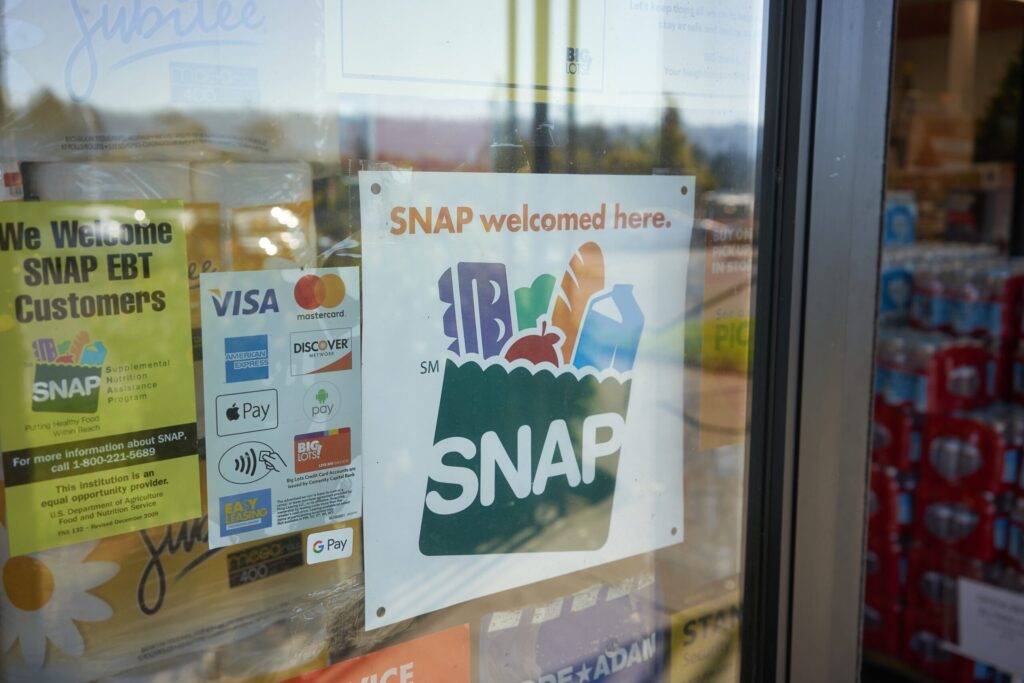
The New Jersey budget has a $6.7 billion surplus, but the governor won’t tap it to cover the cost of food stamps as President Trump seeks to deny the funds. (Stock photo by hapabapa/Getty Images)
An interesting thing happened in New Mexico on Monday.
Lawmakers, angry over the federal government’s insistence it can’t pay November federal aid for food stamps, held a special legislative session to approve the use of up to $163 million in state funds to help cover the lapse through the holidays if needed. Acting Gov. Howie Morales (D) swiftly signed the bill.
Leaders coming together to help their most vulnerable constituents through an emergency — what an idea!
Things are different on this side of the country, where our state’s leaders have opted not to use emergency funds for the same purpose. It’s not that we don’t have the money. It’s that our leaders believe this is President Donald Trump’s problem to solve, not theirs.
Gov. Phil Murphy (D), speaking to reporters last week the day after Democrats trounced Republicans at the ballot box, said Trump fighting not to pay out federal aid for food stamps is “cruel” (food stamps, or EBT, are bureaucratically called SNAP, for the Supplemental Nutrition Assistance Program).
“They’re sitting on about $6 billion, and they’re choosing to allow people to go hungry, 800,000 New Jerseyans. That’s a choice that they’ve made,” Murphy said.
He’s referring to a roughly $6 billion federal fund that is supposed to pay out food stamp benefits in the event of a government shutdown, like the current one. Trump initially refused to tap that fund, then gave some to states to deliver to SNAP recipients, and now wants some money back.
You know who else is sitting on a $6 billion emergency fund? New Jersey. The current state budget has a $6.7 billion surplus, but Murphy did not tap it to cover the cost of food stamps even as Trump seeks to deny the funds.

“No state in America, including New Jersey, can step into the shoes, the financial, existentially important shoes of the federal administration, in terms of whether it’s health care premiums, whether it’s Medicaid, SNAP. So we’ll do our best. As you’ve seen with SNAP, we’ve taken a whole range of steps, but the federal government is the big gorilla on any program like health care or food stamps. We’ll do our best at the edges, but we need Congress and the administration and Washington to step up and do their part,” Murphy told reporters Monday.
If New Jersey decided to fully cover food stamps for a single month, it would cost about $170 million. That’s 2.5% of the surplus. The budget is $58.8 billion.
Murphy’s successor, Gov.-elect Mikie Sherrill (D), sides with the governor.
“Our state budget is very tight. There’s a lot more work we need to do to address affordability issues, including in utility costs, health care costs and housing costs. So at a minimum, the federal government has to do what it’s legally now required to do, and support the SNAP funding,” Sherrill said in Newark last week.
I understand that food stamps are a federal program and it’s incumbent on the federal government to pay for them, and that New Jersey footing the bill is not a long-term solution. I also understand that the federal government may reopen in days, potentially making this specific problem moot (or not, depending on Trump’s mood). But the food stamp chaos is wreaking havoc on the lives of our poorest residents, and Trenton owes it to them to do more than start a SNAP task force or deploy the National Guard to help food banks.
Craig Mainor is executive director of United Community Corp., which runs seven community refrigerators and three food pantries in Essex County and serves about 10,000 meals a month to the county’s low-income residents. Mainor said he saw a “huge increase” in the number of people seeking help from his nonprofit when aid for food stamps was halted at the start of the month.
“There has been an eye-opener for some folks who thought that they would never need it, but now need it. Even when they were collecting SNAP benefits, they didn’t necessarily have to go to the shelters or the food distributions. But now that that’s been cut off, they find themselves in line, taking off from work for some of them. Some of them are seniors who are now forced to stand in line,” he said. “The eye-opener is that at any moment we can all be in a line for food.”
That may all be sorted out in days, either with the federal government reopening or the U.S. Supreme Court deciding not to side with Trump on this matter. But we should not forget that, with a monsoon raging, the state sat on a $6.7 billion rainy-day fund and didn’t use one cent of it to help with the deluge.
GET THE MORNING HEADLINES.
