


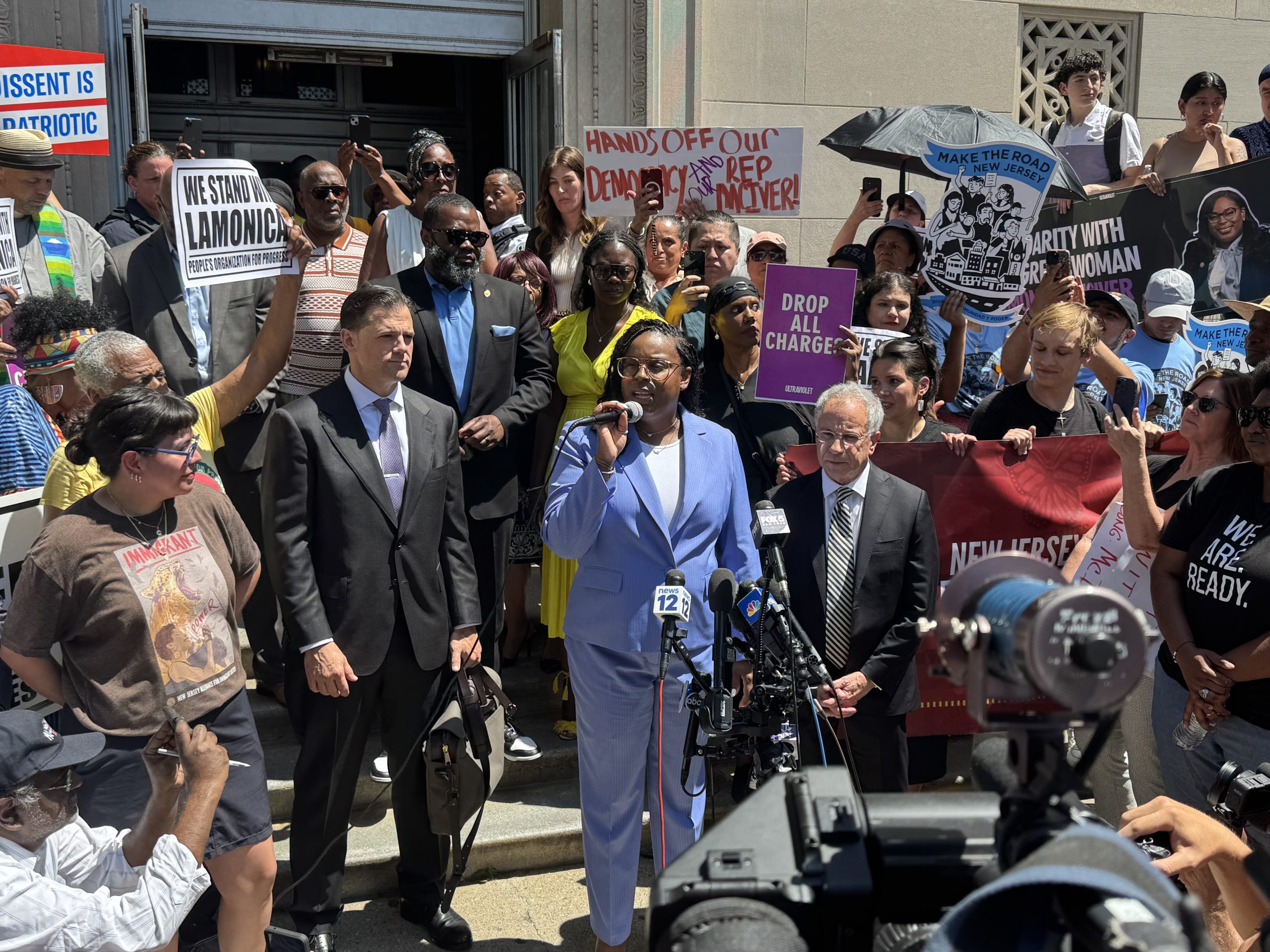
In a nationally watched and politically charged case, a federal judge has denied Rep. LaMonica McIver (D-Newark)’s motions to dismiss assault charges against her, keeping the first-term congresswoman’s trial on track.
McIver was indicted last spring, following a scuffle with federal officers during an oversight visit at Newark’s Delaney Hall immigrant detention facility. Her legal team attempted to throw out the charges on two different grounds: that her conduct was protected by the Constitution’s Speech or Debate Clause, which prohibits the prosecution of members of Congress conducting official legislative acts, and that President Donald Trump’s administration had engaged in vindictive and selective prosecution.
But District Judge Jamel Semper wrote in his ruling today that neither argument stands up to scrutiny, a major victory for Trump’s Department of Justice and for (disputed) acting U.S. Attorney Alina Habba. Semper, who had delayed the scheduled November 10 start date of McIver’s trial in order to complete his ruling, set an in-person status conference for November 20.
McIver did not immediately comment on the ruling.
In her legislative immunity motion, McIver argued that because her oversight visit at Delaney Hall was unambiguously official business, her conduct during it – which the DOJ alleges included impeding the arrest of Newark Mayor Ras Baraka and assaulting Immigration and Customs Enforcement officers – should be protected from prosecution. The DOJ pushed back on her argument, saying it relied on an overbroad interpretation of the Speech or Debate Clause that, if allowed to stand, would give wide-ranging immunity for all manner of illegal acts.
Semper largely sided with the DOJ in his ruling, writing that McIver’s involvement in Baraka’s arrest did not take place during her oversight visit itself (it happened outside Delaney Hall’s gates) and had only minimal connection to official legislative acts. “No genuine legislative purpose was advanced by Defendant’s alleged conduct,” he wrote, and it thus falls outside the Speech or Debate Clause’s purview.
“Impeding an arrest, whether lawful or unlawful, goes beyond any reasonable definition of oversight and, accordingly, exceeds the safe harbor of legislative immunity,” Semper added.
On one other count of the indictment, Semper withheld judgment; on allegations that McIver pushed and struck an ICE officer, Semper wrote, “the factual record is still being developed,” and thus no ruling is possible yet.
As for McIver’s vindictive and selective prosecution claims, the congresswoman’s attorneys pointed to pardoned January 6 defendants as examples of similarly situated defendants who were treated far more leniently by the Trump administration, and highlighted comments made by Trump and Habba that indicated discriminatory intent.
Once again, however, Semper sided with the DOJ and found McIver’s claims to be lacking. For a variety of reasons, he wrote, the January 6 defendants were in an entirely different situation than McIver, and thus cannot be directly compared; the statements made by Trump and others, meanwhile, largely referred to Democrats in general (Trump even said at one point that he had “no idea who [McIver] is”) and were not sufficiently localized to McIver to warrant a dismissal of charges.
“[The Trump administration’s] broad statements are not specific to this Defendant or responsive to her policy positions on immigration, and are therefore not personalized in a way that the requested relief contemplates,” Semper wrote.
Moreover, Semper noted, two other Democratic members of Congress were also present at the Delaney Hall scuffle – Reps. Bonnie Watson Coleman (D-Ewing) and Rob Menendez (D-Jersey City) – but have faced no legal consequences.
“Defendant argues that ‘the prosecution here rests on a retaliatory animus’ because ‘the Executive Branch does not like scrutiny of its immigration policies and practices,’ Semper wrote. “This argument is undermined by the absence of charges filed against the Representatives who were also present on May 9 conducting oversight of the administration’s immigration policies. Video evidence shows that [Watson Coleman and Menendez] were also in close proximity to the Mayor and also advocated on his behalf, but did not physically contest his arrest.”
This is a developing story and will be updated.
Semper McIver ruling
