


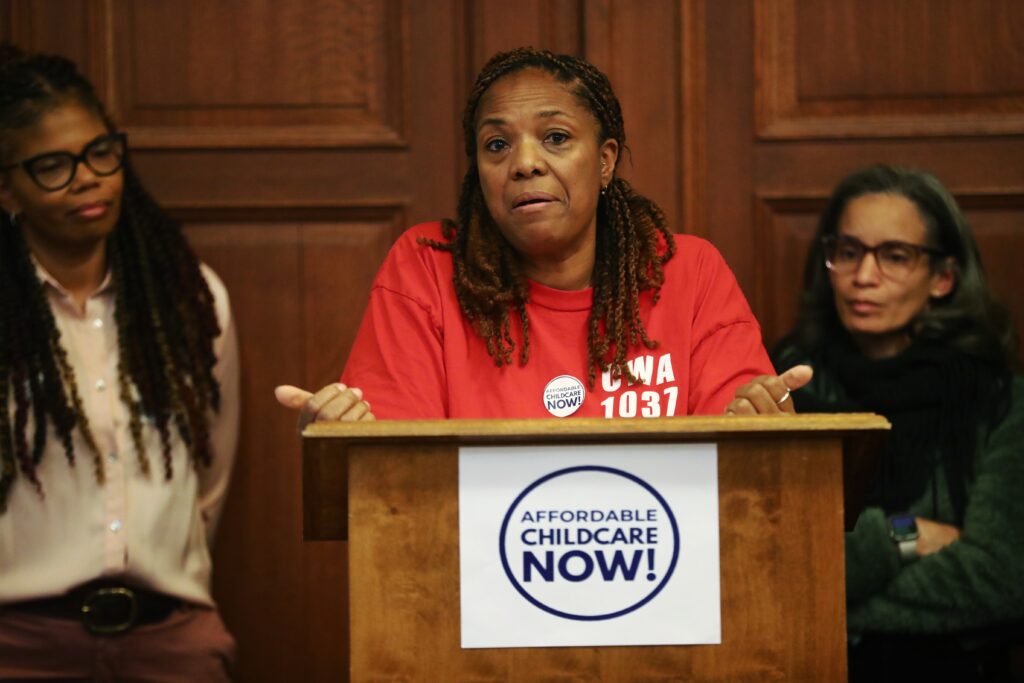
Michelle Stroud, a family child care provider in Toms River, talks about a $30 million budget shortfall in the state child care assistance program during a news conference on Nov. 13, 2025, at the Statehouse in Trenton. (Photo by Dana DiFilippo/New Jersey Monitor)
Advocates are urging New Jersey lawmakers to cover a $30 million budget gap in a state-funded child care program for low-income working parents, saying the shortfall has had “devastating consequences” for families and providers alike.
The state’s child care assistance program quit accepting new applicants on Aug. 1 and raised copays for already-enrolled families after lawmakers in June passed a $58.8 billion budget that did not include enough money to cover the program’s total operating costs.
Those program changes forced some parents to quit their jobs or reduce their work hours because they couldn’t get assistance or afford the higher copays, and that, in turn, drove some providers to cut their hours or consider closing as their enrollment fell, according to a coalition of about 30 social justice advocates and labor unions.
The advocates sent a letter to Gov. Phil Murphy, Gov.-elect Mikie Sherrill, and legislative leaders and gathered at the Statehouse Thursday to call on policymakers both to pony up the $30 million and to find a long-term funding solution that ensures child care is affordable and available for all who need it.
“New Jersey can’t claim to be the state that values working families if it’s willing to balance the budget on the backs of working families,” said Jason Ajiake, political director of labor union SEIU United Healthcare Workers East.
Michelle Stroud, a family child care provider in Toms River, said she has not passed the higher copays on to families whose children are in her care. Under the program, parents pay their share directly to the provider, while the program pays the provider for the rest of the cost of care. Both the copay and the subsidy rate are based on several factors, including a family’s size and income and the kind of care.
“I know how hard it is, so I take the hit instead of my parents,” Stroud said. “No one can afford this. Parents can’t afford the out-of-pocket cost. We can’t afford to give these discounts. Nobody wins.”
Murphy’s office declined to comment and referred the New Jersey Monitor to a comment he made during his February budget address.
“And while, yes, every responsible budget, including this one, requires hard decisions — like scaling back programs that we would rather increase funding for — we can, and we must, make those decisions while also keeping our promises, whether it be making the full payment into our pension system or fully funding our public education system,” he said then.
The state Department of Human Services administers the $876 million program, which also receives federal funding. Eva Loayza-McBride, a department spokeswoman, said officials there are “monitoring program expenses to determine if/when we can reopen enrollment.”
The program serves about 70,000 children from infancy to age 13 (or up to 19, for special-needs children) across the state. Families with incomes up to 200% of the federal poverty level qualify for assistance; for a family of three, that’s about $53,000 a year. The average benefit per child is $11,750, Loayza-McBride said.
“For many of our most vulnerable families, this program is the only path to affordable child care,” said Winifred Smith-Jenkins, director of early learning policy and advocacy of Advocates for Children of New Jersey.
The program got almost $80 million in additional funding in this year’s budget. But Sarah Adelman, the human services commissioner, testified during a May budget hearing that the allocation still would leave a $25 to $30 million budget gap, due to climbing enrollment and unfunded federal policy changes, such as a measure requiring the state to make enrollment-based payments before service is provided. She warned then that the department would have to freeze new applications and hike copays if the budget gap was not closed.
In their letter, advocates described the budget shortfall as a crisis that “demands a fundamental shift in how we value child care.”
“Child care is not a luxury; it is the workforce behind the workforce. It is critical public infrastructure, as essential to a functioning economy as roads and bridges. It is time to treat it and fund it as such,” they wrote.
Advocates noted that the rising costs of housing, health care, utilities, and groceries have dominated headlines this year, but child care costs have created “another affordability crisis.” A September brief by the Rutgers Child Care Research Collaborative found that 76% of New Jersey children under 5 are in non-parental care, with half of those families spending more than 7% of their annual income on child care (that’s the affordability threshold under federal guidelines).
The budget shortfall and program cuts it caused worsen inequities, because women of color are disproportionately represented among both parents and providers who rely on the program, advocates said.
“This is a worker issue, it’s a woman’s issue, it is a social justice issue, a racial justice issue,” said Trina Scordo, executive director of New Jersey Communities United.
Scordo applauded states that have “figured this out,” including New Mexico, which became the first state in the nation to offer free, universal child care this month.
“We’re a blue state. We are a wealthy state. That means we have the resources to figure this out,” Scordo said. “We can do this. It is not impossible. But it takes morality and courage.”
Two state legislators joined advocates at the Statehouse Thursday to cheer the cause. Sens. Teresa Ruiz (D-Essex) and Angela McKnight (D-Hudson) both have introduced bills to address sagging child care funding.

McKnight’s bill, which she introduced last month with Sen. Britnee Timberlake (D-Essex), would allocate $28 million to cover the program’s gap. It has no Assembly companion and awaits a committee hearing in the Senate.
Ruiz, who’s both a working mother and a former preschool teacher, called child care “a cornerstone of my policy agenda since before I got elected.” She has seven pending bills that would bolster child care in New Jersey, including one that would expand the income eligibility for child care assistance. That does have an Assembly companion, but neither chamber has yet advanced the bill.
“Government sometimes loses that common-sense approach. And unfortunately, we’re here because things happen, but it’s time for us to right the wrong,” Ruiz said.
GET THE MORNING HEADLINES.
