

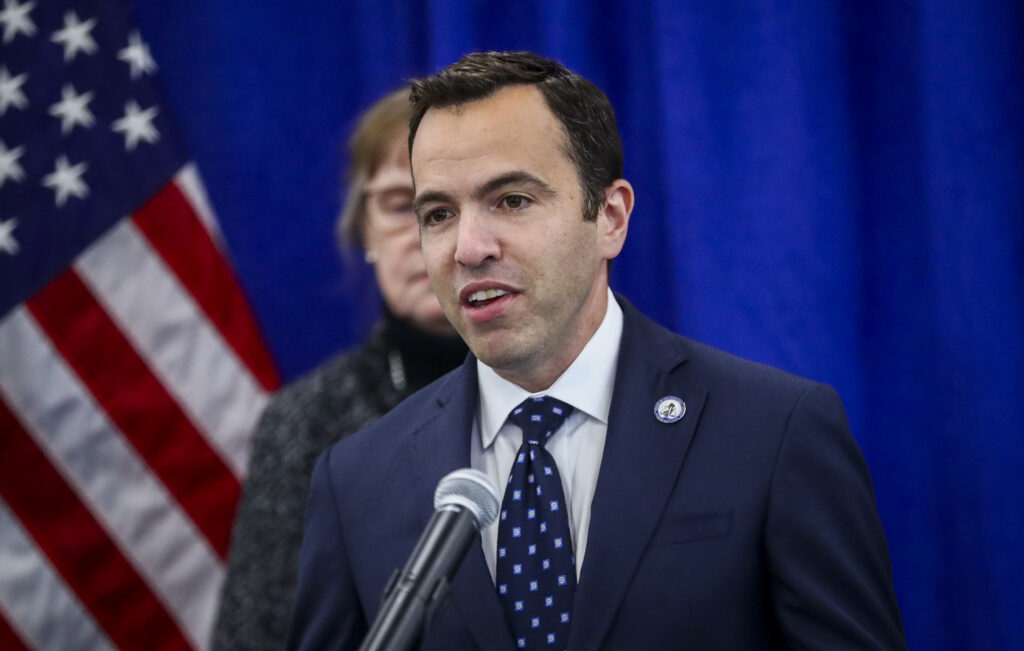
Attorney General Matt Platkin said Horizon drove up the cost of health care for state workers by overcharging the state, a claim the company disputes. (Photo by Dana DiFilippo/New Jersey Monitor)
Horizon Blue Cross Blue Shield agreed to pay New Jersey $100 million as part of a settlement to resolve claims that it made false statements to win a contract managing the state’s public worker health plans and then ignored a contractual provision so it could overcharge the public plans, prosecutors announced Friday.
State officials say Horizon, which administers public plans that insure more than 750,000 state and local government workers and retirees, had ignored a provision in the 2020 contract that required it to charge the state the amount billed by a health care provider or an amount negotiated between the provider and Horizon, whichever is less.
But the insurer knew it could not comply with the provision before it bid into the contract and concealed that fact from state procurement officials, the Office of the Attorney General alleged. Then it ignored the provisions, submitting more than 1,000 false claims to the state alongside fraudulent records to support them, according to state prosecutors.
“At a time when everyone is rightly concerned about the cost of their health care, it is simply unacceptable that an insurance company would seek to defraud our State and overcharge us while driving up the costs of health care for hundreds of thousands of dedicated public servants,” Attorney General Matt Platkin said in a statement Friday.
The state said Friday the settlement is the largest non-Medicaid false claims settlement amount in state history. Horizon denies any wrongdoing, and the settlement does not include an admission of guilt.
The lesser-of provision was a new addition to the 2020 third-party administrator contract meant to reduce costs for the state’s public worker health plans, which are distressed following successive premium hikes and departures by local governments and schools.
The provision required Horizon to charge the state the amount billed by a provider or the amount negotiated between the provider and Horizon ahead of time, whichever was less. For example, if a doctor charged $300 for a visit but had negotiated a $600 cost with the insurer, the provision would bar Horizon from charging the state more than $300.
But the insurer ignored the requirement and even sent plan members documents that misstated the amount it charged the state for their health care, providing lower provider charges even when higher negotiated amounts were paid, prosecutors said in their lawsuit.
Horizon received nearly $500 million across nearly five years under that contract, state officials said. Along with Aetna, the insurer was chosen to act as a third-party administrator for the state plans in contracts awarded last year.
The firm has since begun complying with the lesser-of provision and ceased providing false documents to members, according to the settlement agreement.
A spokesperson for Horizon said Platkin mischaracterized the facts.
“This has never been anything more than a straightforward contract dispute, one that Horizon tried to resolve in good faith more than four years ago in the same way it has resolved similar disagreements over the course of our long and fruitful partnership with the State: through a negotiated reimbursement,” said Thomas Wilson, the spokesperson.
Horizon resolved the underlying issues in 2023, he said, and the payments in question accounted for just 0.07% of claims and less than 0.5% of the amounts paid to health care providers.
“While Horizon’s interpretation of one aspect of the contract differed from the State’s, the settlement makes clear Horizon never retained any portion of monies charged to the State for health care provider claims,” Wilson said. “Horizon paid claims we processed for the State according to the contracts in place with the doctors and hospitals filing those claims.”
In the settlement, Horizon denies overbilling or submitting false documents to the state, positions not shared by New Jersey or private individuals who initially lodged the suit.
The attorney general, for his part, denied any mischaracterization.
“It’s rich that a company that has to pay $100 million back to the State is accusing the State of wasting time and resources,” Platkin said in a separate statement delivered after this story was published. “We look forward to receiving their payment within 25 days.”
The suit against the insurer was initially brought by a group of private individuals, called relators, who sued on behalf of the state under the New Jersey False Claims Act. That law imposes civil penalties on individuals or firms who knowingly make false claims for payments from the state.
The law allows private citizens to sue on the government’s behalf and keep a portion of the proceeds if the suit succeeds.
Five of the six relators who brought the suit will split $12 million from the settlement. They are former State Policemen’s Benevolent Association Executive Director Kevin Lyons, former state PBA President Pat Colligan, former PBA Executive Vice President Marc Kovar, and Mark and Vince Flores, co-founders of the health benefits consulting firm AVYM.
A sixth relator, former state assistant director of health benefits Christin Deacon, will not receive a share of the proceeds because she administered the 2020 contract and became aware of the insurer’s alleged conduct in the course of her work before leaving her position.
“The Division has been, and continues to be, laser-focused on enforcing its contracts and ensuring that our health benefits plans and our members are protected,” state Treasurer Liz Muoio said in a statement.
Of the remaining proceeds, $10 million will go to the state’s false claims prosecution fund — state law requires 10% of proceeds from false claims settlements to be deposited there — and the remaining $78 million will return to the state pension and benefits division.
As part of the settlement agreement, Horizon will submit to additional reporting of its claims data and finances, including daily access to its claims, quarterly reviews, and more fulsome monthly reporting.
The insurer is required to make the $100 million payment by Dec. 2. It must also pay $1.25 million in attorney fees to the relators and unspecified amounts to the state for the enforcement of the agreement.
GET THE MORNING HEADLINES.
