


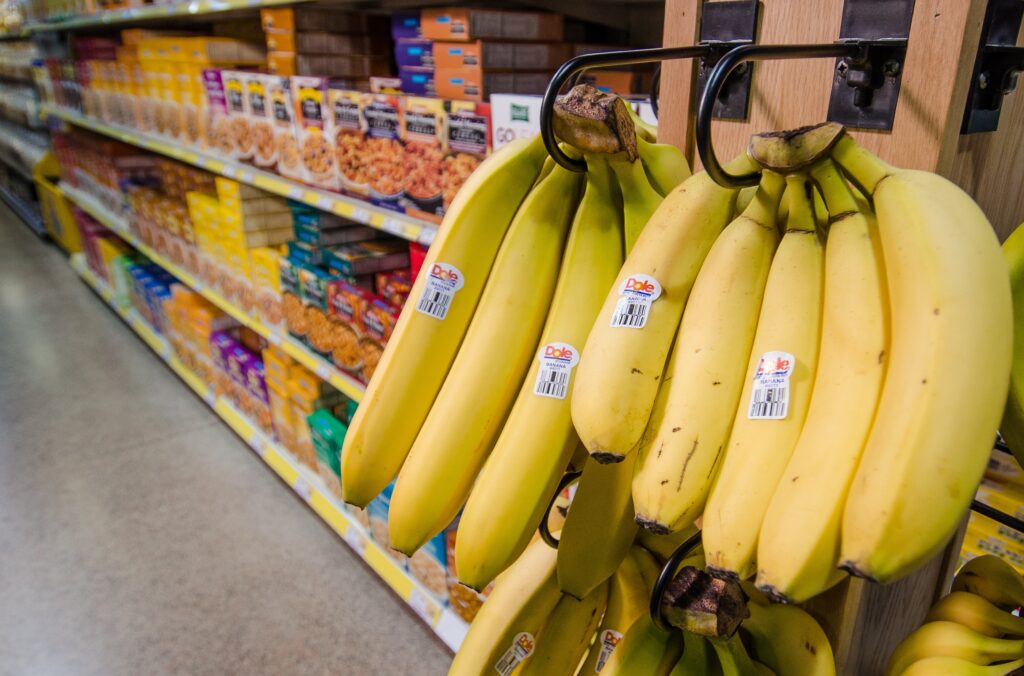
Legislation would require state retailers to spell out the costs added by tariffs on store tags, receipts, and online storefronts. (USDA Photo by Lance Cheung)
New Jersey lawmakers want the state’s retailers to tell consumers how much they’re paying for tariffs, a move criticized as unworkable by an industry group that has broadly opposed the Trump administration’s tariff policy.
Legislation sponsored by Assemblywomen Annette Quijano (D-Union) and Rosie Bagolie (D-Essex) would require retailers to display the portion of a product’s cost attributable to tariffs on store tags, receipts, and online product pages.
“The consumer has the right to know how they’re paying for the tariffs and for the goods. It’s a simple disclosure,” said Quijano, the bill’s prime sponsor in the Assembly.
The legislation, which saw a Senate companion introduced earlier this month by Sen. Brian Stack (D-Hudson), is Democrats’ latest response to President Donald Trump’s tariff-heavy trade policy, which was a frequent target of Gov.-elect Mikie Sherrill on the campaign trail.
Tariffs are a tax on importers — in this case, firms based in the United States — on goods brought in from abroad. Tariffs raise businesses’ costs by increasing the cost of their goods, and firms typically pass some or all of those cost increases onto consumers, though the increases take time to filter through supply chains and into storefronts.
The state bill has drawn some resistance from the New Jersey Business and Industry Association, an industry group that is critical of the administration’s tariffs but warned that complicated international supply chains could make determining tariff costs impractical or expensive.
“There is a good idea behind it. As somebody who does not like tariffs — and BIA has publicly pointed out concerns with tariffs — this is a very burdensome and unrealistic way of trying to tackle the issues that tariffs bring,” said Chris Emigholz, the group’s chief government affairs officer.
Analysts spanning the political spectrum — from the conservative Tax Foundation to the liberal Urban Institute and the slew of investment banks in between — have warned the Trump administration’s tariff regime will cause the country’s gross domestic product to contract and shrink the variety and quality of goods available in the United States.
Disentangling those added costs can be complicated, Emigholz said, because businesses’ supply chains can stretch into multiple countries, each with its own tariff rate, at different stages of production for different products or components that are later imported into the United States.
Complicating matters is that businesses may not pass the entirety of tariff costs onto consumers through price increases. In competitive markets, businesses are incentivized to keep prices down, and those that add the full cost of tariffs to retail prices risk losing sales to retailers that add only a portion.
“Every day, I’m sure there’s some tax increase and some tariff being absorbed by a company for a competitive advantage, and every single day there’s tariffs being passed onto consumers because they can’t afford to,” Emigholz said.
Quijano said retailers could figure out their tariff expenses by talking to wholesalers.
The bill would require wholesalers to maintain records of their tariff costs and share those records with retailers so they can comply with the bill’s disclosure provisions. Retailers found to be out of compliance by periodic audits required under the bill would face fines of up to $500 for each violation.
“You buy from your wholesalers. You know what the price is, and the wholesalers are going to have to tell them. I don’t see it as that hard,” she said.
Uncertainty about how much tariffs were increasing prices was a major driver for the legislation, Quijano said.
“We just see prices increasing. No one’s disclosing that there’s a tariff or how much it is. That’s why this bill is so important,” she said.
The bill includes some exceptions. Retailers with less than $500,000 in annual revenue would not be required to disclose tariff costs, and no retailers would have to disclose tariff costs for any product where the import taxes account for less than 2% of the final retail price.
The bill would grant the state’s consumer affairs director the power to exempt other products from tariff reporting if such reporting would be impractical, unreasonable, or unnecessary to protect consumers.
Quijano, who said she had not yet heard the business group’s concerns, said she may accept amendments to the bill after hearing their worries.
GET THE MORNING HEADLINES.
