

 Listen to this article
The basics:
- From NRBP forum, NJ economy remains stable; 164,000 jobs added since 2020, Newark Metro up 2.4%
- Arts, entertainment, sports, hospitality drivers for Brick City visitor and investor growth
- Experiential tourism, cultural collaboration boost small business revenue and local engagement
- Film and TV production in ‘Film Ready’ Newark continues to grow
The tone was optimistic coming out of the recent Newark Regional Business Partnership Regional Economic Outlook.
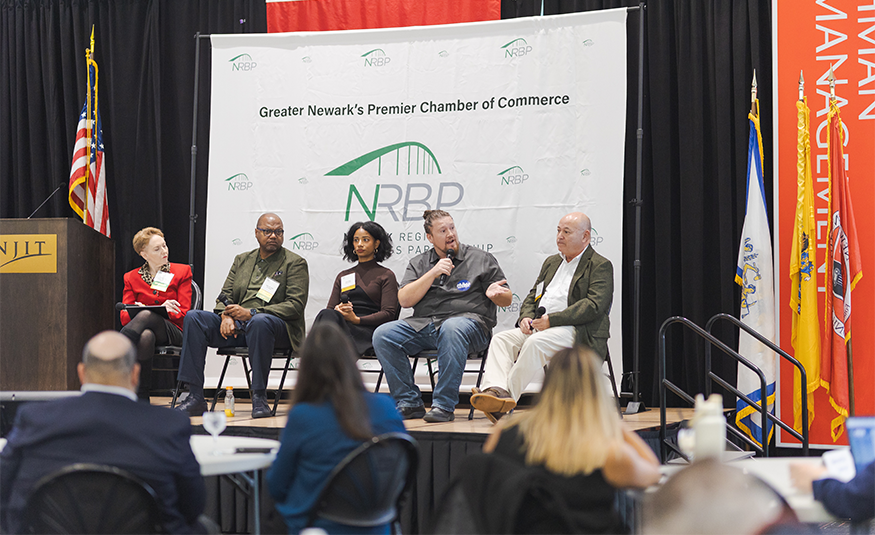
Held Oct. 30 at New Jersey Institute of Technology, the annul NRBP event explored upcoming trends as well as what businesses can expect heading into 2026.
In particular, this year’s event shined a spotlight on the impact of arts, entertainment, sports and hospitality across New Jersey – as the Greater Newark region emerges, in particular, as a destination for visitors and investors.

TD Bank, the Martin Tuchman School of Management at NJIT, Horizon Blue Cross Blue Shield of NJ and Invest Newark sponsored the conference.
By the numbers
At the top, Roseanne Elcenko, assistant director of economic and demographic research, New Jersey Department of Labor & Workforce Development, offered an overall economic update for the Garden State.
While noting that spending patterns and job growth have shifted, she reiterated the New Jersey economy stands “stable and firm.” The assistant director highlighted inflation easing to 3%, sustainable job creation, and employers’ adapting to a more measured and balanced environment.
According to Elcenko, while lower-income consumers are exercising more caution, higher-income households account for nearly half of all consumer spending. This change in behavior is also driving shifts in where demand comes from and how businesses behave, she said.
The NJDOL representative also shared data points. As of August 2025, the state economy added about 164,000 jobs (+3.9%) since February 2020. Zooming in, the Newark Metro Division gained 2.4% to hit 38,800 jobs.
Speaking in October, Elcenko noted the impacts of the federal government shutdown – since ended and the longest in history – on the availability of new data. She noted a statewide quit rate of 1.5% suggests workers are not broadly confident they can easily find comparable or better jobs.
Cultural collaboration
A panel discussion moderated by Suzanne Ishee, director of the NJIT Hub for Creative Placemaking followed. Speakers offering insights on Newark’s cultural and economic renaissance included:
A consensus emerged regarding how collaboration, creativity and community engagement fuel local growth.
Mays highlighted the recently launched Festivals United initiative as a model for strengthening the local cultural landscape. She noted the “unprecedented alignment and collaboration” as helping to carry momentum forward from “those who came before us.”
Randolph pointed to shifting demographics in Newark and growing demand for authentic experiences. “People want to engage with the city in meaningful ways, and there’s a sense that everyone is moving in the same direction,” he said.
Case in point
A recent post-concert activation in collaboration with a local eatery shows how partnerships produce tangible results. And the potential for the city’s small businesses. According to Newark Happening President Ashley Mays, Just Delicious increased sales by more than 35% thanks to the pairing.
That hunger has also fed a rise in experiential tourism.
“People don’t necessarily go into the stadium to see the World Cup game — they come for the experience,” shared Baglivo, who later added, “Visitors are looking for unique experiences — the best coffee, croissant, you fill in the blank. We have things in Newark that NYC doesn’t have or doesn’t offer.”
All speakers agreed the 2026 FIFA World Cup offers an unprecedented opportunity.
Valla noted how Newark’s culture infrastructure is rapidly expanding. “In the Arts and Education District, The Vault is open, Consigliere is open — these are new places that weren’t here last year, adding to the city’s vibrancy and appeal.”
Big screen, big opportunity
New Jersey Motion Picture and Television Commission Assistant Director David Schoner closed the program.
His presentation focused on the growing industry’s impact in Newark. According to Schoner, the Brick City has emerged as a central hub for production, workforce development and small business engagement.
“Newark is film-ready,” Schoner said. “We have the crews, the vendors, and the infrastructure to keep this industry growing.” The city launched its first office for film and television production last fall.
Across the state, film production generated $833 million in qualified spending in 2024 – and all-time high. The industry also created more than 30,000 jobs, making it one of the fastest-growing production hubs nationwide.

Underscoring the local benefit to small operators, Schoner shared the example of a local shop supplying $19,000 worth of balloons for a recent production.
Further boosting momentum in Newark is a recent $750,000 grant toward workforce training through NJ Film Works, which creates pathways to union memberships supporting middle-class career development. Additionally, the Brick City’s Film Ready designation helps promote the area.
In addition to serving as a background for productions, less mobile impacts also crop up across the city. Lionsgate received the state’s first-ever Studio Partner designation in 2022 following its lease with Great Point Studios to anchor a new production facility in Newark’s South Ward. In the spring, the city said it was also in talks to potentially bring a studio project to Newark led by Whoopi Goldberg.
