


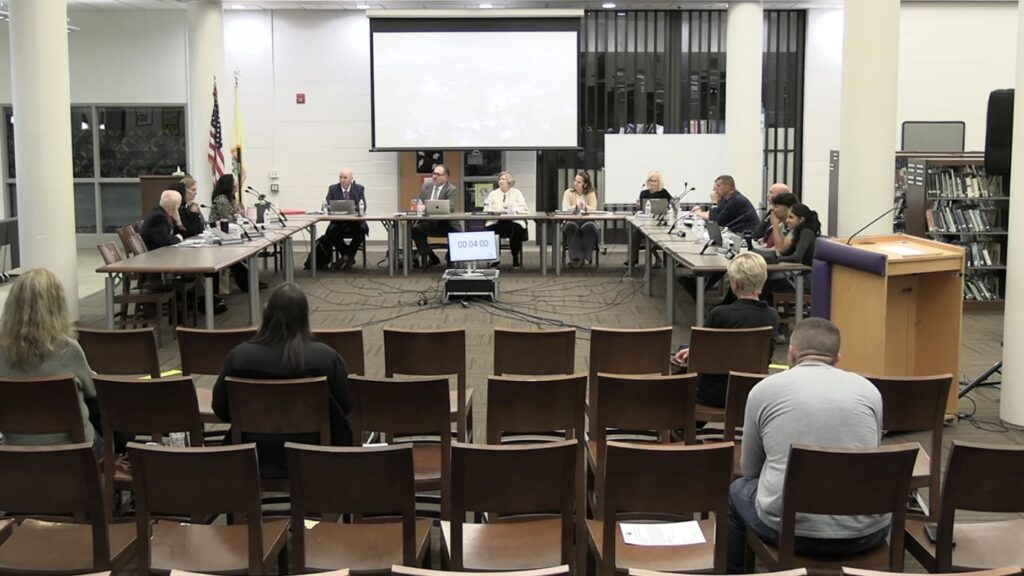
The Monroe Township Board of Education meets on Oct. 15, 2025. The board was sued over its decision to appoint a new member before holding a public discussion.
A panel of appellate judges this week shined a spotlight on the all-too-common issue of government bodies in New Jersey hashing out decisions behind closed doors.
If you’ve ever watched a public meeting, you know what I’m talking about. Officials tell the public they have legal matters to discuss, so they meet privately, sometimes for hours. The state Open Public Meetings Act allows them to do this, with limits, but any reporter or gadfly will tell you they suspect a lot more goes on during these private sessions than the law allows.
The appellate decision from this week involves the Monroe Township Board of Education, which met on Oct. 18, 2023, in part to fill a vacant seat on the nine-member board. It met in closed session for 45 minutes to discuss the candidates, reached a consensus pick while meeting privately, then returned to public session to appoint a guy named Matthew Gorham, without giving the public a chance to weigh in before their vote to add him to the board. That was a violation of the Open Public Meetings Act, the appellate court ruled.
“Substantively, the public only witnessed the nomination and vote to install Gorham. The Board did not take any questions or comments from the public about the candidates or the process because it moved directly to the nomination and vote,” this week’s ruling says.
Making matters worse, the board had previously told the public they’d be interviewing candidates at the meeting, then decided not to.
The Open Public Meetings Act certainly gives the Monroe school board the legal right to discuss potential appointments to a vacant seat outside of public view. But the law also requires them to bring that discussion back before the public before acting, as the new ruling says.
“The fact (that) all its deliberations regarding candidate qualifications and whether to interview those candidates took place in private, without giving the public any insight into these decisions, was problematic,” it says.
Walter Luers, who represented the plaintiff in her lawsuit against the Monroe board, said he’s pleased the appellate panel issued an “important rule of law” stating that school boards, when appointing a new member, must explain the decisions they make behind closed doors to the public.
“This is an important rule for transparency and Board governance in New Jersey, and is consistent with existing New Jersey caselaw,” Luers said.
The fight over the Monroe school board appointment is largely moot — Gorham lost in his bid to stay in the seat in April 2024 — but I hope other public entities take note here. State law governs when you can and can’t meet in private, and simply saying “we’ve got legal matters to discuss” isn’t a good enough reason to shut the public out of matters of public concern. Luers agrees.
“I hope it moves the needle closer to public entities having more disclosures and discussions in public, and certainly when appointing an official that ordinarily the electorate votes for, a higher standard applies,” Luers said.
GET THE MORNING HEADLINES.
