


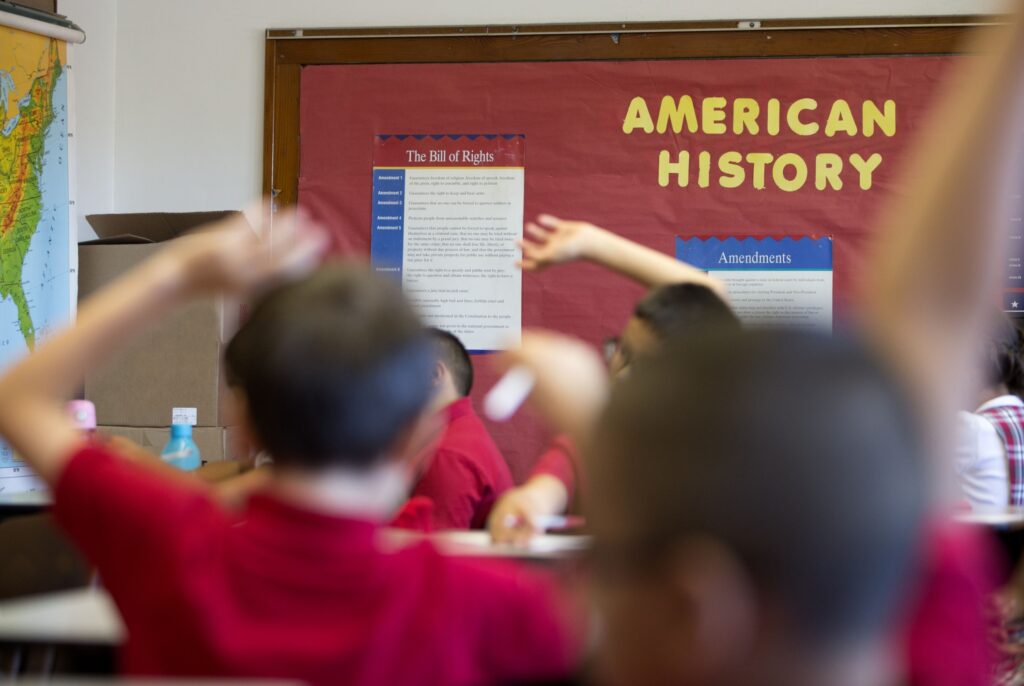
A new plan to require small districts to consolidate has some worried over local representation, while others tout financial and educational benefits. (Photo by Getty Images)
Senate lawmakers are mulling legislation that would require county executive superintendents to consolidate small school districts in their jurisdiction, but the fate of mandatory consolidation appeared unclear after the measure’s sponsor indicated Thursday he may require voter approval for the mergers.
The bill sponsored by Sen. Vin Gopal (D-Monmouth), who chairs his chamber’s education committee, would require executive county superintendents to create plans to merge districts with fewer than 500 students who live in the district and establish or grow regional districts.
“We have a lot of government in New Jersey, and I’m hoping this is going to be the start of that conversation on how we can do this humanely and at the same time improve the quality of life and education and also make life better for taxpayers financially,” Gopal said.
School board member sues NJ officials, alleging they stifle free speech
Officials have long considered school consolidation as a means of lowering the cost of public education by eliminating duplicative services and aligning disparate curricula from elementary or middle schools that send older students into combined regional districts.
But the state’s long-running efforts at voluntary consolidation — including financial incentives and state support for feasibility studies — have created only a handful of mergers, while school expenses continue to drive property tax growth.
School taxes accounted for 52% of local property taxes collected in 2024, according to state data, and the roughly $15 billion in school aid in the current state budget accounts for more than a quarter of all state spending approved for the current fiscal year.
Numerous witnesses who spoke before the education committee Thursday about the bill, called S4861, raised concerns about how mandatory consolidation could cut local officials and parents out of decisions about schooling.
“While the goals of S4861 are understandable, its mandates — particularly the removal of voter approval and the prescriptive consolidation requirements — can produce significant disruption without guaranteed cost savings for education improvement,” said Melanie Schulz, director of government relations for the New Jersey Association of School Administrators.
Backing voluntary mergers, incentivizing shared service agreements, and offering state-funded efficiency audits to districts would be a better path, she said.

The current version of Gopal’s bill would see county executive superintendents draft consolidation plans, which the state education commissioner would approve or deny. If those plans are approved, the bill would require the county superintendent to commission a state-funded feasibility study.
If that study finds a merger would not increase school segregation or create overlarge separations between districts and bring potential for cost savings, a better learning environment, and better-coordinated curricula, the participating schools would merge after five years.
Gopal said he shares concerns about a lack of local approval for school mergers and indicated the bill’s requirement for small districts to merge could change.
“I’m all with you on the voter approval,” he said. “My hope is a county executive [superintendent] or someone is going to show a scenario or a neutral figure: This is what your taxes will be if you do consolidation, this will not. If folks in that community say ‘OK, x, y, and z are going to happen, we want to pay more,’ that’s up to them.”
Some who cautioned against mandatory mergers acknowledged that New Jersey’s non-operating school districts — typically small districts that have a school board but send students to schools in other districts because they do not have any of their own — are ripe for mandatory consolidation.
New Jersey had 16 non-operating school districts in the 2024-2025 school year, according to the Department of Education, out of 695 local education agencies, including 89 charter and renaissance schools.
“It seems like it should be pursued, and I think that was the intent of the law that was passed back in 2007 to start to phase them out. We probably should take another look at that,” said Jonathan Pushman, senior director of advocacy for the New Jersey School Boards Association.
Some others warned that the cost savings from mergers could be overstated, citing state law that requires consolidated districts to use salary guides from the most populous of the districts that would be combined unless each district agrees on another framework.
Salaries in more populous districts tend to be highest, Pushman said.
“Any savings are often offset by necessary investments in existing positions that have to take on more responsibility and new positions to serve the regional,” he said. “It should be noted that 70 to 80% of a school district’s budget is wrapped up in those labor costs, and they won’t go down due to regionalizations.”
Officials from some of the state’s consolidated districts gave a more favorable view of mergers.
The Henry Hudson Regional School District, which absorbed districts in Highlands and Atlantic Highlands following a 2023 referendum, saw improved curriculum continuity, greater purchasing power, increased grant access, and lower costs following the merger, said Tara Beams, the district’s superintendent.
Bob Morrison, a member of the Watchung Hills Regional High School District’s board, cautioned against allowing individual districts to disrupt regionalization studies, warning they have too much ability to slow or complicate the process under the current system.
Watchung Hills last month released a study on the feasibility of merging with nearby districts in Watchung, Long Hill, and Green Brook. Morrison said delayed data reporting, uneven engagement, inconsistent messaging, and leaked draft communications complicated the study process.
“To be direct, I have never seen so many grown adults afraid of what may be revealed in a study, ever,” he said. “The incentive today is to do nothing, to keep the status quo, to do things the way they’ve always been done, and that should be unacceptable when improving our students’ education is at stake.”
The bill did not see a vote Thursday, and Gopal indicated he intends to pass the measure — which is expected to see changes — next year.
Gov.-elect Mikie Sherrill, who takes office on Jan. 20, has said she favors incentivizing mergers but views compulsory consolidation as an option.
“I’d start by offering the carrot to help the areas that want to consolidate, but when there are areas that are not putting enough money into students, into educators, into the buildings, and then they are taking a lot of money in property taxes and from the state level, then we’ll have to start to look at compulsory movements,” Sherrill said during a debate in September.
