


OPINION
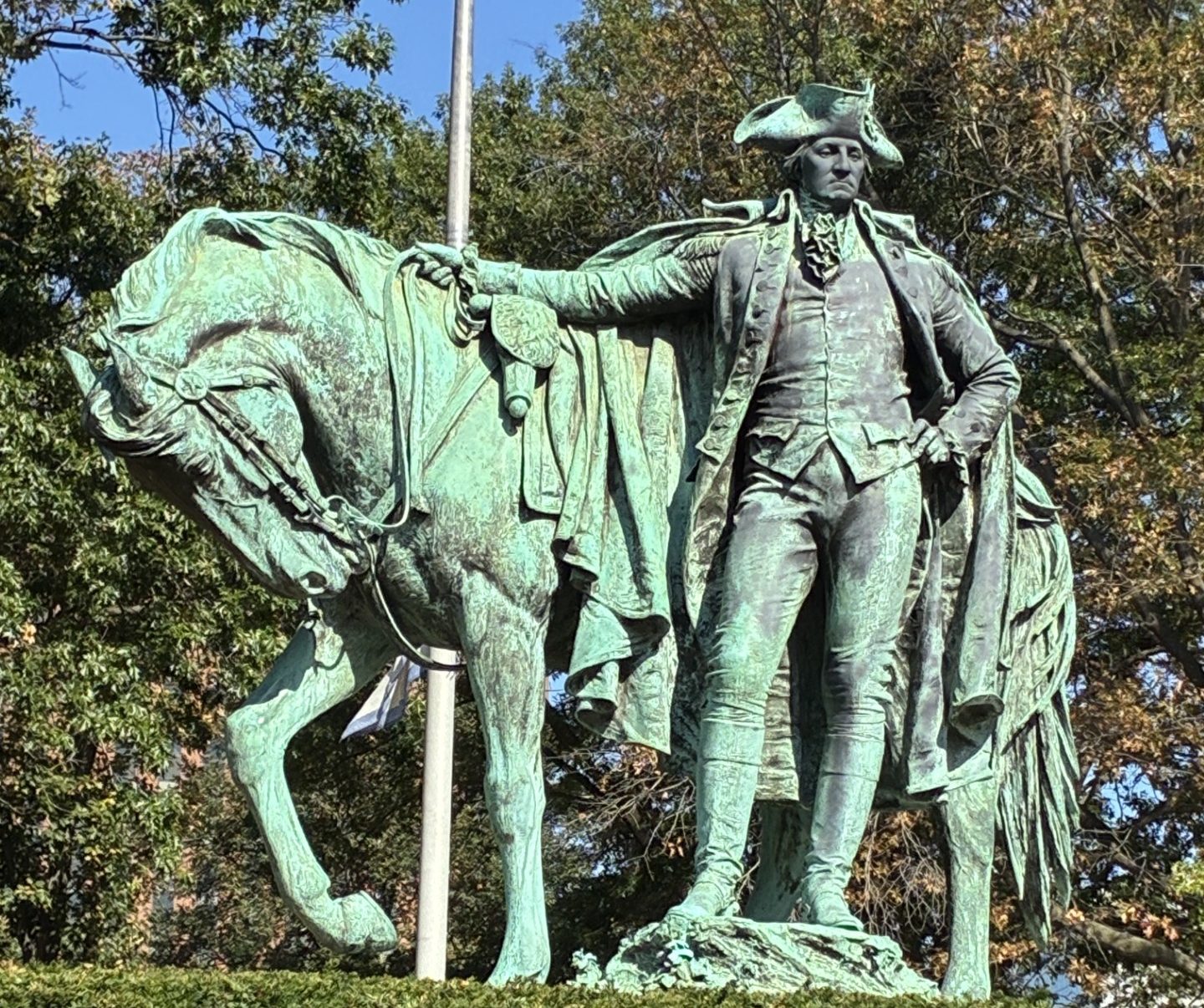
The statue of Gen. George Washington standing majestically in a park in downtown Newark is one of the most unique statues of its kind, depicting the Revolutionary War hero and first American president in uniform alongside his horse.
Almost all other statues of Washington, in this country and abroad, show him either astride his horse or as a solitary figure.
Dedicated in 1912 amid great public interest, Newark’s Washington statue has been neglected for years. At one time, the mound on which it sits was overrun with rats. Today, the statue still bears the stain of black paint smeared on it during the George Floyd protests of 2020.
Is this any way to treat the legacy of a man without whom, most historians agree, there would be no United States of America?
And is there any better time than right now, as the nation prepares to celebrate its 250th year of independence, for government officials and civic leaders to step forward and have the statue cleaned and repaired so it doesn’t fall into a permanent state of disrepair?
Meanwhile, the statue of George Floyd in front of Newark City Hall sits preserved and well- protected, quickly wiped free of white supremacist graffiti when it was defaced in 2021.
The statue of Washington was paid for from the estate of Amos Hoagland Van Horn, a Civil War veteran and one of Newark’s greatest philanthropists.
As a young man, Van Horn ventured to Newark from a hamlet in Warren County to start a furniture repair business and, over time, came to own a highly prosperous home furnishings store on Market Street along with some valuable real estate.
In the years between his wife’s death in 1902 and his own in 1908, Van Horn gave away most of his considerable wealth, a sizable portion of it to fellow Civil War veterans he found in need.
According to the couple’s grave marker in Newark’s Fairmount Cemetery, Van Horn’s wife, Emma, was a descendant of Abraham Clark, one of the five New Jersey delegates to the Second Continental Congress who signed the Declaration of Independence. There can be little doubt that this familial connection reinforced Van Horn’s strong patriotic feelings.
In his will, Van Horn also left money to pay for two other statues in Newark – one of a sitting President Abraham Lincoln in front of the Essex County Historic Courthouse at the convergence of Springfield Avenue and Market Street and the “Wars of America” memorial in Military Park.
Both of those were the work of Gutzon Borglum, one of America’s pre-eminent sculptors most famous for carving out the massive Mount Rushmore monument from rock in the desolate hills of South Dakota.
The noted Scottish-American sculptor John Massey Rhind was chosen for the Washington statue. His image captures the general delivering farewell orders to his troops at Rocky Hill, near Princeton, on Nov. 2, 1783, as he was leaving the service behind.
The statue was such a big deal in its day (when Newark enjoyed national prominence) that President William Howard Taft agreed to speak at its dedication ceremony on Nov. 2, 1912, an event that drew thousands of spectators.
Taft would have spoken but for the fact that his vice president, James S. Sherman, died right before the unveiling and he dutifully attended Sherman’s funeral in upstate New York instead.
The president did send along a telegram to be read at the dedication, however, while a distinguished member of Newark’s clergy filled in for Taft as the ceremony’s keynote speaker.
Ever since then, the bronze statue of George Washington the military officer has stood proudly as a beacon of American resistance to autocracy at the southeast corner of what was once “Washington Park,” renamed several years ago to “Harriet Tubman Square” after Newark mayor Ras Baraka ordered the park’s Columbus statue removed during the Floyd protests.
The Columbus statue’s exquisite Italian marble foundation was later demolished and replaced with a monument to the abolitionist.
Baraka cannot but be aware of the Washington statue’s tarnished and deteriorating condition, something that’s been allowed to occur even though the statue is listed on both the state and national registers of historic places. He has been vocal in his distaste for Washington because Washington was a slaveholder in civilian life.
Who knows that Baraka doesn’t also harbor a desire to remove the Washington statue from the park someday? That may be wishful thinking on his part, but it’s something he could still accomplish without signing an executive order or anyone lifting a finger simply by letting the statue fall apart from prolonged neglect.
But what message would that send about Newark to the rest of the country, if not every place on the planet where democracy is cherished and the struggle against tyrannical rule revered? Nothing positive, to be sure.
So it’s time for Newark to return the Washington statue to the stature it enjoyed on the day of its dedication, ensuring its future as an enduring and gleaming symbol of America’s fighting spirit.
Baraka may have a personal dislike for the former commander-in-chief, who led the Continental Army through Newark at a bleak time for the American side during the Revolutionary War, and in that he wouldn’t be alone. Washington has certainly had his detractors, even in his lifetime.
But disrespecting Washington by dismissing the singular role he played in both the greatest revolution the world has ever known and then in the formation of our country serves no useful purpose, is divisive and only creates the impression that Newark’s leadership is either willfully blind to or has little sense of the city’s past, to say nothing of the nation’s.
Guy Sterling is a retired Star-Ledger reporter who has written extensively about Newark’s history. He organized and moderated a program to commemorate the Washington statue’s 100th anniversary at the site in 2012 and will be doing another program there for the Newark History Society next fall.
