


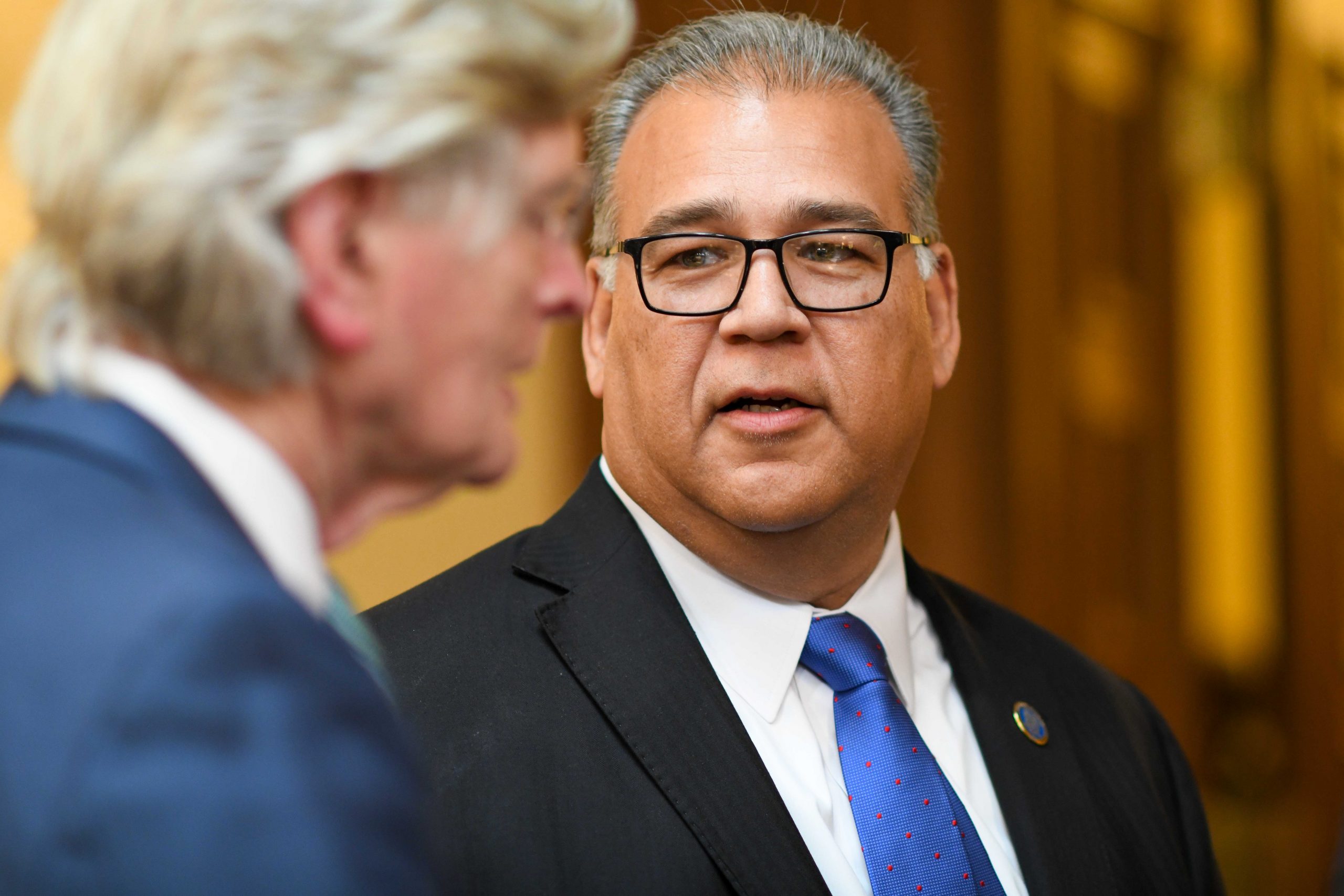
The Senate Judiciary Committee will consider a bill Monday that would create a new crime of political violence and more harshly penalize crimes found to be politically motivated.
State Sen. Doug Steinhardt (R-Lopatcong) first announced he would introduce legislation to address political violence in the days after the September assassination of conservative activist Charlie Kirk. Days later, state Sen. Brian Stack (D-Union City) signed on to the effort, though the text of the bill wasn’t released until earlier this month.
The bill makes political violence a separate charge from the underlying crime; a person found assaulting someone based on their political identity, for example, would be convicted and sentenced under a count of assault and a count of political violence. The political violence charge can not be merged with the underlying crime, mandating separate sentences.
“It is the intention of the sponsor to penalize the increased tendency for actors to resort to violence to redress political grievances,” the bill reads. “The legislation is not intended to create restrictions to free speech. The incidence of attacks on individuals or groups of individuals on the basis of apparent or perceived political affiliation or expression is escalating according to experts in the field of political violence.”
Political violence charges will be one degree higher than the underlying charge. If someone is charged with a second-degree assault that is found to be politically motivated, they would also be charged with a first-degree count of political violence. A first-degree political violence conviction would lead to a prison term between 15 years and 30 years, according to the bill.
The bill includes the creation of a Political Violence Review Board tasked with investigating alleged violations of the political violence law and identifying disparities in its enforcement. The board, according to the bill, would ensure transparency and oversight into political violence prosecutions.
The board would consist of 11 members: the Senate president, Senate minority leader, Assembly speaker, and Assembly minority leader each recommend two members to the governor, and the governor appoints three of his own. The board’s members would serve four-year terms.
Steinhardt and Stack both serve on the Senate Judiciary Committee — the latter is chairman of the committee.
Several shocking instances of political violence in 2025 have prompted state legislators to look for improvements in security and legislative solutions. In addition to Kirk’s killing, Steinhardt, Stack, and others have pointed to assassination attempts against President Donald Trump; the killing of former Minnesota House Speaker Melissa Hortman and her husband (as well as the shooting of Minnesota state Sen. John Hoffman and his wife); an arson attack at the residence of Pennsylvania Gov. Josh Shapiro; and the attempted assassination of Supreme Court Justice Brett Kavanagh.
“This political hate crime bill protects everyone—Conservative, Liberal, and Independent,” Steinhardt said in September when first introducing the bill. “No person should fear hate-fueled political violence for expressing their opinion, and anyone who resorts to such violence to silence that opinion will suffer the full weight of the law. Hate-fueled political violence hurts everyone and erodes the very principles on which our Republic was built.”
The Senate Judiciary Committee will also consider a bill that would strengthen penalties against people convicted of cyber-harassing public servants and their families. Stack, the sponsor of the bill, has been the target of Leroy Truth, a rabble-rousing livestreamer suspected of having ties to North Bergen Mayor Nick Sacco, a Hudson County rival of Stack. Truth, whose real name is Leonard Filipowski, was charged with assaulting a Union City police officer last month, and Stack has allegedly received death threats from people citing Filipowski’s content, a Union City attorney told the Jersey Journal.
That bill would turn cyber-harassment, currently a fourth-degree crime, into a third-degree crime when targeting public servants or their families.
