


 Listen to this article
The basics:
Robert Wood Johnson University Hospital in New Brunswick, together with Rutgers Cancer Institute of New Jersey, introduced an innovative technology to help early detection of lung cancer, the leading cause of cancer deaths in the United States.
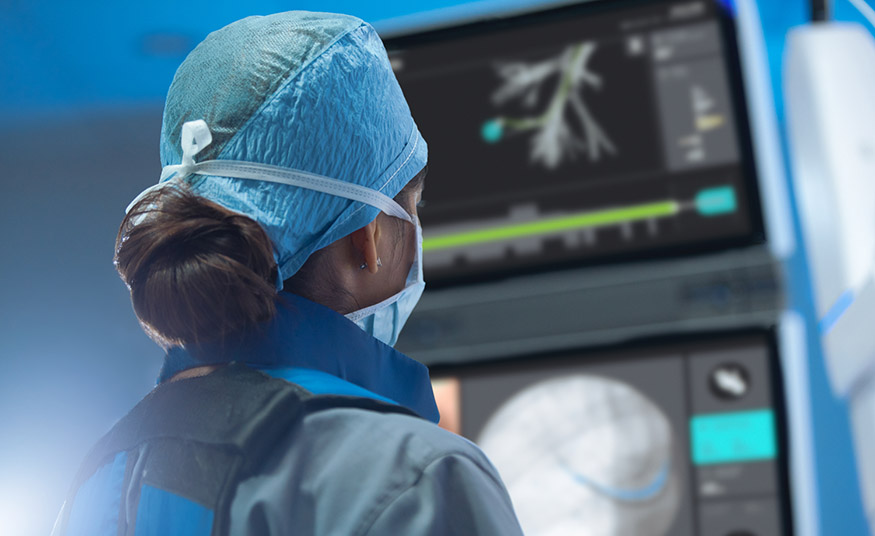
Ion robotic bronchoscopy enables interventional pulmonologists and thoracic surgeons to diagnose lung cancer earlier and more precisely, according to a Dec. 11 from RWJBarnabas Health.
The robotic-assisted system allows specialists to biopsy small, hard-to-reach lung nodules — including those located in the peripheral lung, where more than 70% of cancerous growths occur. The technology uses shape-sensing and robotic guidance to navigate all 18 lung segments and acquire tissue samples with high precision through a minimally invasive approach.
The Ion is available at several other RWJBarnabas hospitals across the state, as well.
“Early detection and diagnosis are critical for lung cancer patients,” said Dr. Neil Ninan, director of pulmonary medicine, Southern Region, RWJBarnabas Health. “This technology is an important advance that helps us identify and access small, difficult-to-reach nodules and more easily perform biopsies enabling earlier diagnosis that can potentially lead to better outcomes for patients.”
A deadly disease
Lung cancer accounts for about 1 in 5 of all cancer deaths, according to the American Cancer Society, which gave 2025 estimates for the disease:
- About 226,650 new cases of lung cancer (110,680 in men and 115,970 in women)
- About 124,730 deaths from lung cancer (64,190 in men and 60,540 in women)
In fact, lung cancer is more common than colon cancer, breast cancer and prostate cancer – and is responsible for more deaths than those cancers combined.
Here in New Jersey, nearly 5,800 people each year are diagnosed with lung cancer.
But, again, early detection is the key. Nationally, 1 in 4 patients with lung cancer receive an early-stage diagnosis, where meaningful survival is achievable.
‘Significant benefits’
That is why technology like this is so critical.
“This technology offers significant benefits to individuals who are at high risk for lung cancer such as current or former heavy smokers, patients who have nodules present in difficult-to-reach areas, and patients with a history of cancer who have suspicious nodules that are currently being monitored,” said Ninan.

Patients with a lung cancer diagnosis also have access to expert thoracic oncologists and surgical oncologists from the Jack & Sheryl Morris Cancer Center, the state’s only freestanding cancer hospital, which NJBIZ has reported extensively on.
“Adding robotic bronchoscopy to our wide range of capabilities further demonstrates our academic medical center’s commitment to pursue every possible option to fight cancer,” said Andrew Evens, deputy director for clinical services, Rutgers Cancer Institute, and chief physician officer, Jack & Sheryl Morris Cancer Center and Rutgers Cancer Institute. “Our patients can be assured that they have access to outstanding clinical care, researchers, clinical trials, advanced therapies, and cutting-edge treatments.”
In addition to these offerings, RWJUH and Rutgers Cancer Institute promote early detection of lung cancer through its Lung Cancer Screening Program. More details are available here.
