


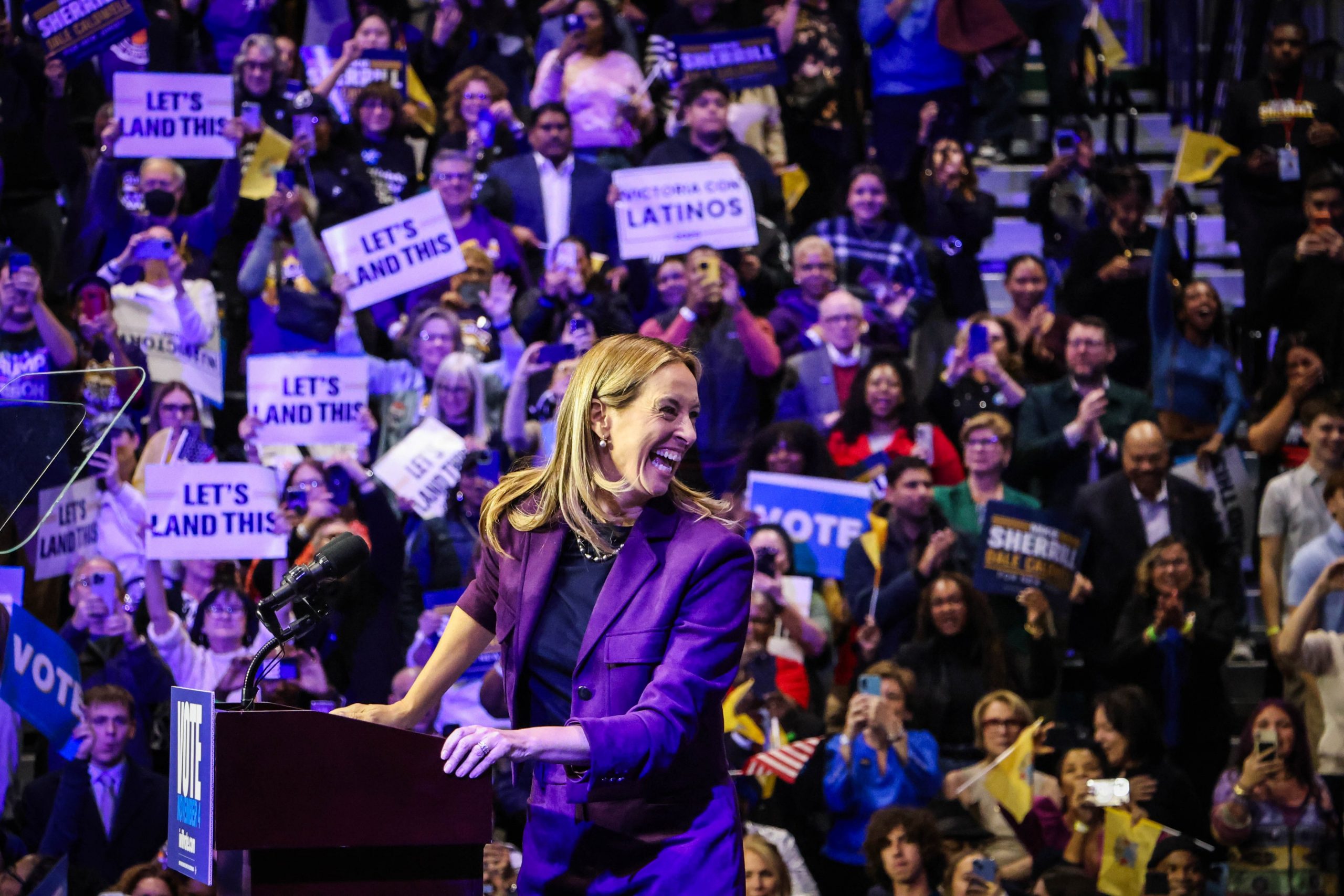
Since Trenton became the state capital of New Jersey in 1790, every newly elected governor has taken their oath of office in that city.
But Gov.-elect Mikie Sherrill will change that 235-year-old tradition, opting to take the oath of office in her home county of Essex, with her inauguration as New Jersey’s 57th governor set for noon on January 20, 2026, at the New Jersey Performing Arts Center in Newark.
The decision is a feather in the cap of Essex County Executive Joseph DiVincenzo, who will host a gubernatorial inauguration in Essex. By skipping Trenton, Sherrill, perhaps inadvertently, sends messages that she won’t conduct business as usual, that she’s an agent of change, and that the legislature will follow her lead and not the other way around.
New Jersey PAC has a seating capacity of 2,800, about 1,000 more than the Patriots Theater at the War Memorial, the site of every gubernatorial inauguration of a first-term governor since 1932.
The new venue makes it unlikely that the State Senate will travel back to Trenton for a late-afternoon session in advance of Sherrill’s inaugural festivities that evening. That means Sherrill shouldn’t expect day one confirmations of any cabinet members – all will begin their tenures in an acting capacity.
Sherrill will become the first since William Livingston took the oath of office in Princeton, where the legislature met during the Revolutionary War, not to become governor from Trenton. Livingston, New Jersey’s first governor, served from 1776 until his death in 1790. During his tenure, the state established the first capital in Perth Amboy. The legislature relocated the state capital to Trenton in 1790.
The lone exception to Trenton inaugurations was Christine Todd Whitman, who took her oath of office for her second term at NJ PAC; the facility had opened three months before. The War Memorial was undergoing renovations at the time and was unavailable to Whitman.
In her inaugural address, Whitman said she had “made it a hallmark of my administration to part from tradition,” and said her decision to take the oath in Newark was a celebration of Newark’s “true renaissance.”
“Here, in a hail which trumpets our belief that the arts are an integral part of any civilized society and every proud state; here, on the edge of a new century, a new millennium — a new tomorrow,” Whitman said.
Sherrill will become the state’s second woman governor and first Democratic woman governor. Whitman, a Republican, endorsed Sherrill a week after the primary election.
The last governor to be administered the oath of office in the statehouse was Morgan Larson in 1929.
After the state constructed the Soldiers’ and Sailors’ Memorial Building in 1930, subsequent gubernatorial inaugurations were held there, starting with A. Harry Moore in January 1933. The building is now commonly known as the Trenton War Memorial.
Traditions have changed over the years: Governors Richard Hughes and William Cahill, the state’s first Catholic governors, celebrated Masses at St. Mary’s R.C. Church in Trenton, on the morning of Inauguration Day. Later, governors shifted to the historic Shiloh Baptist Church in Trenton. Chris Christie began his day with a Mass at Cathedral Basilica of the Sacred Heart in Newark before heading to Trenton.
Whitman also used the Cathedral Basilica in Newark for an interfaith service, but that was not without controversy because of Whitman’s views on abortion. Theodore McCarrick, then the Archbishop of Newark, consulted with the Vatican and permitted Whitman’s use of the cathedral.
Gov. Phil Murphy called his swearing-in “The Phil Murphy Inaugural Experience, with a weekend of events across the state leading to his inauguration.
