

 Listen to this article
The basics:
- BioNJ CEO Debbie Hart discusses public-private partnerships such as HELIX in New Jersey
- Her organization weighs impacts of federal tariffs and health policy uncertainty
- AI seen as a major opportunity for drug development
- Manufacturing, workforce training and funding top BioNJ priorities
This continues NJBIZ’s two-part conversation with Debbie Hart, president and CEO of BioNJ, as the discussion shifts from recent momentum in New Jersey’s life sciences sector to the forces shaping its next chapter.
In the first installment of this conversation, Hart reflected on a year defined by major ribbon cuttings and groundbreakings, the impact of the Murphy administration’s innovation agenda, and clear signs that companies are continuing to invest and expand in the state despite uncertainty in capital markets and at the federal level.
In part two, the conversation turns to collaboration and policy — from large-scale public-private partnerships such as HELIX in New Brunswick to the challenges of navigating federal tariffs and regulatory signals. Hart also weighs in on the growing role of artificial intelligence in health care and drug development, manufacturing and workforce trends, and BioNJ’s priorities as it works to support companies across the full life sciences continuum in the year ahead.
“Yeah, I do see it and firmly support it,” Hart told NJBIZ of the public-private partnerships such as HELIX and others happening around the state and in her sector. “It’s the way that we need to operate. It’s a global economy. It’s a global industry, specifically in life sciences. New Jersey is a leader and needs to remain a leader. And I think the things that have happened – you mentioned the HELIX, in terms of bring academia, health care, life science companies and technology, and venture funds and investors all together in one place, and in a really special place.
“In terms of a place like New Brunswick, where there’s a train line right in there. There’s a large population. There’s academia. There is health care. There’s talent. Just bringing it all together is really important – and we’re just thrilled to see it happening. It’s always been happening but happening at a whole new level.”
Navigating tariffs
The topic then shifted to federal level and how it has been to navigate the tariff environment.
“Interesting is one word,” said Hart. “Let’s put this on the table. We share the Trump administration’s passion for cutting costs to patients – making sure that patients can afford their health care and then access their health care. So, we are all in when it comes to that – patients can’t wait, as we say at BioNJ. And obviously, anyone who’s in the industry – that’s why they’re doing it, to get therapies and cures to patients. There’s that.
“Some of the specifics and the pathways – they’re creating uncertainty in many cases, which is difficult for the industry to continue to grow and thrive when you don’t have certainty,” Hart continued. “When you’re not sure what the markets will be. And, unfortunately, they’ve been in a bad way for any number of years now – coming out of COVID and very unpredictable.
“And combine that with some of the things that are happening in terms of policy at the federal level – it’s created a pretty difficult environment.”
She said she is hopeful it will sort itself out and land in a positive way for patients.
“But, again, scratching our heads a little bit,” said Hart.
Explaining the science

The discussion continued on federal policy under the Trump administration. Hart weighed in on the announcement by Health and Human Services, helmed by Robert F. Kennedy, Jr., placing a warning label on Tylenol (produced by Summit-based Kenvue) about potential connections to autism.
“We all stood up and took notice, of course,” said Hart, noting the ripple throughout the industry. “At the end of the day, the studies just don’t support the claims. So, our job is to promote the science and to explain the science – and to make sure that folks understand it. The industry, of course, stepped right up and has been doing that ever since.
“The concern is, where, for those who aren’t hearing the science – they don’t get have access to the information that is needed to understand that, in fact, the science isn’t there to support what the claims were. Concerns that there might be pregnant people who are not taking Tylenol when they need it. So, they’re risking themselves in other ways. It’s very concerning. But the industry stepped up and explained – and we’re hopeful that the science will prevail.”
[O]ur job is to promote the science and to explain the science – and to make sure that folks understand it.
– Debbie Hart, BioNJ president and CEO
On artificial intelligence, Hart said the potential is immense and noted how, in many cases, the industry is still trying to figure it out a bit.
“The potential in terms of health care savings – it’s just monumental,” she said. “And will take time to develop and play out and have it be available in a way that everyone can understand it and access it and implement it in a way that helps drug discovery; helps drug development; helps drug commercialization.
“But the potential is immense. Part of the challenge is – because there’s so much out there and there’s, in certain cases, a void of information. And how do you navigate that and make sure that you’re picking the winners? It’s a challenge.”
On the horizon
Over the last few months, BioNJ held several notable events, such as the Manufacturing Summit in September, AI & Digital Health Day and C-Suite Summit, both in October, and more. The gatherings offered the opportunity to bring together industry leaders and key stakeholders for valuable discussions, insights and much more.

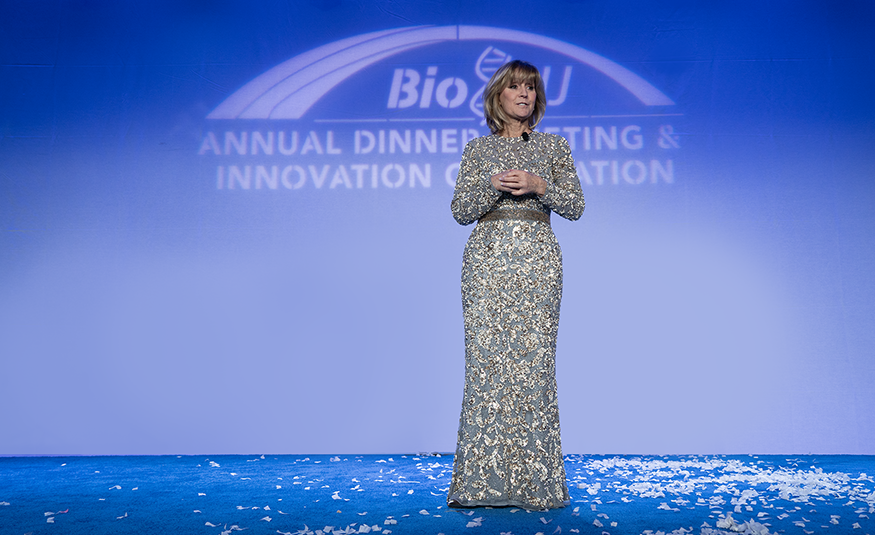
In February, BioNJ holds its annual Dinner Meeting & Innovation Celebration. The organization announced Dec. 17 that Genmab President and CEO Jan van de Winkel will be awarded the prestigious Dr. Sol J Barer Award for Vision, Innovation, and Leadership.
Hart discussed areas within biopharma and life sciences she finds particularly exciting and where there is potential for growth.
“Manufacturing, in general – sort of, the changes and the opportunity and the momentum that we have here in New Jersey on that front, just in general, is pretty exciting,” she said. “Cell and gene therapy manufacturing are, certainly, important. We do have a role in that here in New Jersey, fortunately.
“I think one of the cool things that’s happening in terms of development of any of the areas of technology and the industry, at large, is some of the things that are going on at the state level in terms of training through the Department of Labor, through the New Jersey Council of County Colleges,” Hart said, referencing the NJ BioFutures program.
“Talent is our number one asset here in New Jersey. And we need to make sure that we’re continuing to develop it. I think programs like that will, indeed, help move that forward. So, that’s exciting for sure.”
Getting the word out in 2026
So what are Hart and BioNJ focusing on in the new year and beyond?
“Because it is such a strange time, we are very policy focused for right now,” said Hart. “We’re obviously doing the other things, too. But very policy focused. For five or more years now, we’ve had an initiative to make sure that we are helping to explain the value of medical innovation – at a time when it seems to be less and less understood in certain circles.
“And so, we will be ramping up that work through our messaging and our speaking – and our placement of stories, and that sort of thing. Because it’s just really critical. If we don’t tell the story, who’s going to tell it?”
Hart said this is “absolutely” a critical time to get the message out – now more than ever.
Supporting startups
“And then, the other thing – because funding is in such a strange place right now. There are early-stage companies who need support – and our mid-stage companies who need funds and access. So, we’re doing everything that we can to make sure that, if there’s a job to be done that’s appropriate for us – if there’s a role, we will take it, in order to make sure that everyone can access what they need.
“Another pathway opportunity to support companies – we have the entire continuum of the industry. So, the very largest of the large biopharma, the mid-tier companies, and down to a man or a woman, a molecule. Making sure that they’re all talking to each other, so that they can collaborate,” Hart continued. “They can look for opportunities. There might be more acquisitions – that sort of thing.
“We are very cognizant of our job and our role when it comes to making sure that our companies have what they need in terms of funding level as well.”
