


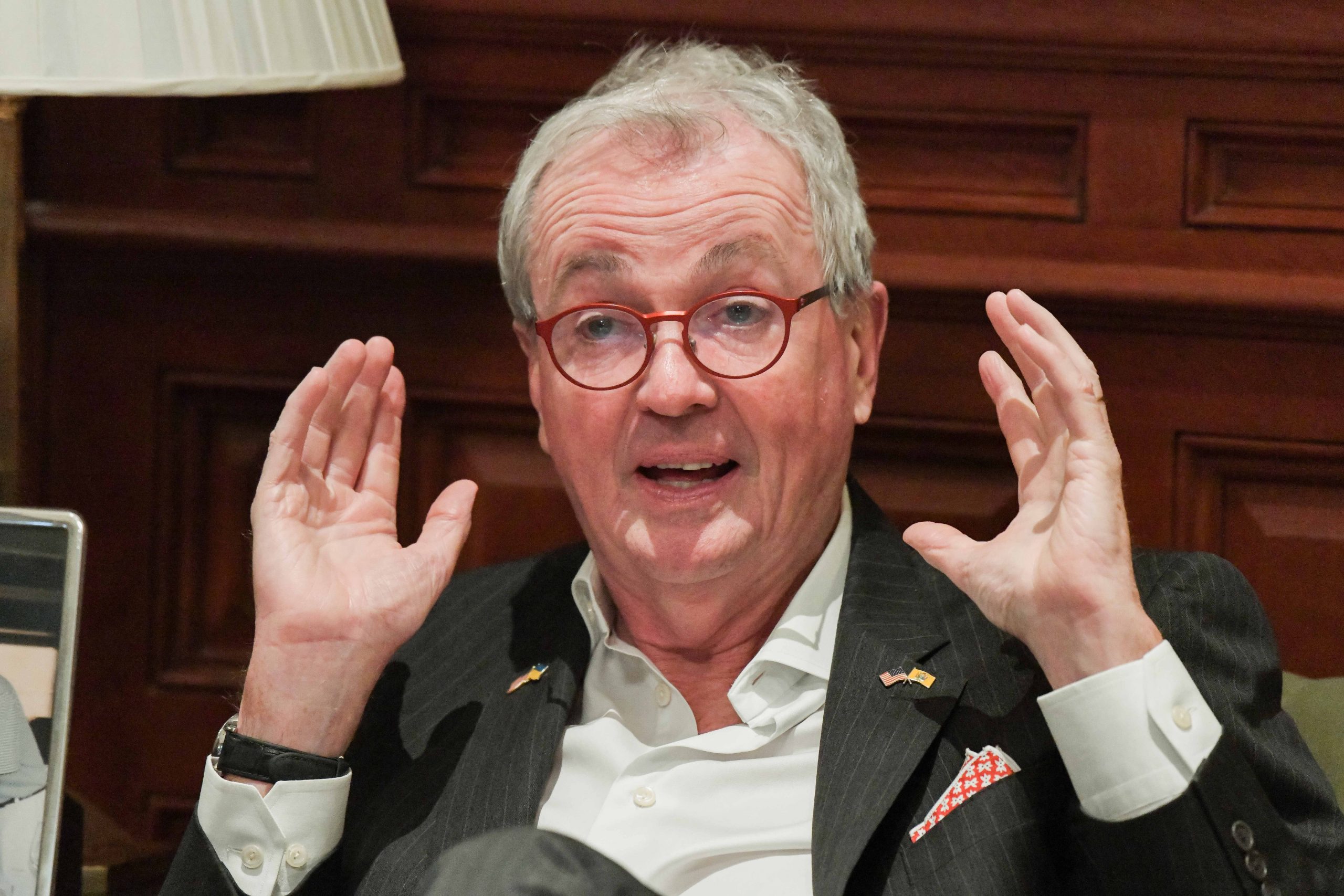
As Phil Murphy prepares to exit after eight years as governor, an air of satisfaction emanates in his office: “We did what we said we’d do,” goes the refrain from the governor and his allies.
NJ Transit? “We batted a very high batting average, much higher than we used to.”
Covid? “No victory laps here,” but “there’s no question we saved lives.”
Regrets about appointing Matt Platkin as attorney general? “None.”
Frustration with senatorial courtesy, which delayed the confirmation of some of his nominees and prevented others from being confirmed at all? “It is a very good system.”
New Jersey has vexed governors for decades — perhaps the last governor to finish two full terms happy with their time in office was former Gov. Tom Kean, who left office in 1990. But Murphy, who admits his administration wasn’t flawless, still leaves the statehouse content with his performance and with a legacy to hang his hat on.
The Murphy administration, with the help of a Democratic legislature, raised the minimum wage, legalized recreational marijuana, earned the state consistent credit rating upgrades, and fully funded the pension system. Murphy argues his administration was America’s most progressive over the last eight years, and says it was surely the most progressive administration in New Jersey’s history.
High property taxes, the Covid pandemic, and national political trends nearly cost Murphy re-election in 2021, but he squeaked by Republican Jack Ciattarelli to become the first Democratic governor to win re-election in New Jersey in more than four decades. And though his record faced scrutiny during last year’s gubernatorial campaign, Democrat Mikie Sherrill dominated. She has shown no interest in dismantling his legacy, unlike Ciattarelli.
In a sit-down exit interview with the New Jersey Globe’s editor and reporters on Monday, 15 days before Gov.-elect Sherrill will take office, Murphy said he achieved all but a handful of his initial campaign promises — 50 of 52, to be exact. The governor has even hit the airwaves with that message: Stronger Fairer Forward, a nonprofit organization aligned with Murphy, launched a six-figure ad buy earlier this week.
“We did what we said we’d do,” Murphy says in the ad. In his interview with the Globe, the governor put forward a different angle on the same idea: “We were who we said we would be.”
Read the New Jersey Globe’s full interview with Governor Murphy here.
What went right
“I’m thrilled I did it.”
When asked what he hopes a summary of his governorship will say 100 years from now, Murphy said he hopes it states he fulfilled his promises and plucked the state out of turmoil. Agencies have granted the state nine credit upgrades in the last three years; Murphy and legislators have increased the minimum wage from $8.60 per hour to $15.92; and the state increased K-12 school funding by nearly $4 billion.
“We didn’t bait and switch. We turned the state around … particularly economically, but also shrinking inequities,” he said.
Before the interview, Murphy’s team distributed a series of documents with dozens of accomplishments: expanded paid sick and family leave; $4.3 billion in property tax relief in this year’s budget; $13.6 billion in foreign investment and $2 billion in film and TV investments in the state; 250,000 new jobs.
The state has also fully funded the pension system for five straight years, a feat not matched since 1996. The state has made $47 billion in contributions to the system during the Murphy years.
Despite the economic achievements, the cost of living in New Jersey, particularly energy rates, was top of mind for voters and campaigns alike in last year’s gubernatorial race. Murphy said that economic concerns will forever be a “perennial” issue in New Jersey, but that last year’s focus on energy rates and health costs was novel.
“It costs too much,” he said. “What’s notable for me, at least, is for the first time in my memory, property taxes have been knocked off the top of the list.”
Officials cut some $150 million in health benefits for state employees last year to address rising premiums in the State Health Benefits Program. The health plans for local government employees are in greater danger; officials worry that premium increases and the departure of many local governments from the program have sent it into a “death spiral.” Murphy agrees.
“We’ve made, I think, constructive changes to the State Health Benefit Plan, working in tandem with the unions and other stakeholders,” Murphy said. “I regret that we could not make more progress with the Local Plan. I worry a lot about that plan and its solvency.”
As for expensive electricity costs, he blamed two “exogenous” culprits: President Donald Trump and PJM Interconnection, the region’s power grid operator. He criticized the Trump administration for suspending offshore wind projects while energy demand continues to outpace supply, and Murphy and other regional governors have previously accused PJM of mismanaging the grid.
“Energy prices and health care premiums have each skyrocketed. Again, neither specific nor unique to New Jersey, but that’s a reality,” he said. “We’re not immune to it.”
The Murphy administration helped establish two long-controversial industries: sports betting and marijuana.
After a yearslong legal battle that preceded his governorship, Murphy signed a 2018 bill to legalize sports betting, including on mobile apps. Murphy, in fact, placed the state’s first legally sanctioned sports bets that year, betting $20 that Germany would win the World Cup and another $20 that the New Jersey Devils would win the Stanley Cup. Neither bet cashed.
Sports betting has become a significant revenue source for the state; New Jersey officials expect to rake in nearly $1 billion from casinos this fiscal year, a figure driven by the proliferation of online sports betting. But experts agree that easy access to sports betting increases gambling addiction and bankruptcy rates, particularly among young men; per the Philadelphia Inquirer, calls to a gambling addiction helpline have more than doubled in New Jersey since 2021, and the nearly 900 callers in 2024 averaged about $34,000 in gambling debts, draining life savings and retirement accounts.
Murphy said that with the benefit of hindsight, he still would have legalized sports betting under the logic that black-market gambling would continue regardless of its legal status, so it’s important to build a legal framework around it.
“We’re not inventing sports betting,” Murphy said. “Chris Christie wrote a very good piece on this a couple of months ago after the NBA scandal came out, and his point was to remind folks that having a legality and structure and rules of the road around this is, in fact, really important relative to what you would have if you had only the black market.”
The governor said sports leagues should “rethink the intimacy” between themselves and the gambling industry, but placed more blame on the ubiquity of cell phones, saying the damage is “unspeakable.” On Thursday, Murphy signed legislation restricting the use of cell phones in K-12 schools, a top policy priority of his final year in office.
“I don’t know this from my own personal experience, but I know it from personal experience: [betting] is within your reach illegally as well,” Murphy said. “My bigger issue is more addiction to personal devices as it is addiction to sports betting. I’m not denying the latter is a concern, but I wish we could have controlled the devices earlier on.”
The governor said he considers legalizing weed to be in the same category as sports gambling. Murphy signed a bill legalizing recreational marijuana in February 2021, a little more than three years into his first term, after a series of complex negotiations with the state legislature and the overwhelming success of a statewide legalization referendum in 2020.
When asked what he would have done if he could have bypassed the legislature, he said he simply would have raised the minimum wage, legalized marijuana, and instituted a millionaire’s tax sooner. “I don’t sit here with a list” of things he wishes he had gotten done, he said.
What went wrong
“With all due respect to the bears, we’re gonna protect the humans first.”
A governor’s defining moments are often not chosen, but instead imposed on them. Nothing from Murphy’s tenure emblemizes that better than the sudden arrival of the COVID-19 pandemic, which arrived partway through his first term and lingered into his second.
The governor, following the lead of public health officials still trying to get a grasp on the virus, shut down New Jersey’s nonessential businesses and operations, as did most other governors. The Murphy administration faced criticism over its handling of the pandemic in state-run nursing homes, culminating in millions of dollars in settlements and a federal report that found negligence and dysfunction were at least partly to blame for the deaths of scores of veterans in those homes.

The pandemic struck during a moment of personal struggle. Murphy was diagnosed with a cancerous tumor on his left kidney just before the pandemic and rushed his post-surgical recovery to return to work. He said the chaos of the pandemic’s early days, when experts didn’t yet know whether masking was effective or how to handle grocery shopping, limited the state’s ability to respond quickly to the crisis.
“I just wish we knew more early on,” Murphy said. “I’m not alone in that one.”
Still, he argued his actions ultimately saved lives in the state writ large and that the pandemic could have been much worse. Murphy said that, as far as he is aware, New Jersey is the only state to commission an investigation into its handling of the pandemic, a report over which it held no influence. The report’s 33 recommendations, he says, leave New Jersey better prepared to handle a similar emergency.
“That is a playbook that I wish we had had that will be there for the next generation,” he said.
Another thorny issue: the long-beleaguered NJ Transit system. During his first campaign for governor, Murphy promised to fix NJ Transit if it killed him. When asked about that comment eight years later, Murphy jokingly reached for his wrist.
“Hold on,” he said. “I’m putting my finger to my pulse. … I’m alive.”
A couple of “Summers of Hell” marred NJ Transit’s record over the past few years, but Murphy argues the system’s operations have improved on the whole since taking office. The governor said the system left to him in 2018 faced engineer shortages, crumbling stations, and poor performance rates. Now those issues have “either completely changed or [are] in the process,” he said.
“I think the most misunderstood story is the arc of NJ Transit. Here’s what I do not begrudge: You take a train to Trenton, the train’s late, you miss this meeting, and you’re pissed. Well, I cannot blame you. I’m pissed too,” he said. “But people forget where it was and the arc of where it is now.”
Murphy said it’s unrealistic for a transit system to bat 1.000. He said that NJ Transit is batting in the upper .900s right now. The Murphy administration says NJ Transit trains have run on time more than 90% of the time over the last six months.
He also argued that many of NJ Transit’s top difficulties are outside of the state’s control. The Summers of Hell were at least partly caused by sagging overhead catenary wires on Amtrak-controlled railroad tracks. State officials lack the authority to renovate those tracks single-handedly, so Murphy said the onus rests on Congress to fully fund Amtrak and its infrastructure.
“I think the big thing — and Mikie will be very good at this, because the Amtrak funding story is a congressional one — is we need to root aggressively for federal funding out of Congress for Amtrak,” Murphy said. “That, to me, is the big X-factor.”
On the campaign trail, Sherrill gave a harsher assessment of NJ Transit. She gave the agency an F grade in a debate last year and said she’d push the agency to improve its communication with commuters. She hasn’t yet announced who will run NJ Transit after she takes office.
The agency will face its biggest test in years when the World Cup visits MetLife Stadium in East Rutherford. Throngs of international fans could push the system to its limits, but Murphy is confident it’ll hold its own. Murphy pointed to a series of Taylor Swift and Bruce Springsteen concerts, as well as to the Club World Cup, a smaller-but-still-major soccer tournament last summer that served as a test run for the high-capacity and tight-security events New Jersey will see this summer.
“I’m highly confident — I would say supremely confident,” he said.
When asked what he failed to complete during his tenure, he pointed to a couple of missed objectives: he managed to establish a public bank in New Jersey, but not to the scale he envisioned. He also felt forced to reinstitute New Jersey’s bear hunt after close calls between bears and humans after non-lethal efforts to contain the bear population failed.
“We had to put the bear hunt back on, which I wasn’t happy about doing, but we almost lost some folks, including kids,” he said. “So with all due respect to the bears, we’re gonna protect the humans first.”
And Murphy’s effort to reform the state’s liquor license system, a relic of an earlier era that allocates a limited number of licenses to each municipality, never fully came together. Murphy gives himself “partial credit” for a few reforms he did get through, but a broader overhaul of the system, he said, fell apart because the “vested interests” who already hold licenses were too hard to overcome.
Still, he expressed optimism that more holistic reforms may come one day: “This should happen, and therefore I think it will, but it won’t be in the next 15 days,” he said.
When probed on whether he regretted nominating any state officials during his tenure, the governor named Tiffany Williams Brewer. After being appointed executive director of the State Commission of Investigation, the Asbury Park Press reported that she was living in Maryland and working as a law professor at Howard University in D.C. She resigned last January.
“I mean, come on, man, you’ve got to be straight,” Murphy said. “And she got very defensive about it at the end. Like, okay, I didn’t move you to Maryland.”
The push and the pull
“This is a different animal than the first time around.”
When Donald Trump recaptured the presidency in 2024, Murphy took the podium and told New Jerseyans that he would cooperate with the president when possible and resist the president when necessary. Over the past 12 months, it’s been much more of the latter.
Murphy and Trump grew closer during the Covid pandemic; the governor says that during that time, the pair consistently spoke multiple times a day. Murphy said Jared Kushner, Trump’s son-in-law and adviser, was especially helpful during that time. The Trump administration sent key resources, including ventilators, to New Jersey, and Murphy even visited the Oval Office in April 2020 to thank the president.
“It’s hard to think about that now, but they really were good,” Murphy said. “Jared was particularly good, but the president was very helpful and supportive.”
And though Murphy prominently supported former Vice President Kamala Harris during her presidential campaign last year, the relationship with the president wasn’t wholly severed. A week after the 2024 assassination attempt against Trump, the governor visited him at his Bedminster golf club to offer well wishes.
Murphy says that, in his second term, Trump is a “different animal.” He’s criticized the One Big Beautiful Bill, the Trump-led congressional legislative package signed into law last summer, and expressed shock at what he views as consistent overreach from the president.
“This time around, it’s very different,” Murphy said about Trump. “There’s nobody holding him back.”
Attorney General Matt Platkin has led or joined dozens of lawsuits against the Trump administration, many of which have found success in federal court. Murphy praised Platkin’s work, even requesting $1 million from the legislature to allow Platkin to hire more lawyers to challenge Trump. He said he’s sure Sherrill will continue that with her attorney general-designate, Jen Davenport.
“I think he’s done a particularly strong job in battling Washington,” Murphy said of Platkin. “That has been literally a daily [task], either suing, joining the suit, leading a suit, joining a letter, joining an amicus. Whatever it might be, he’s been outstanding at that.”
The governor said that, despite rumored tensions, he does not regret appointing Platkin as attorney general: “I know there’s a lot of noise around some stuff, I’m not going to get into that,” he said.
During First Lady Tammy Murphy’s 2024 Senate campaign, Platkin told a federal judge that he would not defend the county line in court; the Murphy administration said attorneys general are obligated to defend the constitutionality of statutes, sparking a public rift. Murphy’s campaign fizzled; the judge ultimately abolished the county line, ushering in a new era of New Jersey politics; and Senator Andy Kim ascended to the upper chamber. (Platkin has since taken on a number of other powerful New Jersey figures, most notably South Jersey Democratic boss George Norcross.)
That Senate campaign, which the governor was closely involved in, goes down as a curious part of the governor’s legacy. Murphy said that he believes the first lady could have won with more spending, but didn’t want to spark a major battle within the party. He also argued that women, especially the wives of elected officials, face more challenges in launching a campaign.

“She feels, and I completely agree, as do her advisers, that she could have, if she chose to, won that campaign. It would’ve cost more money. That wasn’t going to be the issue,” the governor said. “The gating factor was it was going to be an explosion within our party at a time when, I don’t want to put words in her mouth, she felt strongly that that’s kind of the last thing we needed.”
Murphy rejected the premise that the first lady was not a progressive candidate, at least in comparison to Kim. His wife disagrees with his opposition to congestion pricing in lower Manhattan, he noted, and her support for single-payer healthcare is more progressive than his views.
“I think her campaign platform was more progressive than our administration,” he said. “There might have been a false argument about who was progressive or who wasn’t. She was pretty damn progressive — more progressive, in fact, than I am.”
Murphy proudly calls his administration the most progressive in the Garden State’s history, but he expressed no interest in tearing the system down. He endorsed the State Senate’s practice of senatorial courtesy, the unwritten rule that requires all Senate-confirmed gubernatorial nominees to get signoff from their local senators. His support for the practice continues despite the stonewalling of some of his nominees, like acting Comptroller Kevin Walsh, who has served in an “acting” capacity for six years.
“Look at the lack of congressional input on anything that’s going on right now in Washington, or the screen door confirmation process that was in the Republican-controlled Senate,” he said. “I think it’s a very good thing.”
But the abolition of the county line allowed for the election of legislators who don’t view the system the same way. Kim has taken an interest in challenging political machines from the U.S. Senate, and he’s joined by a handful of new assemblymembers who won their primary elections openly flouting those same machines.
The governor said he disagrees with the “stone-throwing” style of progressives who want a transformation of the system, instead arguing that transactional politics can achieve many of the results that progressives want.
“You go, ‘The system’s not perfect.’ I get it, but are you going to work in the system and get shit done, or are you going to throw stones and complain about how the system’s not right?” he said.
Murphy said he has no regrets about signing a bill reforming the Open Public Records Act, a piece of 2024 legislation that critics say harmed government transparency. The bill was part of a “broader agenda,” he said, allowing him to reach agreements with legislators on his priorities.
“I didn’t run for governor to revise OPRA. That was not a passion of mine. And when you are dealing with other branches of government and you’re trying to put through a very big, comprehensive agenda, you have to compromise,” he said. “You end up doing things that — ‘Gosh, that wasn’t a top 10 priority of mine, but I know it is for someone else’ — that’s making the sausage, as they say.”
He offered a similar take on the county line.
“If you accept, and I think we can prove this factually, that we’re the most progressive administration in the history of the state and in America the past eight years, I therefore reject the premise completely that we need to burn the house down,” Murphy said. “That’s why I was always ambivalent on the [county] line. I mean, I just never saw the line the same way the purists have seen the line. They’re welcome to their opinion. I’ve got mine, and I know what we’ve accomplished.”
And despite his disagreement with the “stone throwers,” he said most of the state’s advocates understand that he sees a bigger picture.

“I do think if you’re a purist and your expectation is, “You have to bat 1.000 in my particular lane,” … you’re probably, if not definitively, going to be disappointed at some point,” he said. “There are, I’m happy to say, many more advocates who are pragmatic and understand that there’s a bigger narrative.”
On Tuesday, Murphy will deliver his final State of the State address as governor before a joint session of the legislature, where he will tout his accomplishments and, almost surely, say, “We did what we said we’d do.”
After his governorship ends, though, it’s time for a break. Murphy said he and the first lady will leave the country to travel the night of Sherrill’s inauguration, first to Europe, then to some warmer climates. And though he’s not done with politics, he and the first lady haven’t decided what will come next.
“We’ll do something,” he said. “I don’t know what it is, but we want to make sure we’re not tired and sprinting through the goal line and then collapsing and making a decision. We’re not going to do that. We’re going to wait a while.”
Unlike the U.S. Constitution, the New Jersey Constitution sets no limits on nonconsecutive terms for governors, meaning Murphy could return in four or eight years and do it all again. When reminded of this, the governor was quick to reject the idea.
“This is it.”
