


 Listen to this article
The basics:
- New Jersey K–12 districts must restrict non-academic student cell phone use starting in 2026–27 school year
- Law requires statewide guidelines with flexibility for local boards of education
- Builds on $3M Phone-Free Schools Grant Program supporting early-adopter districts
- Early results show improved student focus, engagement, school climate
In one of his final and, perhaps, most impactful actions before he ends his time in office, Gov. Phil Murphy signed bipartisan legislation Jan. 8 requiring all New Jersey school districts to adopt policies restricting student use of cell phones and other internet-enabled devices during the school day.
The new law will take effect statewide beginning in the 2026–2027 school year.
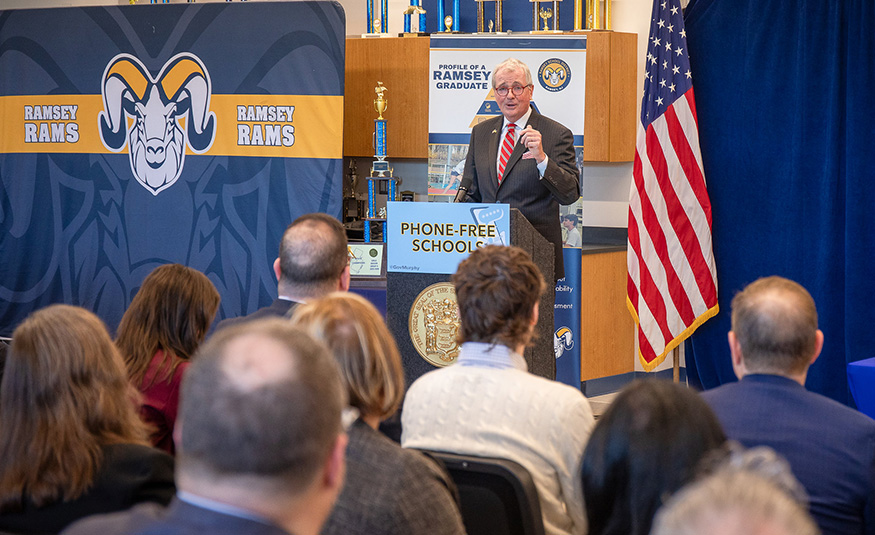
Murphy signed the Senate Bill 3695/Assembly Bill 4882 during a visit to Ramsey High School, one of several districts already implementing bell-to-bell phone restrictions.
The governor first announced his intention to pursue phone-free schools during his 2025 State of the State Address. He later highlighted the effort during a visit last year to Woodbury Junior-Senior High School, where local leaders reported improvements in student engagement and school climate.
“I am incredibly honored to be here this morning because we are celebrating one of the final and, I would argue one of the most consequential pieces of legislation I will have the honor of signing into law as governor,” said Murphy in Ramsey. “And this legislation is all the more meaningful because it will advance at least two of our biggest priorities – number one, preserving New Jersey’s best-in-the-nation, public education system.
“And secondly, strengthening our state’s reputation as a global leader in responsible innovation.”
A place for learning
“With today’s bill signing, we are ensuring New Jersey schools are a place for learning and engagement, not distracting screens,” Murphy said. He cited positive results in districts, such as Ramsey and Woodbury, including improved focus, reduced anxiety and stronger student interaction.
The law requires the New Jersey commissioner of education to issue statewide K–12 guidelines restricting non-academic use of personal, internet-enabled devices during regular school hours, on school buses and at school-sponsored events, with limited exceptions. Local boards of education must adopt policies aligned with those guidelines, while retaining flexibility for implementation.

The Department of Education is now reviewing its existing guidance. It expects to publish statewide guidelines in mid-January. The updates will outline best practices for secure device storage, staff training and equitable enforcement.
The legislation builds on steps already taken by the Murphy administration, including a $3 million Phone-Free Schools Grant Program that awarded funding to 86 districts to support implementation.

“Recent research has made it clear that access to cell phones in school impacts both student mental health and academic achievement,” said Education Commissioner Kevin Dehmer. “Today’s legislation provides the framework to ensure every classroom is place for learning and free of distractions. Our guidelines will be practical, developmentally appropriate, and equitable, helping districts create policies that protect student focus and well-being.”
Support from Sherrill
Gov.-elect Mikie Sherrill praised the law as a major step to protecting kids.

“Our young people are facing a mental health crisis – but, we all know that when children put the screens down, their mental health and academic results improve,” said Sherrill. “I look forward to implementing this important legislation and continuing to make progress on kids’ online safety and holding Big Tech accountable for the content they push towards our kids.”
Sen. Paul Moriarty, D-4th District, and Assemblywoman Rosy Bagolie, D-27th District, served as prime sponsors of the legislation. They said the bill responds directly to concerns raised by educators and parents — and will help create productive, distraction-free learning environments.
“The signing of this pivotal bill into law is momentous for the well-being and productivity of students across New Jersey,” said Moriarty. “By developing a commonsense approach to help mitigate the hugely negative impacts of unrestricted cell phone and social media use in schools, educators will be well equipped to fight the crisis facing their students to guarantee a productive, distraction-free learning environment.”
“The signing of this pivotal bill into law is momentous for the well-being and productivity of students across New Jersey,”
— Sen. Paul Moriarty, bill sponsor
“This bill will help ensure that students are fully engaged in learning while they are in the classroom,” said Bagolie. “While internet-enabled devices such as smart phones and tablets can be useful tools, the rise of social media has unfortunately caused significant harm to our learning environments.
“Our legislation is a response to what parents, teachers, and principals have consistently told us—they need our support. A4882 will ensure that we are doing our part to help educators and our students succeed.”
Case study
“At Ramsey School District, our phone-free policy has fundamentally transformed the daily experience for our students,” said Andrew Matteo, superintendent of Schools, Ramsey School District. “By removing the distraction of the cell phone, we have reclaimed the classroom as a space for deep academic focus and critical thinking. Teachers report a significant increase in student engagement during instructional time.
“Since implementing our phone-free policy at Ramsey, the ‘sound’ of our hallways has changed.”
At the bill signing, Massimo Randazzo, a senior at Ramsey High School, shared his thoughts on the adjustment to this policy.
“Like most students in New Jersey, I’ve grown up with a phone in my pocket. It’s been there through classes, practices, meetings and nearly every part of my daily life. That context matters,” said Randazzo. “Because for teenagers, phones aren’t just distractions. They’re integrated into how we communicate, how we socialize, and how we manage our time.
“So, when my school introduced a phone-free policy, it wasn’t a minor adjustment; it was a real shift in how the school day functioned.”

Here and now
He said his classmates were frustrated when Ramsey High School introduced the Yonder pouches to place the phones in.
“We’re used to having constant access to our phones. And adjusting to life without them during the school day wasn’t easy,” Randazzo explained. “But once that initial resistance passed, the impact became clear. In class, focus improved. There was no buzzing in pockets, no quick checks on your desks, no waiting for the bell just to see who texted.
“In the hallway, something else changed. Instead of everyone rushing between classes staring at screens – students actually started talking to one another,” he continued. Randazzo noted that it made students more social and present. “What surprised me most was the effect on stress. I assumed being separated from my phone would make the day more tense. Instead, it created a break from non-stop notifications, group chats and the pressure to always be available.
“The school day felt calmer and more manageable.”
I assumed being separated from my phone would make the day more tense. Instead, it created a break from non-stop notifications, group chats and the pressure to always be available.
– Massimo Randazzo, Ramsey High School senior
Randazzo added – that’s not to say that everything went perfect.
“The adjustment was difficult,” he continued. “And there were practical inconveniences. Checking emails, coordinating with coaches or even making plans with friends for after-school required new habits. But we adapted. And we adapted faster than we expected.”
As he closed his remarks and reflected on the process, Randazzo said the takeaway is simple.
“It didn’t fix everything. But it changed how the school day actually felt. As a senior, it helped me be present – stay where my feet are – and focus on the people and moments around me during my final months at Ramsey High School.”
