

For thousands of runaway slaves in the 18th and 19th centuries, the Underground Railroad represented freedom and a chance at a new life with 16 stops on that journey located in some taverns, churches and privately owned farms in Bucks County. VisitBucksCounty.com has a listing that includes driving directions to see all 16 sites.
One of those vital sites in the safe, hidden network of Underground Railroad locations was Mount Gilead Church, the first all African-American congregation in Bucks County.
“It was a critical step in the Underground Railroad,” said Megan Connelly, spokesperson, VisitBucksCounty.com. “Between 1830 and 1840, the congregation expanded from 70 people to 162. These runaway slaves from Maryland, Delaware and the Carolinas used the cover of Buckingham Mountain to create their new lives and live remotely.”
Gather Place Museum in Yardley.
(Courtesy of Visit Bucks County)


The capture of their most famous churchgoer, Benjamin ‘Big Ben’ Jones, who was sold out by a white resident in the area, became one of the major rallying cries for the congregation. And gave them more incentive to continue their church and make sure it was stronger than ever, said Connelly.
The small church and a graveyard still exist today in Holicong near New Hope, and visitors are invited to attend services there.
Said Connelly: “There are rumors that Big Ben is buried there, though others say he is presumed to be buried in a potter’s field by his wife Sarah, somewhere near the Bucks County Almshouse.”
Bucks County’s stops on the Railroad played an important part in the runaway slaves’ journey northward to freedom, said Connelly, noting many of the 16 places from Upper to Lower Bucks can be seen today during Black History Month.
During the revolution, armaments were stored in the cellar of 1870 Wedgwood Inn, a Victorian bed & breakfast at 111 W. Bridge St., New Hope. But during the time of the Underground Railroad, it was used to hide people on their journey north. A hatch in a gazebo on the property led to an underground tunnel system connected to the canal and providing access to Lumberville.
Another safe haven is the almost 200-year-old African Methodist Episcopal (AME) Church in Bensalem. Robert Purvis, an abolitionist and one of the founders of the American Anti-Slavery Society, rowed slaves up the Delaware River from Philadelphia to take refuge at the church and farm in Bensalem. He aided some 9,000 fugitives, making him one of the most important figures in Bucks County associated with abolitionism.
Beautiful iron grillwork on the porch of the Archambault House at 115 E. Washington Ave. in Newtown Borough, is a recognizable sight and it is one of the stops on the Underground Railroad during the Civil War. Joseph O. Archambault, a dentist, innkeeper, postmaster and former owner of the Brick Hotel, helped slaves keep moving north.
“This is a private residence and should be viewed from afar,” said Connelly.
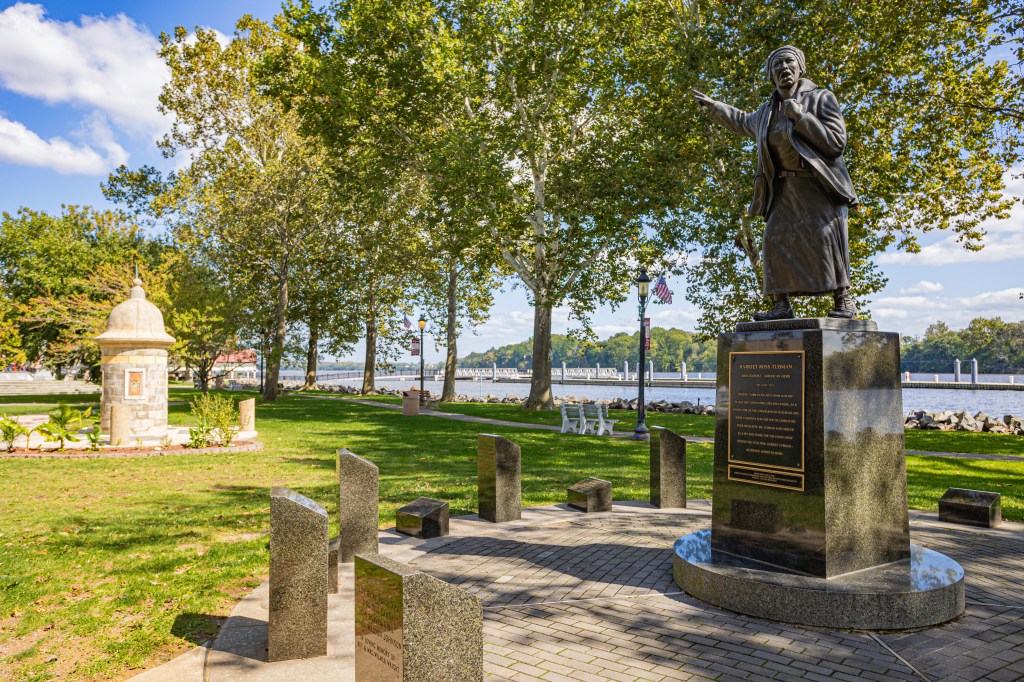
While in Lower Bucks, the interested should visit Bristol Borough, she said, because the area provided many hiding spots for slaves on the move. “The people of Bristol purchased freedom for runaway Dick Shad, who had been a slave for 20 years in Virginia,” said Connelly. Nearby in Yardley, several locations likely were hiding places for runaway slaves – like a white-columned mansion on South Main Street in Yardley Borough; a shop on Afton Avenue; a house on South Canal Street, and a stone house on River Road. Yardley also is home to the Gather Place Museum on African-American and abolitionist history. Another can’t miss is the Harriet Tubman Memorial Statie.
“Tubman dedicated her life to freedom and is perhaps one of the most well-known conductors on the Underground Railroad,” said Connelly. “She risked her life a number of times before the Civil War to guide nearly 70 slaves northward.”
Due to the distance between stops – up to 10 miles – Richard Moore’s stone house in Quakertown became one of the most important stations on the journey. A local potter, Moore became known for hospitality and many runaway slaves were directed to his home on South Main Street, now a private residence.
Other Underground Railroad stops in Bucks County exist with extraordinary history, with more information available at VisitBucksCounty.com.
