


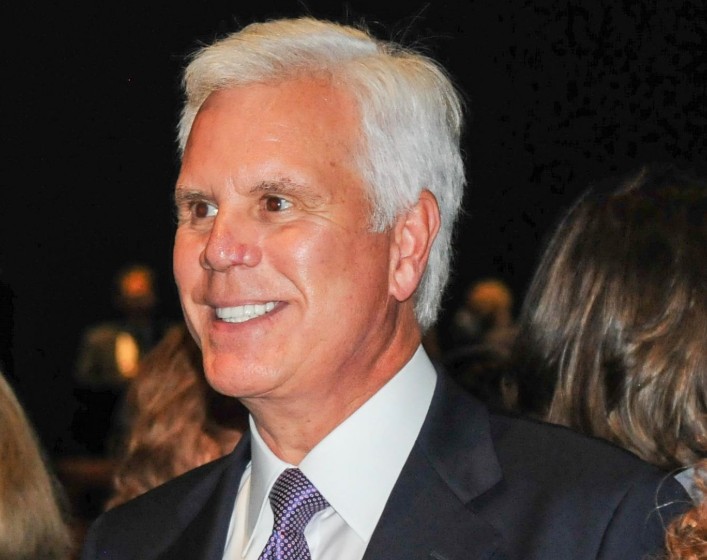
Prosecutors in the embattled state Office of Public Integrity and Accountability might have knowingly and improperly used federal wiretaps that went well beyond the scope of a judge’s approval to indict Democratic powerhouse George E. Norcross III on racketeering charges last year, court documents show.
The indictment against Norcross and others was dismissed last February by Superior Court Judge Peter Warshaw in February 2025, and a state appellate court panel upheld the dismissal less than two weeks ago. Now, questions about the tactics used by the attorney general’s office in the Norcross matter could validate claims of prosecutorial misconduct in other cases over the last eight years.
In 2016, the Federal Bureau of Investigation obtained an interception order for Norcross’s work and cell phones from the U.S. District Court for the Eastern District of Pennsylvania. Federal prosecutors never charged Norcross and would not confirm that any investigation existed.
When New Jersey prosecutors later wanted to use those federal wiretaps in a state grand jury, they were required to obtain a separate federal court order. The order, signed by U.S. District Court Judge Paul Diamond in September 2022, authorized the use of wiretap evidence only for specified offenses.
Court filings show that the OPIA exceeded Diamond’s authorization and used wiretaps to support additional charges not included in the state target offenses presented to the federal judge.
A brief filed in December 2024 sought to suppress evidence obtained from wiretaps, arguing that the attorney general’s office never produced the complete wiretap application more than five months after the indictment was filed, nor did it produce the judge’s court order.
“The state seeks to shield from view what it had no hesitation wielding as a public sword,” said Lee Vartan, who represented co-defendant William Tambussi. “The state made a deliberate decision to prosecute this case in the press … The state opened this case by liberally quoting from protected discovery material, including the federal wiretaps.”
A July 2024 letter from Assistant Attorney General Michael Breslin to Chief Division Counsel Carmen DiMario of the FBI’s Philadelphia office regarding the use of wiretap materials, but that communication contains substantial redactions. That letter was sent nearly three weeks after Attorney General Matt Platkin announced the indictment against Norcross and others. Breslin quit his job as an FBI agent in the same office and now works as a deputy attorney general. He had one case on his plate: prosecuting Norcross and his co-defendants.
A spokesperson for the attorney general’s office declined to discuss the latest allegation of prosecutorial overreach.
“We do not comment on criminal matters,” the spokesperson said.
It’s not entirely clear whether this represents a dramatic change of policy under the state’s new attorney general, Jennifer Davenport. Under Gurbir Grewal and Platkin, the office didn’t hesitate to hold press conferences and issue press releases to detail allegations made by state prosecutors.
The OPIA has faced multiple allegations of prosecutorial misconduct.
Last April, Superior Court Judge Reema Sethi Kareer dismissed an indictment against former Phillipsburg Councilman Frank McVey, who was accused of threatening Mayor Todd Tersigni in a blackmail scheme. McVey spent years trying to pry discovery from the state, which was legally obligated to provide it but purposely and strategically withheld it.
Because then-Warren County Prosecutor James Pfeiffer once represented Tersigni in a private legal matter, a judge disqualified the entire prosecutor’s office from participating in the case against McVey. That included Anthony J. Robinson, the first assistant prosecutor and a former top lawyer at the OPIA. The allegations forced McVey to drop out of the mayoral race and lose his council seat.
In 2022, Superior Court Judge Marilyn Clark found that Deputy Attorney General Eric Cohen omitted critical exculpatory evidence that might have benefited Saddle Brook Police Chief Robert Kugler in a 2021 grand jury presentment that indicted him for permitting police escorts for funeral processions to cemeteries involving a local funeral home he owns. At the time, Kugler was the Republican nominee for Bergen County Sheriff.
Cohen is no longer employed by the attorney general’s office and is now in private practice.
At least five former state and federal prosecutors have accused Deputy Attorney General John Nicodemo of prosecutorial misconduct, alleging that he held back evidence from defense attorneys and lied to grand juries. Nicodemo, a cartoonish failed dinner theater actor, is no longer a line prosecutor and now occupies a desk job at the Division of Highway Traffic Safety, albeit at his old salary.
Thomas Eicher, the controversial founding director of the Office of Public Integrity and Accountability, stepped down in March 2024. Harsh criticisms of the OPIA – along with Eicher, deputy director Anthony Picione, and the number three lawyer, Peter W. Lee, also departed – Platkin went outside the OPIA structure to recruit Drew Skinner, a former Assistant U.S. Attorney for the Southern District of New York.
Skinner lasted 18 months, and Platkin picked Eric Gibson, a former federal prosecutor from the Eastern District of Pennsylvania, to supervise the state’s prosecution of Norcross.
Now, Davenport must decide if she will restructure the OPIA – and if she will retain Gibson.
Norcross is preparing to file a $100 million lawsuit against the state for malicious prosecution. The attorney general’s office said it will defend prosecutors from being targeted.
