


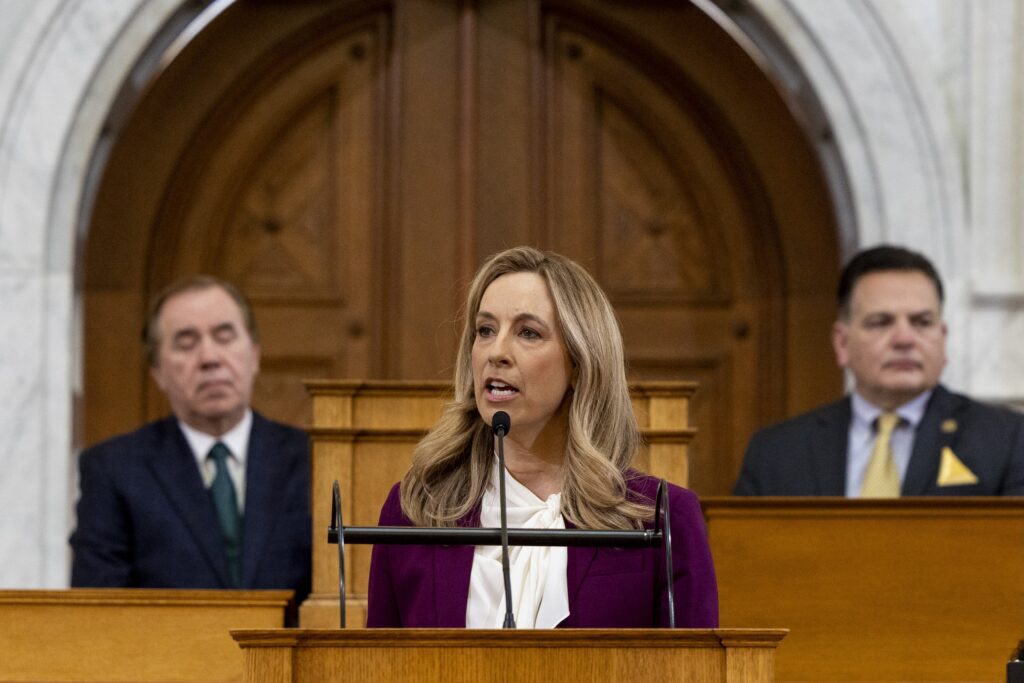
Gov. Mikie Sherrill on Tuesday called for the state to still spend more than it takes in through taxes and fees, but her plan largely avoids new and costly programs that would boost the state’s expenses. (Photo by Anne-Marie Caruso/New Jersey Monitor)
Gov. Mikie Sherrill proposed New Jersey spend a record $60.7 billion in her administration’s first budget plan, one underwritten by the removal of legislative spending additions and cuts to a property tax relief program championed by the Assembly speaker, among others.
In her first annual budget address to a joint Legislature, Sherrill on Tuesday called for the state to spend nearly $1.7 billion more than it takes in through taxes and fees, a slight decline from the structural deficit in the current fiscal year, but largely avoided new and costly programs that would boost the state’s expenses.
The spending gap marks a reduction from what Sherrill last week said would have been a $3 billion deficit absent cuts to state spending.
“If we do nothing, our entire $7.2 billion surplus will be gone in less than two years — and we’ll be another $750 million in the hole. Since our Constitution requires a balanced budget, failing to act now would trigger far worse in the future,” Sherrill said.
How a NJ bill to protect migrants has morphed since ex-governor’s veto
Sherrill, a Democrat, took office on Jan. 20.
Her budget proposal is just the start of New Jersey’s budget season. The plan now goes to lawmakers, who will spent the next roughly three months hosting budgets hearings before sending their own budget plan back to Sherrill for her signature or veto. The state must have a budget in place by July 1.
Sherrill’s plan would leave New Jersey’s surplus at $5.4 billion, roughly half of its pandemic peak but still far larger than the near-nothing surpluses New Jersey maintained for much of this millennium.
Sherrill is also seeking reductions to the nascent Stay NJ property tax relief program championed by Assembly Speaker Craig Coughlin (D-Middlesex)
That program, which promises to cut New Jersey seniors’ property tax bills in half and began issuing its first benefits this quarter, would see its maximum award reduced from $6,500 to $4,000 and its income eligibility cap slashed from $500,000 to $250,000.
Benefits from the senior freeze and Anchor property tax relief programs are counted against Stay NJ awards, and Sherrill proposed removing the extra $250 senior homeowners receive under Anchor, though they would still receive that money from Stay NJ.
“Stay NJ is a great program,” the governor said. “It keeps seniors, so often living on a fixed income, in their home. But it benefits households that make as much as $500,000 a year. I’m changing that, to safeguard Stay NJ for middle class seniors. If you make $250,000 or less, your tax relief is in this budget.”

The governor’s budget would maintain a full pension payment at $7.3 billion and fully fund the state’s school funding formula, bringing formulaic school aid to $12.4 billion. As was the case last year, the budget would cap school aid cuts to 3% of a district’s prior aid allocation and limit increases to 6%.
Though Sherrill’s proposal would increase tax obligations for some businesses, it avoids changes that would raise individual income tax burdens.
Her proposals would temporarily cap the amount of losses businesses are permitted to deduct from their state taxes at $1 million in a bid to control what Treasury officials said was an unintended jump in the write-offs after tax reporting changes former Gov. Phil Murphy signed into law in 2023.
Another change would limit the alternative business calculation deduction — another deduction used to write off business losses but one aimed at small firms — based on a business’s pre-tax income.
Businesses with less than $500,000 in gross income would see the benefit halved, while those making between $500,000 and $1 million would see it cut by 75%. Those that make more than a million would lose access to the deduction altogether
“The whole point was to level the playing field for entrepreneurs. But bigger companies started
A third change would impose a per-employee fee of between $325 and $725 on employers with at least 50 workers enrolled in NJ FamilyCare — that’s New Jersey Medicaid — based on the number of employees enrolled in the program.
Together, the three tax changes are expected to add about $750 million to state coffers.
Elsewhere, Sherrill’s proposal would cut some state spending across state government.
Overall, Sherrill’s budget proposes nearly $2.4 billion in cuts to existing line items. Of that, $700 million represents one-shot spending items in the current budget that were not due to recur in the fiscal year that begins July 1.
“The hard truth is we’re going to have to make some tough choices to deliver for people long-term. To get to affordability, we have to start with responsibility,” Sherrill said.
The governor’s proposal would, on net, cut about $110.3 million in aid to universities and the students that attend them. New Jersey’s four-year public colleges would get a $136.4 million reduction in operating aid. Among other things, those cuts are partially offset by increases in state aid for universities’ fringe benefit costs.
Sherrill’s budget plan introduces $3.3 billion in spending increases that would more than offset the cuts. New expenses for NJ FamilyCare account for the largest increases ($770 million), though additional funding for Stay NJ and funding for programs for those with developmental disabilities would also push up spending totals.
GET THE MORNING HEADLINES.
