

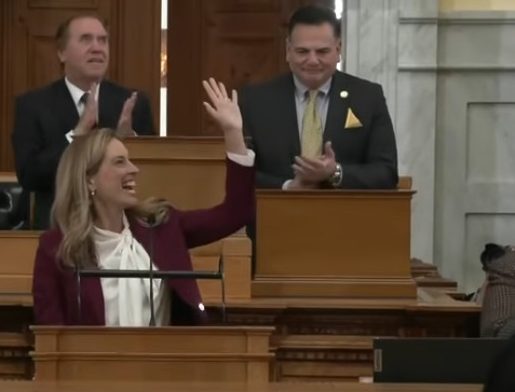
Gov. Mikie Sherrill delivered the following address to present her first budget to a joint session of the New Jersey Legislature:
Lieutenant Governor Caldwell.
Senate President Scutari.
Speaker Coughlin.
Majority Leaders Ruiz and Greenwald.
Republican Leaders Bucco and DiMaio.
Members of the 222nd Legislature.
Chief Justice Rabner and Judge Blee.
Members of the Cabinet.
Former Governors Christie, McGreevey, and DiFrancesco.
Former Lt. Governors Way and Guadagno.
Our brothers and sisters in organized labor, faith leaders, and friends.
My family – Mom, Dad, Ike, and Marit.
And my fellow New Jerseyans.
We’re here today to discuss a central issue of government: our budget.
But before we begin, I think it’s important to recognize the servicemembers killed or injured in the Middle East this month, and their families.
Please join me in a moment of silence.
[moment of silence]
And I’d like to give special thanks to all of our New Jersey National Guard troops and their family members, including two who are here today:
Krista Romano – whose husband, Tech Sergeant Seth Schoenfeld, has been with the Air National Guard for 17 years.
And Stefanie Garcia – who has served alongside her twin sister, Sergeant First Class Darlene Gomez, since they enlisted together when they were just 17.
Both Sergeants Schoenfeld and Gomez are now deployed in the Middle East.
Thank you all for your service.
And thanks to all of you for coming together in this chamber today.
Some people see government service as a job.
Some people see it as a calling.
Some are in it for the prestige; and sadly, others are in it simply to enrich themselves.
As I stand here, presenting a budget that relies on the hard-earned tax dollars of over 9 million New Jerseyans – it’s fair to ask why I’m in government service.
It’s because I know what well-run government can do. It’s life-changing.
And I know what people can lose when government fails.
I’ve seen it in my own family.
My grandfather’s parents lost everything in the Great Depression.
Through generations of hard work – fleeing a famine, starting a farm, selling cars in the suburbs – they built our family’s American Dream, only to lose it all, because of bad decisions by government that crashed our nation’s economy.
But my grandfather was young; and even though he started with nothing, he got drafted, became a pilot, and flew in World War 2. After the war, he joined the UAW and worked as a welder for years.
He raised eight kids in a tiny house with only one full bathroom – a house built by FDR’s Works Progress Administration, the WPA – eligible because of his service to our country.
When he and my grandmother got older, Social Security, Medicare and a good union pension meant my family didn’t go bankrupt caring for them. They even had a little left over for their kids.
In the swings of my grandfather’s life, I saw the two sides of government: what happens when it’s run poorly; and the promise of a government run well.
I stand before you because our country helped my grandfather succeed.
The fact that our family could go from having nothing, to me becoming Governor of New Jersey in just two generations, is what the promise of America is all about.
It’s why I’ve always been so proud to serve this country – in the Navy, at the U.S. Attorney’s Office, in Congress, and now as Governor of our state.
I’ve been thinking a lot lately about what service means, and what it means to lead.
I took my first oath to the Constitution as a teenager, and the lessons I learned then have followed me since:
Focus on the mission.
Find a way or make one.
The only easy day was yesterday.
Public service calls us to do hard things. But dedicated public servants, working day-in and day-out, are what make stories of opportunity like my family’s possible.
Unfortunately, though, today, we’re not creating enough of those opportunities.
Government hasn’t been working the way it can – the way it should.
And here in New Jersey, a broken budget is at the heart of so much of that.
For too long, too many in Trenton have taken the easy way out – opting for a quick fix, instead of laying the foundation for a solid future.
Last November, voters were clear:
They sent me here to be a different kind of leader.
To make their lives more affordable.
To protect our kids.
To make our government more accountable and change how business is done.
I take that trust seriously, so I got right to work.
I’ve signed 16 Executive Orders so far – freezing utility rate hikes, boosting energy supply, streamlining government, cutting red tape.
We responded to two historic snowstorms – we were prepared, we communicated, and we cleaned up.
Time after time, we’ve taken the Trump Administration to court – and we’ve won.
We’re fighting and winning for the Gateway tunnel and its thousands of jobs.
I just announced the state’s largest infrastructure investment in decades.
And that’s just my first month-and-a-half.
But the hard truth is: we’re going to have to make some tough choices to deliver for people long-term.
To get to affordability, we have to start with responsibility.
When we started this budget process, we were staring down an estimated 3-billion-dollar structural deficit for this year, or about 5 percent of state expenses, historically one of the worst budget gaps in the nation.
If we do nothing, our entire 7.2-billion-dollar surplus will be gone in less than two years – and we’ll be another 750 million in the hole.
Since our Constitution requires a balanced budget, failing to act now would trigger far worse in the future.
It could mean blunt cuts to public services, for everything from school funding to pensions.
It could mean credit downgrades and higher interest rates, pushing us deeper into debt.
And it could mean tax hikes for businesses and families.
I won’t let that happen.
I refuse to put off for tomorrow what we have to fix today.
Because right now, we’re facing a perfect storm of fiscal challenges; short-term and long-term, federal and state.
The Trump Administration is recklessly slashing critical programs –from healthcare and housing, to food aid and foster care, schools and infrastructure.
And yes, Trump’s massive cuts are blowing an immediate hole in our budget, hurting New Jerseyans.
At the same time, the covid-relief money is ending. Six years of emergency cash flooding in from Washington helped to paper over our very real fiscal problems.
Meanwhile, costs everywhere keep rising. It’s hurting families’ wallets – and increasing costs the state pays to provide healthcare, to fund schools, and to buy the utilities and services needed to serve New Jerseyans.
Trump’s devastating cuts. Covid relief drying up. Costs continuing to rise.
Those things have all collided to put us in this position.
But we also have to face the fact that for decades, previous administrations have allowed for business-as-usual in Trenton, and failed to find any real and solid fiscal footing.
There have been too many one-offs. Too many temporary fixes. Too little willingness to challenge what’s always been done.
As a result, the state budget has doubled in size since 2010.
Utility rates have skyrocketed, and leaders were slow to respond.
School funding has soared, but too many third graders still read below grade level, and kids’ mental health keeps getting worse.
Just look how pensions have been mishandled.
This year, we’ll spend over 7 billion dollars to fully fund our state pension system. New York, in comparison, spends 2 billion.
New Jersey owes nearly 6 billion a year in back-payments – because for or 30 years, other administrations, Democratic and Republican alike, simply refused to pay our bills.
I give Governor Murphy and many of you here a lot of credit for resuming those payments.
But if others had done their jobs – if they’d honored the promises made to public workers – we’d be paying 6 billion dollars LESS per year now.
Imagine what we could be doing with that money, if for 30 years, elected officials hadn’t mortgaged our kids’ futures.
Imagine what we could do for schools, healthcare, small businesses, law enforcement.
That’s the price we all pay.
And it’s what we have to come together to change now.
I promised a different kind of leadership. To do not what’s easy for me, but what’s best for our state.
That’s our duty as public servants.
It’s time to close the deficit the right way, structurally, so we’re not just plugging new holes every year.
It’s a simple lesson we learn as kids: You can’t spend more than you earn.
In these past weeks, my team and I have reached out to every member of this legislature, both Democratic and Republican.
I’m grateful how many of you have committed to tackling these tough choices together – so we can build a New Jersey that’s more affordable, accountable, and financially sound.
Today, I’m submitting to this legislature the most fiscally responsible budget that our state has seen in years.
It fully funds our pension system.
It does NOT raise taxes on individual New Jerseyans.
And it includes 2.6 billion dollars in budget solutions – nearly 2 billion in tough, necessary cuts; and over 700 million in new revenue from closing corporate tax loopholes.
Together, it’ll put us on the path to balancing our budget structurally, in 2028 and beyond.
And it rewards our tough choices with savings – savings we’ll invest back into lowering costs for New Jerseyans. Providing a better future for our kids. Building a government that’s accountable.
This budget is the path to getting our fiscal house in order.
And it’s a platform from which we’ll generate jobs and opportunity – for the working families who sent us here to fight for them.
New Jersey is the 22nd largest economy in the world. We have the best entrepreneurs and builders. The most scientists and engineers per square mile. The most courage.
The reason I take this work so seriously is I know we have a chance to build something incredibly special – if we make the effort to lay that foundation.
So here’s how we’ll get it done.
Our work starts by ending previous administrations’ bad habit of tacking last-minute giveaways onto each budget.
These days, we simply can’t afford that.
For example, in the final working days of the last Administration, New Jerseyans were stuck with nearly 3 billion dollars in extra spending – 2.5 billion in corporate tax breaks and 240 million in giveaways.
That can’t happen. We can’t afford that process anymore. It’s not accountable; it’s not efficient; it’s not what the people of New Jersey deserve.
I’ve spoken to leadership in both houses – we have to chart a new way forward.
And at the same time, this budget protects middle-class families, who are bearing the burden of soaring property taxes.
In fact, it provides the most property tax relief in state history: nearly 4.2 billion dollars next year.
Relief is essential.
And Stay NJ is a great program – it keeps seniors, so often living on a fixed income, in their homes. But it benefits households that make as much as 500,000 dollars a year.
I’m changing that, to safeguard Stay NJ for middle class seniors. If you make 250,000 or less, your tax relief is in this budget.
That’s going to save taxpayers hundreds of millions of dollars a year.
And we’ll target more relief to low- and middle-income senior renters, through the ANCHOR program.
That’s a fairer, more efficient use of taxpayer money.
And we’re also paring back some corporate tax breaks – capping the deduction that our highest-earning companies can take for net operating losses.
After COVID, more started claiming this deduction, to write off losses seen in those years.
It’s time to move on. We won’t keep shortchanging the future.
Limiting this loophole saves taxpayers almost 500 million dollars.
At the same time, some companies have been using a deduction that was introduced 15 years ago, to help small businesses weather the Great Recession.
It’s called the Alternative Business Calculation, and the whole point was to level the playing field for entrepreneurs. But bigger companies started using it, too.
So our budget limits that deduction to the actual small businesses it was meant for, capping eligibility at business income of a million dollars a year.
The car repair shop and the diner down the block are the ones who should benefit.
This fix will save another 120 million dollars a year – without taxing families a dollar more.
Altogether, the commonsense changes outlined in my budget will reduce our structural deficit by 1.2 billion dollars from its level last month.
Those savings will help plug the gap left by expired covid funding.
They’ll help protect the fundamental opportunities that Trump is trying to gut.
They’ll free us to invest in the future that New Jerseyans have asked us to build.
And they’ll help create a government that delivers for the people it’s meant to serve.
People like Tracy Porter, a union worker who’s been building the Gateway tunnel project.
I met Tracy last month at a rally in Secaucus, fighting for Gateway funding.
Tracy’s dad moved to New Jersey from Georgia in the Sixties.
He had a third-grade education, but he put himself through night school to start his own subcontracting business.
Tracy’s dad called New Jersey “the land of opportunities.”
Like my grandfather, he raised eight kids in a tiny place with only one full bathroom, this time in Newark.
Tracy worked his first construction job alongside his dad, helping to lay apartment foundations when he was just 11.
Years later, he joined a union, LiUNA Local 472. Over 30 years, he worked up and down the Turnpike, building many of the roads and bridges that all of us use every day.
Now, Tracy is putting his own kids through college. The youngest is a freshman, on the Dean’s List, studying psychology. He pays her full tuition.
I want to give Tracy a big hand – he’s here with us today.
But there’s a catch to Tracy’s story – something else that’s all too common.
Even though he loves and sees a future here in New Jersey, he doesn’t live here now.
He commutes from Pennsylvania, because the cost of living here is just too high.
I heard that same story again and again on the campaign trail as people would come up and tell me: “Mikie, it’s getting too expensive. I don’t know how I’ll afford to stay.”
People kept awake at night worrying about rising costs.
For them, affordability isn’t just a slogan; it’s a basic measure of whether they can live a secure life.
And when everyday expenses keep rising faster than paychecks, and leaders don’t respond, people lose faith in the idea that government can work for them.
I promised to change that – to lower costs for working families and stand up to the bad actors ripping them off.
How we respond is a key test of how well government does its job.
I started on Day One by taking action to lower utility costs – and in New Jersey, we have some of the nation’s highest.
Imagine you’re on a fixed income.
Imagine you’re Herb and Mary Michitsch. They’ve lived in their red brick house in Kenilworth for 55 years. Herb retired after 40 years as a manager for AT&T.
They saved their whole lives for a comfortable retirement, but now find themselves paying up to 400 dollars a month on electricity bills.
They’re both almost 90, and watching today on the livestream. Hi Herb and Mary!
I made a commitment to fight for people like them.
There’s no question that New Jerseyans are facing higher electricity bills because our regional grid operator, PJM, has seriously mismanaged it.
It’s failed to get enough power online to meet growing needs, and it’s been too slow in finding a way to manage new demand from data centers.
It’s left people like Herb and Mary holding the bag.
So, I declared a State of Emergency to freeze utility rate hikes.
And I signed an executive order to increase new power generation, to lower costs long-term.
We’re growing solar and battery capacity: in my first month-and-a-half, I’ve already approved six new projects. And we’re modernizing natural gas facilities and exploring the opportunities that new nuclear sites bring.
Because more power means more supply and lower costs.
But that’s not all that’s squeezing families.
We can’t make New Jersey more affordable until we make housing more affordable.
I’m a mom; I want my kids to be able to move back here – but not into my basement.
Home prices and rent have soared 60 percent in some places since 2020.
We have to increase supply, to bring costs down.
My budget moves to do that by protecting the Affordable Housing Trust Fund to the tune of 70 million dollars, so we can use that money as it was intended: to build housing that’s affordable.
It increases downpayment assistance for people looking to buy a first home – sometimes the first in their families to do so.
It helps us to brace for the impact of federal cuts to emergency housing programs, expanding our work to end homelessness.
And it supports programs to get vets into permanent housing. Because this is the year we effectively end veteran homelessness in New Jersey.
As a veteran, I know what those who served have sacrificed for this nation. The least we owe them is a safe place to live.
At the same time, there are new challenges in the housing market.
Rent these days can be set by algorithms that use your data to charge the highest price they think you can bear.
The same goes for groceries – where they switch prices based on things like time of day, or even your gender, or phone browsing history.
That means if you have to shop after work, when stores are crowded, you’ll pay more than if you’re free to shop at noon.
It means if the store knows you just searched for a certain product online, it might charge a higher price. That’s outrageous.
I’ll work with all of you to pass legislation limiting this kind of for-profit surveillance by Big Tech.
And when it comes to healthcare – we’re facing one of the biggest crises of our time.
We all know the healthcare system in America is broken.
Costs in New Jersey are among the nation’s highest, and that affects everything: families, businesses, schools, property taxes, the state budget.
And Trump’s cuts are about to make everything worse.
Because Washington refused to extend Affordable Care Act credits, nearly half-a-million New Jerseyans will see their premiums triple this year.
And because his H.R.1 law makes people jump through hoops to stay on Medicaid, 300,000 more New Jerseyans will be kicked off.
To prevent that, this budget invests in new technology to help people meet Trump’s burdensome paperwork requirements.
But many families will still lose coverage – and the cost of insuring them directly would be billions of dollars.
Instead of asking taxpayers to foot that bill, this budget looks to large employers.
It asks any company with 50 or more employees on Medicaid – companies like Amazon and Walmart – to cover their workers, which they should do anyway; or pay a fine.
That helps warehouse workers, cashiers, healthcare aides – people who keep our economy running.
It’ll reduce strain on hospitals, easing the expected surge in E.R. care, the most expensive kind.
And it’ll raise 145 million dollars a year, to cover Trump’s extra Medicaid costs.
But that’s just the start. As devastating as federal cuts are – New Jersey hasn’t done itself any favors by letting overall healthcare costs skyrocket for so long.
The bills are a burden to anyone who buys insurance, for themselves or their employees – and that includes the State, and local governments.
The State Health Benefits Program has been pushed to the brink, putting coverage for hundreds of thousands of public workers at risk.
So in the coming year, we’ll enact real reforms, with everyone at the table, to fix the program, keep it solvent, and bring down costs now.
We’ll also continue to change the way we manage prescription drug costs.
Today, a type of shadowy middleman, called a “Pharmacy Benefit Manager,” or PBM, sits between insurers, drugmakers, and pharmacies.
They drive up the cost of medications as much as 10 times, while padding their profits with secret manufacturer rebates and insider tricks.
Our state Medicaid program could save 20 million dollars if PBMs weren’t allowed to inflate the prices it’s forced to pay.
All New Jerseyans pay the price for that.
And PBMs harm independent pharmacists, too – dictating copays and pocketing reimbursements.
Pharmacists like Amit Sikka at Liberty Drug in Chatham, who’s here with us now.
I visited his pharmacy last year. It has been a fixture in the community for over 60 years, and now employs 20 people, as so many great small businesses across our state do.
I promised him I’d crack down on PBMs – reducing their power, and with it, the price of prescription drugs.
I intend to keep that promise, Amit.
I know many of you in this legislature have been doing great work on this, and I look forward to partnering with you to pass a comprehensive and historic PBM reform bill.
But the pain of higher costs doesn’t come just from big-ticket items like housing and healthcare. It adds up in small ways every day.
Take transportation, which costs the typical New Jersey family 14,000 dollars a year.
But as we see with New Jersey Transit, for example, riders aren’t always getting what they pay for.
This budget ensures there are no cuts to service. And it’ll help to fully modernize one of the oldest rail fleets in the nation – starting with 40 new rail cars and 250 new buses this year.
And shortly, we’ll be opening the brand new Portal Bridge, on the line from Newark to Penn Station –replacing a century-old swing bridge, finally ending the signal failures and delays.
And of course, I’m going to keep fighting for every dollar owed to the Gateway Tunnel project, the biggest, most urgent infrastructure project in America.
I’ll keep standing up for the thousand workers, like Tracy, who are already on the job, and the thousands more who will soon begin work.
A few other members of LiUNA Local 472 are here with us today – it’s been an honor standing with you all these past months!
I’ll also keep standing up for the 200,000 daily commuters for whom this project means finally knowing you’ll make it home in time to get your kids at daycare, or to have dinner with your family.
And we’ll keep fighting for the 20 billion dollars in economic growth it’s expected to bring.
If President Trump threatens it again, we’ll keep suing him – and keep beating him – in court.
I’m always going to stand up for workers.
And I’m always going to stand up for our kids.
When I think about the work we’re doing, when I recall my family’s path and the doors of opportunity that America opened for us – I always think about my kids.
I think about all of our kids, and the future we’re building for them.
I know parenting is hard. Parenting right now is even harder.
That’s why this budget invests in our children from the moment they’re born.
It expands the “Family Connects” home visitation program to EVERY county – so parents of all newborns can have a specially-trained-nurse visit them at home.
It invests in our state childcare program.
And it continues to fund the school formula with a record investment in K-12 education – although everyone in this room knows we’re not getting the bang for the buck that we need.
Evidence shows the huge benefits of shared services for things like special education, transportation, books, and software.
So this budget invests in and lays the groundwork for consolidating services and curricula.
It’s better for students, offering continuity as they move from elementary to middle to high school in one unified system. And it’s better for districts, providing needed savings.
At the same time, we’re investing in evidence-based literacy tools and high-impact tutoring programs that have launched in 300 districts since covid, to bring kids back up to speed.
They’re working: In Camden, math scores jumped 80 percent, and literacy scores doubled. In Franklin, 83 percent of students improved a full grade-level in math. In Elk Township, 74 percent improved a full grade in reading – and some improved as many as five.
But the pandemic not only affected kids’ learning; it had a huge impact on their mental health, and social media continues to make that worse.
Kids are struggling with pressures that didn’t exist when we were young: the always-on online culture, fierce competition, worries about school violence, and concerns about the future.
We know the current model of care has not been good enough for our kids.
So this budget sunsets it, and brings specialized, intensive mental health support back into schools, with a new program called “SPARK,” that meets students in their own environment.
That work is so important, especially given the impact of social media today.
My four kids are between the ages of 14 and 20. And I can tell you with certainty: our country is failing our children when it comes to protecting them online.
It’s personal – to me, and to millions of parents on whom Big Tech has dumped an impossible responsibility.
You’ve seen the commercials: the companies masquerading as good actors; providing parents with “tools;” making us feel like whatever happens to our kids online, it’s somehow our fault. We just haven’t used their “tools” right.
The truth is, a new platform or feature rolls out every day, with the most advanced algorithms designed to addict us all.
Trying to keep up with this would be a full-time job, and the platforms know it.
Not long ago, they started studying the effect that social media has on young people – and they suspended their research, because the early results were so bad.
Instead, we’re left hearing devastating stories from parents about the last thing their kids saw online. The last chat they had with AI as it told them how to take their own lives.
All while Big Tech CEOs and their companies become the biggest and richest in the world.
This isn’t just the Big Tobacco of our era – it’s worse.
And it’s exactly the kind of situation where government has a role to play to keep our kids safe.
But instead, Washington has walked away.
Not here. Not in New Jersey.
In my campaign last year, I outlined a full Kids Online Safety Agenda, to protect our children and hold Big Tech’s feet to the fire.
I look forward to working with you all, as you craft strong, evidence-based legislation to protect our kids and their future.
I also want to thank my friend, Adam Renteria and his mom, Robin, for joining us.
In just 7th grade, Adam went through some of the worst bullying and harassment that a kid could face, which the apps should’ve flagged.
I met Adam last year and asked him to share his story.
With hard work, he went from a kid who for months couldn’t even come out of his room – to a star speaker at events across the state. He served on one of my transition action teams and gave policy recommendations.
Thank you, Adam – I’m so proud of your leadership.
This budget funds our new Office of Youth Online Mental Health Safety and Awareness – which I launched, as promised, with an executive order on my first day as Governor.
And it creates a Social Media Research Center, to study the impact of digital technology on young people’s mental health.
In New Jersey, we’re not going to rely on Big Tech to come clean about the harm these technologies cause.
We’re going to lead the way, and give overworked parents some relief.
I believe we’re at a unique moment in history, a time of enormous change.
Rather than fix what’s wrong with government, Washington is looking to dismantle it.
These investments are an important first step in building an efficient, transparent government that delivers for working people.
They reduce costs to taxpayers.
And there’s another reason to do this – to support the dedicated public servants who support us all.
New Jersey has the finest public servants in the nation.
We just saw it again, as we went through both the storm of the decade, and then the storm of a generation, in less than one month.
The reason we’re all sitting here not thinking much about that, is because of the thousands of people who worked through the night in the cold – plowing roads, clearing train tracks, fixing downed powerlines in near white-out conditions.
Some of them are here with us today from IFPTE Local 194, the Turnpike workers’ union – thank you!
The best way we can thank them is to build a government that’s worthy of their service.
I’ve only been in office a month-and-a-half. I know we have big things to do together.
And while this is the most fiscally responsible budget our state has seen in years, it’s just the start.
We can’t solve every problem overnight.
But with this budget, we’ve almost halved the structural deficit, avoided raising taxes, and fully funded pensions.
We’ve given notice that special interest giveaways are over, and moved resources to help working people instead.
And this is the budget we can afford.
If there are things you think we need to add – come to me with places we can cut.
It’s simple math: any additions require subtractions.
At the same time, this budget does make us less vulnerable to Washington. Less vulnerable to a President who puts himself above the country, enriching himself at everyone else’s expense.
From his illegal cuts to Gateway, to his illegal tariffs, to his skyrocketing gas prices – whenever Donald Trump gets involved, costs go up, jobs get lost, and working people suffer.
But while his Administration is demonstrating how much damage a poorly run government can do, we’ll prove how much strong state leadership can transform lives.
That’s what we’re building together here.
I know these changes aren’t easy. But that’s what public service is all about.
I was taught in the Navy that leaders have a responsibility: not just to tell people what to do, but to listen. To think not of themselves, but of the mission.
They call it servant leadership.
And I see it around this room – in many of you, who’ve served this state with honor, sometimes for a lifetime, sacrificing time with your families, putting your communities first.
I see it in your leadership:
Speaker Coughlin and President Scutari – in their commitment to this institution, its members, and our work together to make this the session where our state finds sure footing.
I see it in members of the Budget Committee– who’ll be staying here for the coming months of hearings and hard work, until we see this through. Thank you!
I see it in my Republican friends – I worked with many of you when I was in Congress, and I know there are plenty of things we all agree on.
And I see it in the military veterans and the Gold Star mom here on the floor today, serving in this legislature.
I see it in all of you – people who’ve stepped up throughout your lives, ready to do hard things together, for the good of this country and the good of our state.
Today, reality is forcing us to change not just the way we do our budget, but how we approach our work. It’s asking us to make hard choices, for the sake of a better future.
But one of the best things about New Jersey is that when we’re called to it, there’s no challenge we’ve backed away from.
I’m in this with you for the long haul.
Sometimes there’s a mentality that says: “Why do you care? You won’t be here in 10 years.”
Maybe it’s because when you have kids, you suddenly have a longer time horizon.
The whole reason I’m standing here, submitting this budget, even serving in this office, is because of my four kids. Because of all of our kids.
The decisions we make now, the foundations this budget builds, will have an impact for decades, long after all of us have left the statehouse.
It means doing things differently – but it’s worth it.
Because it’s worth building the kind of government that really does make New Jersey – as Tracy’s dad said – the land of opportunity, for generations to come.
This is an affordability budget, rooted in fairness for hardworking families.
It answers first to people around their kitchen tables, not in the boardroom or the backroom.
It lays the groundwork to expand opportunity, and tackle even harder problems in the years ahead.
I want to build a future where working families can afford to live and thrive here.
Where the world’s brightest minds can innovate and build here.
Where government delivers for the people and businesses it’s meant to serve.
In life, you rarely get to choose your mission; you rise to it.
This is our mission. This is what we’re building. This is the time to do it.
Thank you.
God bless the great State of New Jersey.
And God bless the United States of America.
