


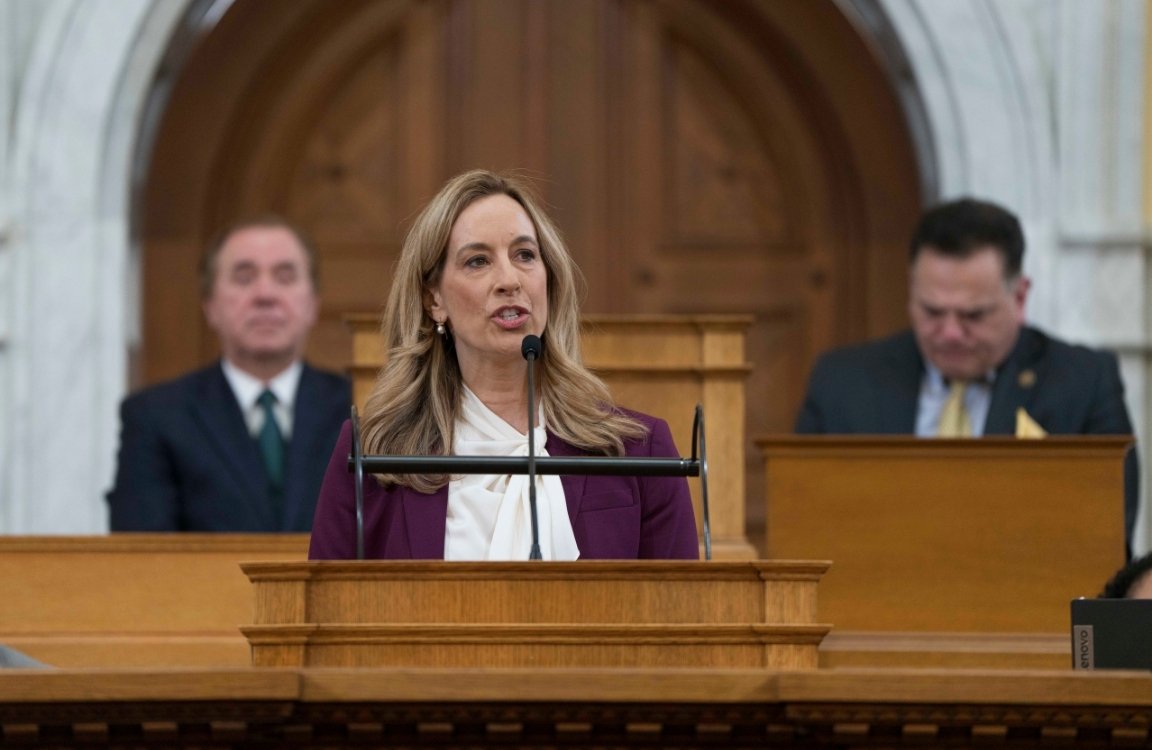
Gov. Mikie Sherrill unveiled her first budget Tuesday before the 222nd Legislature, a record $60.7 billion for fiscal year 2027, that focused on fiscal responsibility, affordability, protecting children’s futures, improving government accountability and transparency.
Sherrill said the proposal does not impose new taxes on individual New Jersey residents and prioritizes government efficiency and accountability.
“Government hasn’t been working, and the budget is broken in New Jersey,” Sherrill said. “We have one of the worst budget gaps in the nation.”
Sherrill and acting Treasurer Aaron Binder said during a press conference on Feb. 26 that New Jersey faces a “serious” structural deficit that could empty the state’s reserves in two fiscal years.
Some estimates have put the looming deficit at $3 billion.
Sherrill said that because Washington refused to extend Affordable Care Act credits, nearly 500,000 New Jerseyans will see their premiums triple this year and 300,000 more New Jerseyans will be kicked off Medicaid.
Sherrill is asking any company with 50 or more employees on Medicaid – companies like Amazon and Walmart – to cover their workers or pay a fine. Sherrill said this will raise $145 million a year, to cover extra Medicaid costs.
“I refuse to put off tomorrow what we need to do today,” said the governor on Tuesday.
Sherrill called her budget an “affordability budget,” which Binder says “finds solutions to cut costs without compromising services for everyday New Jerseyans.”
The budget includes a proposed surplus of $5.4 billion, while redirecting more than 74% of the total budget back into New Jersey communities in the form of grants-in-aid for property tax relief, social services, and higher education, as well as state aid to schools, municipalities, and counties.
The budget aims to rein in costs by nearly $2 billion. While the last eight budgets increased almost 7% annually on average, this budget is 1.6% above the fiscal year 2026 adjusted appropriation.
Sherrill proposed $12.4 billion for K-12 schools, the largest amount in state history and a $370 million increase over last year’s funding. The budget also included a record $1.4 billion for Preschool Education Aid.
Sherrill expressed concern over the negative impact social media is having on children.
To that end, she proposed $125,000 for the new Office of Youth Online Mental Health Safety and Awareness in the Department of Health. The budget also includes $500,000 for a new Social Media Research Center at one of New Jersey’s higher education institutions.
The budget allots $15 million for high-impact tutoring – double the amount from the previous year – that would help nearly 100 more districts and 13,500 more students, with the goal to accelerate learning and address academic achievement gaps spurred by the pandemic.
The 2027 budget proposal includes $7.3 billion for the state’s pension system, marking the sixth consecutive full payment.
As part of Sherrill’s focus on affordability, the 2027 budget proposes property tax relief totaling $4.2 billion. This includes $2.3 billion for ANCHOR, $350 million for Senior Freeze and nearly $700 million for Stay NJ.
The $250 bonus formerly extended to senior homeowners and renters under ANCHOR is set to expire after FY 2026.
Under this budget proposal, senior renters would continue to receive the $250 bonus while many senior homeowners would continue to receive the additional benefit amount through Stay NJ instead.
Eligibility for Stay NJ would be modified to cap the qualifying income threshold at $250,000, matching ANCHOR. Additionally, the maximum benefit amount for Stay NJ would be capped at $4,000.
One of Sherrill’s first executive orders was to freeze utility rate hikes and expand power generation.
Following that action, the Sherrill administration will direct the Board of Public Utilities to identify funds for another round of Residential Energy Assistance Payments (REAP) for lower-income residents and identify funding to provide further rate relief as needed.
Sherrill addressed housing affordability by trying to ease financial burdens for New Jerseyans looking to buy their first home.
She proposed increasing the Down Payment Assistance Program allocation by an additional $5 million, while reducing transfers from the Affordable Housing Trust Fund by $70 million in order to make room for new construction.
A proposal for $11 million for the existing Bringing Veterans Home initiative to transition homeless veterans from temporary housing placements to permanent housing drew a prolonged standing ovation from the lawmakers.
Sherrill took on the so-called “last-minute giveaways” that were tacked onto each budget. She put the total at $2.5 billion in corporate tax breaks and $240 million in “other giveaways.”
“That can’t happen,” she said. “We can’t afford that process anymore. It’s not accountable; it’s not efficient; it’s not what the people of New Jersey deserve.”
In terms of making government more efficient, the budget proposal includes an additional $13.3 million for the New Jersey Innovation Authority to support operating initiatives like the Permitting Dashboard and the New Jersey Report Card; supports technology upgrades across State government, including $3 million for the Division of Consumer Affairs to upgrade its licensing system and complaint database; and reduces business registration fees and improves procurement assistance for minority and women-owned businesses.
Sherrill’s budget includes a 26% increase to $1 billion for NJ Transit.
The budget also includes about $2.1 billion for the State Transportation Capital Program — $1.3 billion for investments in state, local highway, and bridge projects, and another $782 million for NJ Transit capital projects.
