

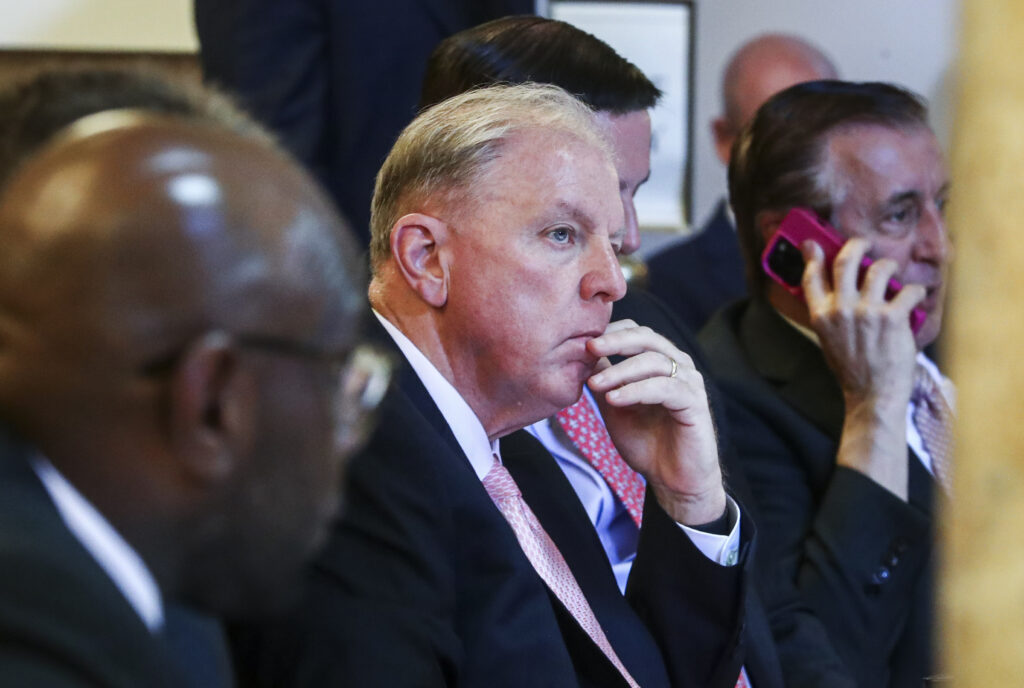
New Jersey allows people to record phone calls as long as one party gives consent to the recording. State Sen. Joe Cryan wants all parties to give consent. (Photo by Dana DiFilippo/New Jersey Monitor)
A New Jersey lawmaker wants to alter New Jersey’s law governing the recording of phone calls and other conversations.
The bill introduced by state Sen. Joe Cryan (D-Union) would require consent from all parties to a conversation, rather than the one-party consent called for under current law. Cryan said it’s a bid to blunt scams using increasingly robust audio deepfakes.
“I’ve had life experiences relayed to me about people being taped and that taping being used for nefarious reasons. As a result of that, protections really should be discussed,” Cryan said.
Under New Jersey law, a person can record a conversation so long as they are party to it or have consent from at least one person who is. The federal government, Washington D.C., and 38 other states use that same framework, while 11 states require consent from all parties to a conversation.
The bill, introduced last month, has already drawn controversy over its potential impact on news reporters who record interviews and events to ensure they can accurately quote speakers. New Jersey Press Association Chairman Brett Ainsworth said the group opposes the measure as drafted and said it could have unintended consequences outside of the media.
It could bar domestic violence victims from recording their abusers absent the abuser’s consent, limit workers’ ability to record harassment from managers, or prevent whistleblowers from coming forward, said CJ Griffin, the association’s general counsel. Griffin has represented the New Jersey Monitor in a variety of legal matters.
“Even if the sponsor includes an exception to allow the media to record, the bill will still stand in the way of reporting because journalists would lose an important source — whistleblowers and others who have documentary evidence of wrongdoing caught on tape,” Griffin said. “There are also serious constitutional concerns because the public has a First Amendment right to record the police or public officials, for example.”
Ainsworth questioned whether the bill would do much to blunt deepfake scams.
Audio deepfakes generally require a sample of the voice they’re spoofing. That sample can be pulled from existing sources posted online or be purpose-made for the deepfake.
“From my personal perspective, the deepfake issue is a serious one, but I fail to see how two-party consent would be effective. Wouldn’t the faker just manufacture a deepfake anyway?” Ainsworth said.
The use of deepfakes to aid crimes is already illegal. Under a bill Gov. Phil Murphy signed into law in April, those who produce or share deepfakes with an unlawful purpose — say, to extort or defraud someone — face up to five years imprisonment and fines of up to $30,000.
One-party consent recording would carry similar penalties under Cryan’s bill, which calls for prison sentences of between three and five years and up to $15,000 in fines.
It’s not clear when the bill might be heard by the Senate Law and Public Safety Committee. At present, it has no companion in the Assembly.
GET THE MORNING HEADLINES.
