


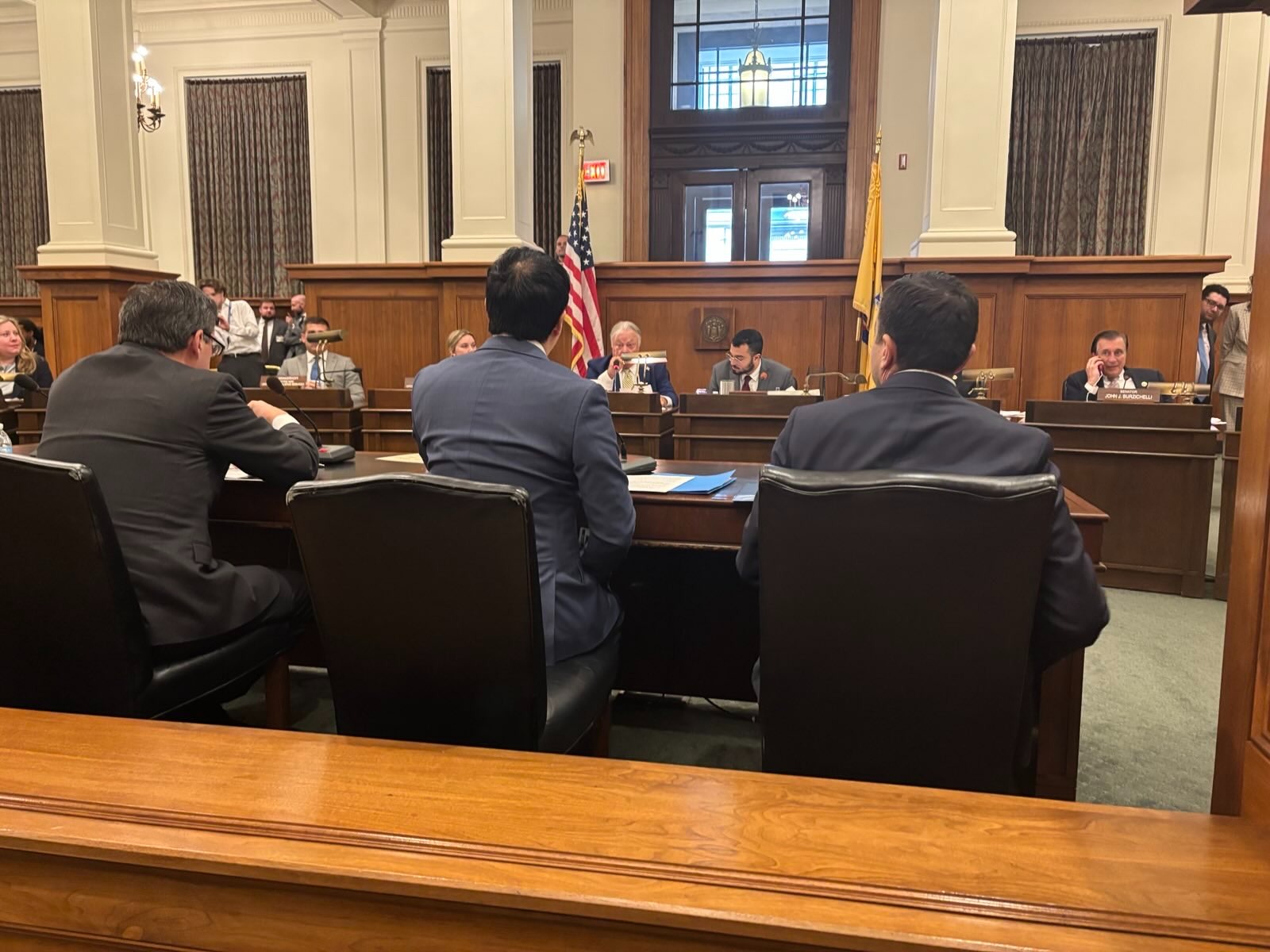
In a contentious hearing, the state Senate’s State Government Committee unanimously approved an oversight reform bill that would transfer much of the investigatory authority of the state comptroller to the State Commission of Investigation, a proposal that’s drawn ire from progressive advocates.
The entire state Senate must still pass the lame-duck bill, and companion legislation has not been introduced into the Assembly. Senate President Nick Scutari, the bill’s sponsor, said the bill seeks to restore the glory days of the SCI, which was once the state’s “premier” oversight agency before languishing in recent decades.
The Senate president, who emphasized the bill does not remove oversight but rather relocates some of those authorities, has long suggested the state possesses too many watchdog agencies. In January, after the State Commission of Investigation’s former director resigned because of a residency issue, Scutari said he wanted to explore the consolidation of agencies.
Under the legislation, the comptroller’s office would keep its Medicare fraud and auditing units, which account for the majority of the office’s work. The bill would move the office’s investigatory arm — authority that once resided with a now-defunct inspector general’s office — to the SCI, which would now house a new inspector general role. The bill would also take away the governor’s authority to name the chair of the SCI and instead grant it to the Senate president and Assembly speaker.
Scutari filled in for state Sen. Shirley Turner (D-Lawrence) at the hearing and personally advocated for the legislation — Scutari later left and was replaced by state Sen. John Burzichelli (D-Paulsboro).
“This is not a parochial battle for people to fight,” Scutari said. “This is an additional layer of oversight.”
Bruce Keller, the executive director of the SCI, said his agency is better equipped to handle the investigatory work that now lies with the comptroller because the SCI has access to law enforcement tools, criminal databases, and corruption data that currently lies outside of the comptroller’s authority.
“If you objectively favor wide-ranging, unfettered investigative work done more broadly, done with more resources, done with fewer limitations, it is both logical and efficient to reallocate the former [inspector general] investigative work to the only independent investigative entity in state government,” Keller, a former federal prosecutor, told the panel today.
Keller said the bill does not affect the comptroller’s auditing, Medicaid fraud, or procurement oversight authorities; he said the office does well in those arenas but is otherwise “hamstrung.”
“The bottom line, the investigative work of OSC is neither being eliminated nor consolidated out of existence by this bill,” Keller said. “It would continue under the auspices of an entity with an almost 60-year successful track record of doing it, an entity whose statutory mandate expressly makes it better suited to conduct that work without interference, and then discloses findings to you and the public in the interest of a goal we all share: transparency.”
Acting Comptroller Kevin Walsh suggested the bill was “retribution” for his work, which has occasionally targeted allies of top Democratic officials. Murphy has nominated Walsh to be comptroller three times, but the Senate has declined to vote on his nomination, leaving “acting” in Walsh’s title for years.
“Fundamentally, this is a bill that no one has asked for, except people who are upset by the powerful being held accountable,” Walsh told reporters before the hearing. “A vote for this bill at the end of the day is a vote for corruption, and we must do everything we can to oppose it.”
Scutari rejected the accusation that the bill constitutes retribution; “this has nothing to do with one individual,” he told reporters.
“I’m thinking about revamping government in a way that will work for the people, so that we can get some real sunlight on some of these issues and get real change, rather than people thinking so much of themselves that I have the time to think about one individual,” he said.
At the hearing, the acting comptroller said the legislation moves authority from a “stellar” office to a floundering agency. Walsh said the Comptroller’s Office has published 25 reports this year, saving taxpayers millions, while the SCI has published none. Walsh said there’s no reason to remove subpoena power from the comptroller’s office, arguing it’s not a “zero-sum game.”
Some high-profile officials publicly oppose the legislation. Senator Andy Kim and Attorney General Matt Platkin joined Walsh in a pre-hearing press conference, and all three testified against the bill.
In a statement, Gov.-elect Mikie Sherrill, who takes office next month, declined to endorse or rebuke the legislation. Her predecessor, Gov. Phil Murphy, also typically declines to comment on pending legislation.
“I am opposed to efforts that weaken essential accountability and oversight, including with our watchdog agencies that root out government corruption, waste, and abuse,” Sherrill said. “I will not weigh in on pending legislation as it changes, is amended, and moves through the legislature. But let me be clear: I know from both my service in the Navy and as a federal prosecutor that strong accountability and oversight are essential to ensuring good governance and public trust.”
Scutari said he’s spoken with Sherrill, but didn’t specify how those conversations went.
“I think she’ll speak for herself,” he told reporters.
Murphy has not commented on the legislation. Walsh publicly asked the governor to veto the bill, should it arrive at his desk.
Proponents and opponents of the bill both suggest this year’s election results justify their stances. Scutari argued the bill constitutes an aggressive change to address corruption, which is what voters demanded.
“I’ve heard, based upon the elections, that people are clamoring for real change,” Scutari said. “This is change. This is not the status quo. This is moving forward the creation of a powerful inspector general with a real, serious group of individuals to vet out waste, fraud, and abuse.”
Kim argued the opposite, saying the bill will only further dismay New Jerseyans who believe their government is corrupt.
“This effort to be able to gut transparency and accountability in our state right now, which is in the bill before this committee today, is the wrong move at this moment,” Kim said. “This is something that we should be having a deeper conversation about in terms of what comes next.”
Many major advocacy groups also declared opposition to the legislation, including the Working Families Party of New Jersey, the New Jersey ACLU, New Jersey Citizen Action, and Make the Road New Jersey.
Wiretap authority
A major point of contention in the bill is the authorization for the SCI to obtain a wiretap with the assistance of the Attorney General’s Office and the approval of a judge.
The SCI once possessed that same authority, but legislators stripped the SCI of wiretapping power in the early 1990s, and Platkin said he is not sure it was ever used beforehand.
“The idea, I suspect, why it was taken away — and I know no one wants to say this — is because there are serious constitutional issues with a legislative body or any civil body … seeking to obtain or participate in a wiretap,” Platkin said. “A wiretap which, over 60 years, the Supreme Court has placed significant limitations on who can obtain that information.”
Keller said concerns that the wiretap authority could be abused are misguided, since a prosecutor and a judge would have to sign
“Having been involved in wiretap applications, I can assure you the standards are very rigorous,” Keller told the panel. “If you’re worried about abuse, it’s a genuine, legitimate concern. I don’t think it’s capable of being abused.”
Platkin, meanwhile, called the wiretap authority an “intimidation tool” that threatens the separation of powers. He said such evidence might not be admissible in court if it were procured from a non-prosecutorial agency. He said that because the SCI does not lie within the state government’s executive branch, it lacks the authority to act as a prosecutorial agency, which could lead to legal challenges.
Platkin said he believes the legal difficulties mean a significant portion of the law will not be “allowed to come into light.”
“Give [the SCI] whatever authority it needs, as long as it doesn’t trample on a separation of powers and create real law enforcement challenges,” Platkin said.
A Monday afternoon hullabaloo
Opponents to the bill condemned the process of the bill hearing, which opened with a nearly 40-minute presentation from Keller, the executive director of the SCI and a proponent of the bill.
Kim, Platkin, and Walsh also sought to testify on the bill, and legislative committees typically grant high-ranking officials the opportunity to testify before the public. The trio, however, was forced to go last, a delay that forced Kim, an antagonist to New Jersey’s entrenched political machines, to miss a train that would have delivered him back to D.C. before a floor vote. Several members of the public, including New Jersey Policy Perspective analyst Peter Chen, offered to yield their time to Kim, but Beach would not allow it.
Opponents were already testy because the bill text was released on Tuesday evening before Thanksgiving in a lame-duck year, a process that Kim and others have said is untoward. Scutari defended the process to reporters, saying the public had nearly a week to read the bill and prepare testimony, a longer timeframe than for some other bills.
After Keller’s presentation, Beach, the committee chairman, limited the public to three minutes of testimony in the interest of preserving time, and he similarly cut Kim off at three minutes, sparking an argument.
“Why do you think you’re special?” Beach asked after Kim asked for time to finish his remarks. “You’re not.”
“You gave Mr. Keller special privileges,” Kim fired back.
“He came at my request,” Beach said, to which Kim and the crowd laughed. “You didn’t.”
Platkin, who was seated next to Kim during the squabble, said Beach’s actions constituted viewpoint discrimination that the Office of the Attorney General would investigate.
Other senators on the panel, including state Sens. John Burzichelli (D-Paulsboro) and John McKeon (D-West Orange), cooled the temperature with questions for Kim, but Walsh and Platkin also bickered with Beach in subsequent minutes.
Beach, an ally of South Jersey Democratic powerbroker George Norcross, who faced a now-dismissed indictment from Platkin’s office, attacked Platkin in the final minutes of the hearing, saying the attorney general has failed throughout his tenure and was the reason for the legislation.
“You are the problem here,” Beach told Platkin. “You and your leadership.”
Platkin said the remarks were irrelevant. “I’m not going to be attorney general come January 20th, Kevin’s not going to be the comptroller. My department is not even mentioned in this bill. I’m here because I am concerned about an agency that, by the way, has held me accountable, and B, about significant separation of powers concerns and how that will affect law enforcement.”
After more arguing, Beach said Platkin has dragged down his department, and Platkin defended his record, including his lawsuits against President Donald Trump. Walsh joined in on the argument, saying, “What have you been doing, senator?” With that, McKeon stopped the arguing.
“This is a place of respect,” McKeon said. “We have a job to do to vote, and this should end.”
Beach, apparently frustrated, adjourned the meeting before realizing the panel hadn’t actually voted on the bill yet. After undoing the error, the committee unanimously cleared the bill from committee.
Saying he was hungry, Beach refused to take questions from reporters after the hearing, including whether Kim, Walsh, and Platkin were purposely held for the end.
Scutari said he doesn’t have information on when the bill could be introduced in the Assembly. Regardless, Walsh said he doesn’t think Murphy would sign the bill into law, should it land on the lame-duck governor’s desk.
“He wanted me to unearth big problems and to report them,” Walsh told reporters after the hearing. “And he has nominated me three times to this position, which I think shows, despite some feathers among the political class being ruffled, he supports the work that we’ve done, or he at least recognizes the importance of it. I would be very, very surprised if on the way out, he undermined an important feature of executive branch oversight and diminished the power of the executive.”
