


 Listen to this article
The basics:
- Tim Sullivan steps down as NJEDA CEO after nearly 8 years
- Final day featured the groundbreaking of 1888 Studios in Bayonne, a significant project for NJ’s film and TV industry
- Sullivan led NJEDA since 2018, steering pandemic relief and diversified economic growth
- Deputy CEO Mary Maples named acting CEO as the state awaits permanent leadership
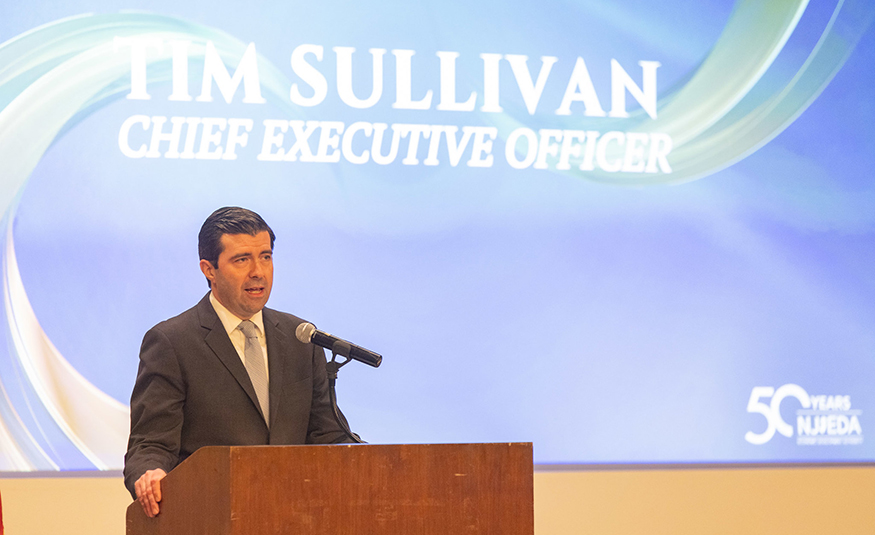
Tim Sullivan’s final day leading the New Jersey Economic Development Authority was a notable one — marked not by a quiet exit, but by a high-profile groundbreaking for a major film and television studio project in Bayonne that he played a key role in bringing to life.
Sullivan joined state and local officials, industry leaders and Gov. Phil Murphy and First Lady Tammy Murphy on Dec. 16 at the launch of 1888 Studios, a transformative waterfront development that underscores the state’s emergence as a national hub for film and TV production.
It was a fitting capstone to Sullivan’s tenure with a tangible example of the long-term economic investments he helped shepherd.
Since taking over at NJEDA in February 2018, Sullivan has been a key economic adviser to Gov. Murphy and guided the state’s economic development agenda.
Sullivan guided the agency through the unprecedented disruption of the COVID-19 pandemic – overseeing massive small business relief efforts – and into a period of aggressive, diversified growth, helping reshape the state’s economic landscape on the other side of the crisis.
Under his leadership, the NJEDA expanded its role across sectors including:
- Innovation and technology – including AI and fintech, film and television (the New Jersey Motion Picture and Television Commission came under the NJEDA purview during his tenure)
- Real estate development
- Community revitalization
- Child care
- Small business support
- Workforce-driven economic policy

As Sullivan steps down, Deputy CEO Mary Maples has been named acting CEO. Gov.-elect Mikie Sherrill has not yet named a new permanent leader.
Exit interview
Sullivan’s impending departure was referenced repeatedly during remarks at the Bayonne groundbreaking, with speakers acknowledging both his role in advancing the project and his broader impact on the state’s economy, particularly in the realm of film and television, given the subject of the groundbreaking.
Following the event, NJBIZ spoke with Sullivan about his final day, reflecting on his time in office, the initiatives he helped launch, and the emotions that came with closing out a defining chapter of his public service career.
“Obviously, the work we’ve gotten to do is incredibly exciting and fun. All good things come to an end – and it’s the right time as the Murphy administration comes to an end. It’s time to sort of turn the page. But the work has been incredibly gratifying and rewarding,” Sullivan said.
“And the other big feeling is gratitude. Whether it’s to the governor, first lady, to my cabinet colleagues, to the folks at the EDA – starting with board and our dedicated team we have. Just grateful for a lot of people’s support and partnership over the years.”
Sullivan spoke about the camaraderie and good relationships within the administration and cabinet, as well as the relationships beyond the administration and with other stakeholders.

“One of the hallmarks of Gov. Murphy’s time in office has been – not without some conflicts and disagreements with folks in the Legislature and mayors and various other political actors – partnership and collaboration, both sides of the aisle, too,” said Sullivan. “If you look at film and TV, this is an industry that’s had bills with lots of support from Republicans and Democrats alike.
“I think [those are] very Jersey things to be – spirited and be combative, and get into it and arm wrestle a bit. But have those kind of relationships – incredibly important.”
NJ ready for action
Within the film and TV industry, there have been three groundbreakings this year for major studio projects. Sullivan shared what that means for New Jersey.
“I think it means we’ve gotten to lift speed on the film and TV business,” Sullivan explained. “So, the promise of what this industry can be is being realized. Sen. [Raj] Mukherji mentioned it during his remarks – the brick-and-mortar that is being built here in Bayonne, in the South Ward of Newark, and Monmouth County at Netflix – means that there’s going to be a permanent industry being built here.”
He said that once the studios will create year-round activity, lots of jobs and economic activity – and lots of support for the communities.

Sullivan also spoke about the so-called innovation economy and some major announcements at the NJ AI Hub.
“I think the Strategic Innovation Centers and the innovation economy is one of Gov. Murphy’s strongest legacies that he’ll leave behind – not just for Governor-elect Sherrill, but for whoever comes after her and after her,” said Sullivan. “The innovation economy investments that Gov. Murphy has made are going to pay dividends for decades to come.
“We’re just barely beginning to see the very earliest beginnings of that – with folks like CoreWeave, biggest U.S. tech IPO since 2021, a Jersey-based company, is just a taste of what’s coming our way; with the right investments,” he continued. “It’s up to the governor’s successors and the Legislature to continue to support that. But I think that base that’s been built there is incredibly strong.”
Small businesses go big
The discussion shifted to small business and the efforts undertaken on that front by the NJEDA – particularly during and coming out of the pandemic. Sullivan detailed how small business is also integral to areas such as film and TV.

“One thing I try to highlight is that film and TV, for example, huge job spinner, and a huge amount of support for small businesses – caterers, contractors, security firms, hair and makeup companies. Small and mid-sized businesses that are going to be the vendors to these studios – it’s a huge impact,” said Sullivan. “Certainly, once the pandemic hit and then coming out of it, Gov. Murphy and the Legislature allocated a huge amount of resources to supporting small business.
“Some of it was just to recover and get through the pandemic. The governor will leave office with having a record number of small businesses despite what happened during the pandemic speaks to the amount of support that was needed – and that was provided by the governor and Legislature,” Sullivan continued. “The governor’s commitment to small business goes well beyond the pandemic, in terms of nearly a quarter-billion dollars in appropriations in his budgets to support small business.
“That’s up from – frankly – nothing under his predecessors of both parties. I think the key to sustainable economic development is not just focusing on big businesses or just focusing on small businesses – or just focusing on real estate or community development. It’s doing it all. And trying to be as comprehensive as you can. I think Gov. Murphy’s report card on that is A+.”
Pandemic: Lessons learned
Sullivan next discussed the focus of the NJEDA and the administration, broadly, on child care.
“Child care is incredibly important because of a couple of things,” said Sullivan. “One, there’s a lot of child care small businesses. It’s a huge part of our small business economy. Go to any strip mall or downtown or community, you’re going to see a child care facility.
“It’s economic infrastructure. If the pandemic didn’t teach us that the economy doesn’t work without a functioning, high-quality, affordable, reliable, child care system – I don’t know what will. It’s like electricity or water – if the child care system is not working, good luck getting people to show up to work. Because all of us who are parents or grandparents or caregivers, the first and most important thing is – are the kids safe and healthy and somewhere they should be? And if they can’t find that in the child care system, they can’t go to work.”

So what is the biggest lesson learned during the pandemic?
“One of the lessons, certainly, is outreach,” said Sullivan. “The importance of getting the word out about programs. The very earliest, darkest days of the pandemic – first and foremost, was a health crisis; people were dying. But it was a business crisis, an economic crisis.
“And we had all these great programs that we weren’t getting the word out for,” he continued. “We weren’t getting the word out to all of the communities in New Jersey. So, that was foreign languages, specialty media, etc. Getting that word out is incredibly important. You could have all of the best programs in the world. But if the people you’re trying to reach don’t know about them – that’s not very helpful.”
NJEDA leadership evolution
Sullivan also described the evolution of the agency over the last eight years.
“Again, I think Gov. Murphy is going to get rightly credited for more major investments in our economy and in the EDA,” he said. “It’s a bigger, stronger, more robust, more resilient organization. It’s 51 years old – and I think Gov.-elect Sherrill will inherit a great organization full of great people. That she can take it in whatever direction she wants.
“I’d vote for something similar to what Gov. Murphy focused on. But she’ll get to take it in whatever direction she sees fit. And it’s an incredibly effective delivery vehicle. When there’s a crisis – when there’s an emergency. Where there’s sinkholes on Route 80 – where there’s Superstorm Sandy – where there’s the pandemic. The EDA is second to none at responding to those crises quickly, effectively, and with integrity.”
When there’s a crisis – when there’s an emergency. … The EDA is second to none at responding to those crises quickly, effectively, and with integrity.
– Tim Sullivan, outgoing NJEDA CEO
As for his advice to the next administration, Sullivan suggested paying attention.
“You’ve got to do your best to listen,” said Sullivan. “Economic development is a partnership business – whether it’s listening to mayors or community groups or activists or business groups, you’ve got to do a lot of listening. You can’t do enough listening to stakeholders. Because when great projects come along, you want people to have trust in you to see it forward.
“So, being open-minded and listening to good ideas is incredibly important.”
Public-private partnerships
Sullivan spoke about the importance of public-private partnerships, something that has been a core tenet in a number of programs and initiatives during his time at the NJEDA, such as the SICs.
“Good or great economic development involves public-private partnerships 99.5% of the time,” he said. “But who the actors are can change. Sometimes it’s higher ed. Look at the AI Hub … it’s the State of New Jersey, through the Economic Development Authority. But it’s Princeton University, it’s Microsoft, and it’s CoreWeave.
“First off, you couldn’t ask for three higher caliber partners than that. But also partnering with higher ed is a public-private partnership – and bringing that skillset and expertise to bear is incredibly important.”
Mentors
NJBIZ then asked for Sullivan’s closing thoughts on working with and serving under the governor and first lady.
“They’re incredible. And I think they’ll never get the credit they deserve, particularly the first lady,” said Sullivan, noting First Lady Murphy’s energy on so many different issues throughout the administration. “Their dedication – their passion – their tirelessness. There’s no issue too small for them to engage on. There’s nothing that they won’t roll up their sleeves to get involved in. The example they’ve set for me as a professional, as a working parent – is second-to-none.
“I’m leaving their employ. But I’ll probably never leave their service.”

As for Sullivan’s next chapter or areas of focus?
“We’ll see,” said Sullivan. “I need some time to clear my head – and figure out what I want to be when I grow up, so stay tuned. No news to make there, as the governor would say.”
Regrets? He’s had a few
Asked about disappointments, Sullivan mentioned wind power.
“It’s hard to think of an area in which Gov. Murphy didn’t leave a stamp on the economy. You’d be bullshitting if you didn’t say how offshore wind played out over the last couple years – almost entirely due to changes in federal policy, let’s say – is frustrating. But long-term, I remain confident that Jersey is going to be an offshore wind hub and that energy gets harnessed.
“It’s frustrating to see something that holds so much promise held up for such little rational and factual basis. That’s frustrating. So, there’s one.”
On the plus side
But there have also been rewards.
“Getting to see the impact that we can have on people’s lives. And getting to work with extraordinary colleagues at the EDA,” said Sullivan. “Some of them have been there for 35 years. Some of them just joined a couple weeks ago. But we have an incredible team at the EDA – dedicated, caring, competent, high-credibility individuals – that it has been an honor to serve with.”

