


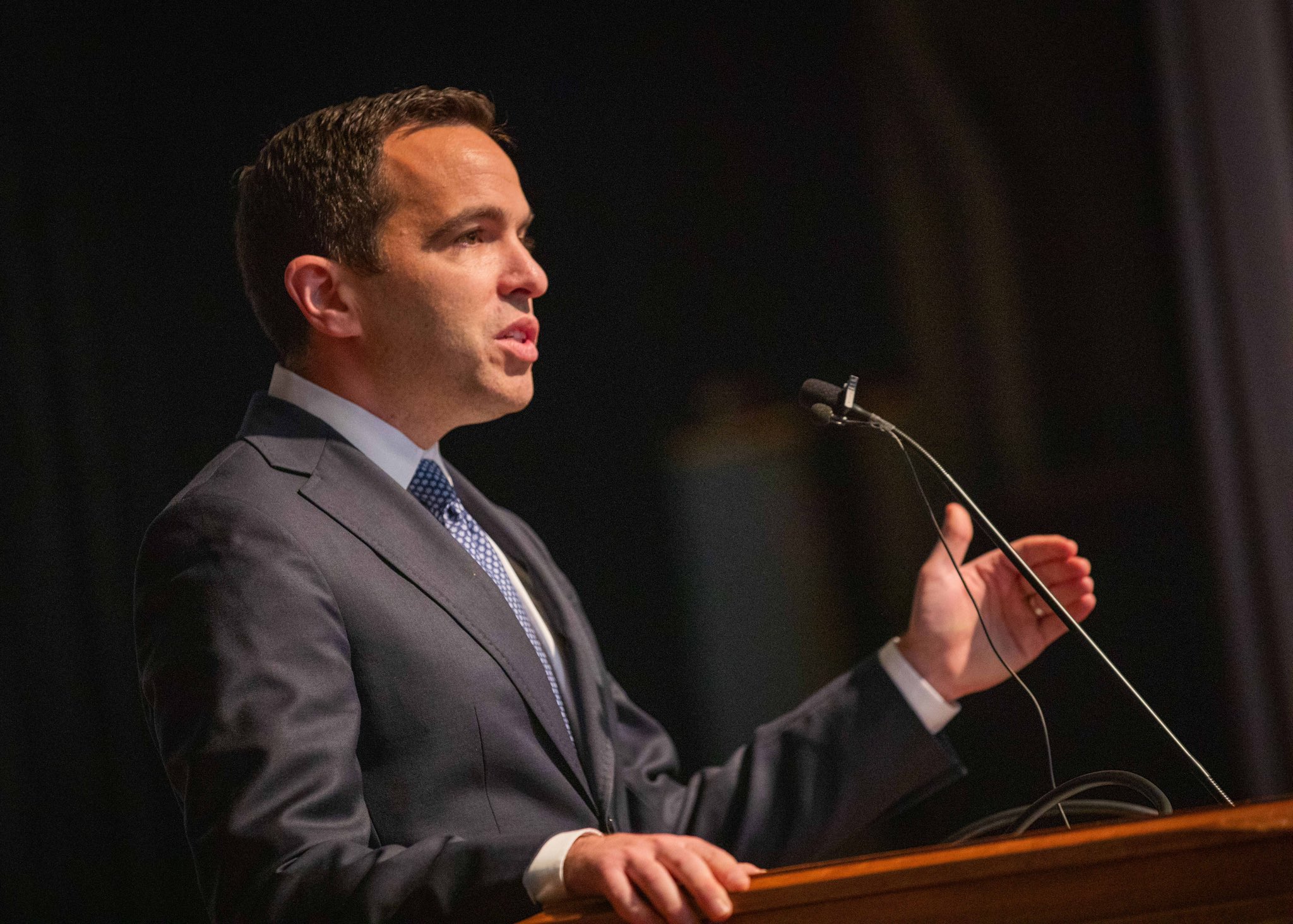
A commission named by Attorney General Matt Platkin to address diminished public trust in government and a history of public corruption in New Jersey has recommended the creation of a statutory Inspector General’s Office within the Department of Law and Public Safety to investigate allegations of prosecutorial misconduct, even when the conduct is not criminal.
The suggestion follows a call by Senate President Nicholas Scutari to create the Inspector General post, albeit in just the one department. The inspector general would also be charged with investigating accusations of civil fraud, abuse, and conflicts of interest.
The Transparency and Reliability Uniting to Secure Trust (TRUST) Commission appointed by Platkin earlier this year also urged increased staffing and funding to the embattled Office of Public Integrity and Accountability, along with a dedicated community engagement specialist, and a review of whether OPIA and the Division of Criminal Justice should be reunified to improve efficiency while preserving independence.
The commission urged the creation of a centralized compliance unit to monitor adherence to statutes, Attorney General directives, licensing standards, and oversight findings across divisions such as the Division of Criminal Justice, the Police Training Commission, and the Division of Consumer Affairs.
It also called for a streamlined, user-friendly system for accepting public complaints and referrals, including a single online entry point, clearer routing of submissions, and guaranteed acknowledgment that a complaint has been received. The panel further recommended improvements to the public-corruption reporting portal, making it more accessible, anonymous, multilingual, and prominently linked from the Attorney General’s homepage.
The Commission also suggested actions for other branches of state government, calling on the legislature to establish a New Jersey Consumer Product Safety Commission within the Division of Consumer Affairs to ensure that recalled products are removed from store shelves—a power no state agency currently possesses.
Lawmakers were also urged to pass a statute mirroring the federal prohibition on lying to government officials, closing a gap in state law that allows deliberate deceit to go unpunished.
The Department of the Treasury was encouraged to revise its letterhead rules so the Attorney General is listed as the highest-ranking official, reinforcing the office’s independence. Finally, the Commission called on the Governor’s Office to convene a multi-agency working group to expand the state’s Open Data Center to include searchable financial disclosures, procurement data, and other anti-corruption datasets, laying the groundwork for a more transparent and accountable government.
Members of the TRUST Commission include: Sue Altman, State Director for U.S. Senator Andy Kim; Charles F. Boyer, pastor of Greater Mt. Zion A.M.E. Church and co-founder of Salvation and Social Justice; Ronald K. Chen, Rutgers Law School professor and former dean; and John J. Farmer Jr., former New Jersey Attorney General, U.S. Attorney, and Rutgers Law School dean. The Commission also included Paul J. Fishman, former U.S. Attorney for the District of New Jersey; Virginia A. Long, retired New Jersey Supreme Court justice; Edward M. Neafsey, former First Assistant Attorney General and retired Superior Court judge; Hetty Rosenstein, former New Jersey State Director for the Communications Workers of America; Edwin H. Stier, former Assistant U.S. Attorney and former Director of the Division of Criminal Justice; and Debbie Walsh, Director of the Center for American Women and Politics at Rutgers University.
