


 Listen to this article
As demand for CAR T therapies strain traditional manufacturing, Autolus Therapeutics has tapped Cellares to evaluate whether that company’s automated Cell Shuttle platform can support expanded commercial production.
Cellares will partner with Autolus Therapeutics to assess if the platform can help meet rising demand for the company’s U.S. Food and Drug Administration-approved CAR T therapy – Aucatzyl (obecabtagene autoleucel).
The companies announced the agreement Jan. 6. Cellares operates its first commercial-scale IDMO Smart Factory in Bridgewater – with additional facilities under construction in Europe and Japan.
The assessment will determine whether the Cell Shuttle system could complement Autolus’ existing manufacturing operations at its Nucleus facility in Stevenage, U.K.
Aucatzyl is approved in the United States, the U.K. and Europe for adults with relapsed or refractory B-cell precursor acute lymphoblastic leukemia. Autolus is also studying the therapy in clinical trials aimed at expanding its use into pediatric B-ALL and autoimmune diseases, such as lupus and multiple sclerosis.
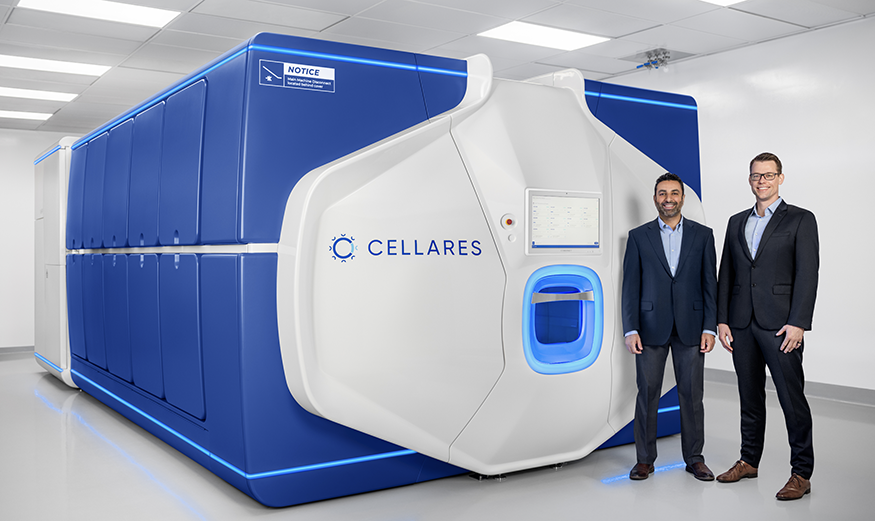
As NJBIZ previously reported, Cellares’ Cell Shuttle platform is a fully automated, closed system that integrates all steps of CAR T manufacturing into a single-use, pre-sterilized cartridge. The platform can process up to 16 patient batches in parallel. And, according to the company, it enables up to 10 times higher throughput than conventional cell therapy manufacturing facilities with comparable space and staffing.
The system pairs with Cellares’ Cell Q platform, which automates quality control and generates fully digital batch records.
Building up
The Cell Shuttle was the first manufacturing platform to receive the FDA’s Advanced Manufacturing Technology designation, providing additional touchpoints and priority review pathways when referenced in regulatory submissions.
“We are evaluating obe-cel [Aucatzyl] in a range of indications beyond acute leukemia, and if successful, expect future demand to exceed the manufacturing capacity at our Nucleus facility,” said Christian Itin, CEO of Autolus. “Cellares’ Cell Shuttle platform may provide an attractive option for a capital-efficient expansion of our manufacturing footprint in the future.”

Fabian Gerlinghaus, co-founder and CEO of Cellares, said scaling production while maintaining consistency and cost control remains a central challenge for the CAR T sector.
“If a commercial CAR T shows durable benefit, the next question is whether the industry can produce enough doses at a sustainable cost,” said Gerlinghaus.
He noted that Autolus has already built a strong manufacturing foundation.
“Our role is to extend that foundation with a global infrastructure that can reduce cost and process failure rates, while meeting total patient demand,” said Gerlinghaus.
