

The basics:
- Officials project more than $3B in economic impact, over 1M visitors in NY-NJ region
- MetLife Stadium will host 8 matches, including World Cup Final July 19
- Airbnb estimates $450M in New Jersey economic activity, 1,800 jobs, 42,000 guests
- Business leaders urge NJ companies to engage early via fan fests, activations, vendor programs
Business leaders say the 2026 FIFA World Cup will drive billions in economic impact for New Jersey and New York, capped by the Final at MetLife Stadium.
A number of events, discussions and gatherings have emerged all around the state on this very topic. And how New Jersey companies and communities can capitalize on the tournament and that economic boom.
One such event took place Dec. 9. Leaders and stakeholders gathered at New Jersey Performing Arts Center in Newark as part of the NJPAC Business Partners Roundtable series.
Moderated by Jonathan Schultz, co-founder and managing principal of Onyx Equities, the Scoring Big: NJ’s Playbook for World Cup 2026 panel included:
- Jim Kirkos, CEO, Meadowlands Chamber of Commerce
- Veronica Contreras, sports anchor, Telemundo 47 News
- Daniel Diaz, director of business development – World Cup Local Ad Sales, NBCUniversal Local
- Bettina Garibaldi, chief marketing and communications officer, FIFA World Cup 26 NYNJ Host Committee
- Gus Penaranda, CEO, president, Evolvere Consulting Inc.
- Alain Xiong-Calmes, public policy manager, Airbnb
Host with the most
Opening up the discussion, Schultz noted some of the things being done by his company, Onyx. Last July, the real estate investment and property services firm was named as the first Official New York New Jersey World Cup 2026 Host City Supporter.
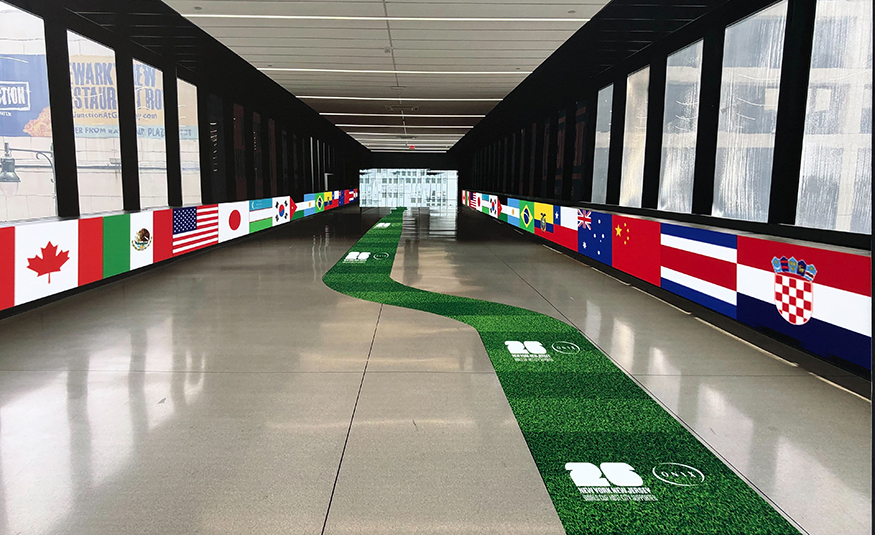
“We did put an activation in Gateway Center. We put a mini-soccer field in the building, a lot of branding, and the flag,” said Schultz, continuing, “We would love people to come visit, check out what we’re doing. We’re so excited about creating energy for this.
“This is the biggest thing happening in the world. I’ve never felt any event have the forces that this event does have. So, I’m proud to be a really small part in it – and so is Onyx Equities.”
The panelists discussed the potential economic impact of the world’s biggest sporting event.
“This is obviously one of the biggest World Cups ever across three counties – 16 host cities,” said Garibaldi. “In the United States alone, 11 host cities. And our region – New York New Jersey – is a host city. Which we’re really unique in that sense because there’s no other host city that’s kind of a two-in-one.
“So, it’s huge. The numbers speak for themselves.”
A ‘cultural moment’
Officials are projecting more than 1 million visitors to the region. The area will host eight matches, including the Final July 19, with an anticipated economic impact north of $3 billion.
A slew of events and activations will also take place throughout the region on game days during the nearly 40-day tournament, such as a Fan Fest in Jersey City and the Flag Cities celebrations across North Jersey.
“It’s much more than just a soccer tournament,” said Garibaldi. “For those who might not necessarily be a soccer fan, this is a bigger, more cultural moment. Quite frankly, whether you like soccer or not, you will be turning your head and hearing about it in one shape or form.
“And it’s truly going to be something that local businesses, municipalities, etc. — we want them to get engaged. We want to empower folks to really benefit from this.”
It’s much more than just a soccer tournament. For those who might not necessarily be a soccer fan, this is a bigger, more cultural moment.
– Bettina Garibaldi, FIFA World Cup 26 NYNJ Host Committee
Xiong-Calmes discussed the perspective and projections from Airbnb, which is an official accommodations partner with FIFA.
“I think it’s really fascinating to look at our platform, in particular, because … you start to understand how all this global tourism actually turns into local dollars for small businesses, for homeowners, and for communities,” said Xiong-Calmes. “We actually commissioned a study with Deloitte to look at economic impact. And we found that when you look at all of the host regions, there’s going to be about $3.6 billion of economic activity just on our platform – and then roughly 400,000 guests.
“But then when you zoom in on New Jersey. New Jersey is the only state and the only region where you really have access to two different stadiums. You have access to, of course, MetLife, but you also have access to Lincoln Financial Field. And that’s really unique.”
A ‘World Cup corridor’
Philadelphia will host six matches in total during the tournament.

“When you look at what the opportunity is for New Jersey,” he continued. “New Jersey, really, truly, is a World Cup corridor in a way that no other region really is. Then, when you look at the economic impact. We expect there to be $450 million of economic activity created, about 1,800 jobs and 42,000 guests – and that’s just on our platform.”
Xiong-Calmes explained that for every $100 that somebody spends on the Airbnb platform, they’re spending an average of $262 in their local communities.
“Somebody might wake up in the morning. They want some coffee. They walk down the street to get it,” said Xiong-Calmes. “Maybe they have a lunch, too. They take a break in the afternoon to go shopping at a retailer – because they’re going to be here for a while for all the matches.
“Then, they go to a bar to watch a match that they don’t have a ticket for. There will be a ton of spending generated on the platform.”
Repeat customers
Xiong-Calmes noted that about 50% of hosts and homeowners on the Airbnb platform say they use the money made from hosting to help with the rising cost of living. Meanwhile, 60% even said it helps them avoid foreclosure.
“The World Cup, really, I think, can help people make their lives more affordable,” said Xiong-Calmes, before revealing the longer-term view that the study found. “We estimate that, looking at the next five years, about 65% of folks will want to return. And that will generate probably somewhere in the realm of $200 million in economic activity and create another couple hundred jobs.”
Diaz laid out the scale of just how big this event is — particularly the Final at MetLife Stadium.
“The estimated audience just for the World Cup Final is 2 billion viewers,” said Diaz. “The take-home line will be the most connected moment in the history of civilization. It is unlike anything else.”
Kirkos has played an integral role within the business community to maximize this once-in-a-lifetime moment economically for businesses. He discussed the lessons learned from Super Bowl XLVIII, held at MetLife in 2014.

“We really did learn a lot of lessons,” said Kirkos. “Our collective attitude when the Super Bowl came to town was that it was going to be OK for us to just sit back because so much business was going to come into town, that it would just come to us. And that’s wrong. And that’s what we learned. That’s the biggest thing we learned.
“We learned that we have to be, as a community, proactive.”
Raising the flag(s)
But Kirkos said that he is excited about the World Cup because he can see all of the dialogue, engagement and preparation from leaders and stakeholders — including many on that panel and in that room.
“We’re going to do it so much better for World Cup than we’ve ever done before,” said Kirkos.
He also mentioned the aforementioned Flag Cities program, which NJBIZ previously reported on. “In the Meadowlands area, we’re going to produce something called Flag Cities,” Kirkos said. “It’s five local activations the day before each one of the five preliminary group round games – in places like Lyndhurst, Secaucus, East Rutherford, Bergen County. And there’s one more location to be named.
“Those will attract 5,000 to 10,000 people each; will give the local community and local businesses the opportunity to do business, vendor villages; and will allow people to touch and feel,” he continued. “We didn’t have that mentality back in Super Bowl. But we have it now.”
Proactivity
Kirkos outlined the collaboration with different partners and organizations. He described how the local communities are more receptive. Everybody is approaching it with that mindset of not just sitting back and waiting for the business to come to their door.
“We’re working collectively every day with the host committee. The Fan Festival at Liberty State Park is going to be amazing. And then, the fan festivals that are being created in Newark and in all kinds of communities, in Flag Cities – they’re all going to be amazing,” said Kirkos.

Penaranda said that the World Cup is going to blow people’s minds. He noting how powerhouse Brazil will play in the first match at MetLife Stadium June 13 against Morocco.
Brazil will also have its base here in Jersey during the tournament.
Red Bull New York’s soon-to-be-completed RWJBarnabas Health Red Bulls Performance Center in Morristown will serve as Brazil’s training grounds during the tournament. The facility will go by Columbia Park Training Center during the World Cup. The Brazilian Football Confederation is slated to stay at The Ridge Hotel in Basking Ridge during the tournament.
Plan B
Penaranda noted how he has worked with many of the leaders on that stage for several years to help businesses be a part of this opportunity.
MetLife Stadium matchups
- Brazil vs. Morocco (Group C): 6 p.m. June 13
- France vs. Senegal (Group I): 3 p.m. June 16
- Norway vs. Senegal (Group I): 8 p.m. June 22
- Ecuador vs. Germany (Group E): 4 p.m. June 25
- Panama vs. England (Group L): 5 p.m. June 27
“Everyone is free to go to the FIFA.com website and apply. The host committees for all the cities have applications if you want to become a vendor,” said Penaranda, who runs the Unity Chamber of Commerce. “But that’s Plan A.
“What we’ve been doing for the last almost three years is talking about Plan B. If I don’t get here – well, how can I still be part of this? We have been holding events across the State of New Jersey, specifically, for small- to mid-size businesses, which also opens up opportunities for some of the corporations that call New Jersey home to be sponsors.”
Leaving it all on the field
Penaranda ran through some of the efforts to help businesses and organizations prepare for the World Cup, including World Cup 101 sessions, the Countdown to the World Cup event, and more.
“We’ve helped 10,000 businesses in the last three years. It’s a small percentage of the 900,000 that call New Jersey home,” said Penaranda. He says he hopes for support from the Sherrill administration in creating a 2026 Small Business Commission to help at least 40,000 to 55,000 businesses. “And that’s just going to make the effect on July 20 better for more people to do more in the coming years.”
Of course, July 20 is the day after the Final. Leaders have spoken often during this preparation process that their goal was to leave it all out on the field, so to speak, so that they could wake up on July 20 and know they put their best foot forward to maximize the tournament’s impact in New Jersey – both in the short- and long-term.
“I can almost guarantee you that on July 20, when we’re all taking a big, deep breath – after all the games are over and the Final is complete,” said Kirkos. “I think we’re going to be able to stand really tall to say we’ve done everything we can to activate our local communities, to give local businesses opportunities they didn’t have, to give local residents to touch and feel with this greatest sporting event on the planet.”
The post New Jersey businesses prep for World Cup 2026 economic surge appeared first on NJBIZ.
