


The basics:
- ULI NNJ event explores ULI/PwC‘s Top 10 Markets to Watch: Jersey City ranks No. 2, North Jersey No. 7
- Panelists cite office recovery, transit-oriented development, NYC spillover as key regional drivers
- JLL closed 91 deals totaling $4.4B in 2025 – with nearly 20 office sector transactions
- Triangle Equities outlines North Jersey TOD projects; IDs New Brunswick, Jersey City as emerging growth markets
When the anticipated new commercial real estate cycle didn’t land in 2025, the industry was left to traverse a decelerated timeline. Coming into 2026, professionals are proceeding amid decreased visibility, thanks to factors such as tariffs, the federal tax bill, interest rate uncertainty and immigration.
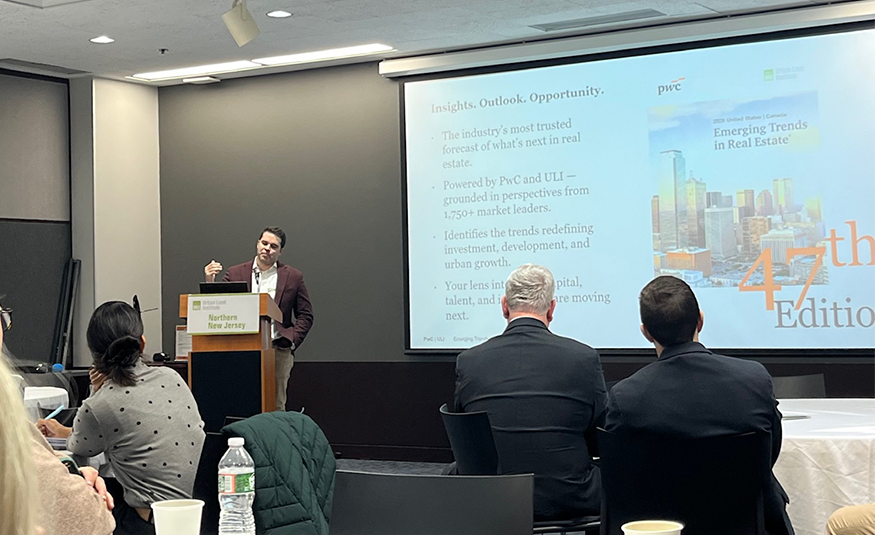
Now in its 47th year, Urban Land Institute and PwC’s most recent Emerging Trends in Real Estate market outlook found tempered optimism in the sector. That could signal slower – but more stable – growth ahead for 2026, according to the “Navigating the Fog” report.
PwC Financial Services partner Ricardo Ruiz delivered an overview of this year’s forecast during a Feb. 3 event. The ULI Northern New Jersey meeting gathered at The Eisenhower Conference Center in Livingston.
New Jersey occupied notable space in the publication’s Top 10 Markets to Watch. Jersey City ranked second on the list, while North Jersey came in at No. 7. Dallas/Fort Worth continued its reign at the top of the list for the second year in a row.
The New Jersey contingent did make considerable gains. Jersey City in Hudson County jumped 17 spots over its 2025 position. And North Jersey surged 15 positions. According to the report, “Northern New Jersey is considered a net buy for apartments, while second-ranked Jersey City is broadly considered for acquisitions outside of office properties.”
Inside the 2026 real estate forecast
Following Ruiz’s presentation, a separate panel focused on the local scene. Speakers touched on how North Jersey has benefited from spillover from New York City; significant year-over-year increases in construction costs; long lead times on certain equipment, such as switch gear or transformers; the office market comeback; and how real estate is still a people business.
Drawing from the report, Ruiz explored 10 themes, including uncertainty in capital markets, niche as the new normal, the emergence of self storage, data centers, student and senior housing and how demographics now shape demand.
By a show of hands, nearly all attendees acknowledged the use of AI in their daily work.
Top investment sectors to watch:
- Alternative led by data centers new
- Multifamily rising
- Industrial falling
- Single family resi rising
- Retail rising
- Hotels falling
- Office rising
*SOURCE: PWC/ULI NNJ REPORT
In the year ahead, the real estate industry will focus on efficiency and technology to adapt to macroeconomic changes, according to the report. An underlying emphasis on discipline and strategic investment in sectors that align with long-term stability will lead the charge, it anticipates. Navigating the Fog published in November 2025.
“Supply constraints are getting tighter. Activity gains are finally starting to accelerate …. So what does that mean for commercial real estate? The assets that perform are going to be the ones that are operationally productive,” Ruiz said. “The buildings that capture economic growth while supply’s constrained. They’re going to have a decisive edge through location, quality, functionality and an efficiency driven economy. Essential real estate, the right assets, the right places will be able survive and thrive.”
North Jersey in the spotlight
Picking up in North Jersey, JLL Capital Markets Senior Managing Partner Jose Cruz opened the local discussion recounting recent activity. And projecting gains ahead in the office market.
Cruz said his team recorded 91 closings last year, representing $4.4 billion in transaction volume. Nearly 20 of the deals were in the office sector.
“Some of those are definitely repositioning, and some of them are tear downs. But the demand for existing office to continue as existing office is there,” he said.

Josh Weingarten, director of capital markets at Triangle Equities, said his company has three transit-oriented developments in North Jersey representing $900 million in development value. Its flagship projects are The Crossing at Brick Station in East Orange and 90 Bayard St. in New Brunswick.
What Weingarten sees in the market today corresponds directly to the ULI/PwC’s report’s hottest markets. He said renters are coming to New Jersey to bridge the affordability gap from Manhattan. And that employers are following suit.
“Combined with how much incentive the state of New Jersey is offering developers to come in and invest to private capital … between the Aspire program, HMFA programs for supporting affordable housing — to really have all the tools necessary to develop ground up in New Jersey,” Weingarten said.
Commenting on Jersey City later in the program, Cruz noted some lease-ups as high as 80-100 units a month. “You can’t even move them in that quickly,” he said.
Emerging markets
Which areas are “next” in the Garden State?
Weingarten said, “We’re very cognizant of the supply pipeline as well, looking for places with proven demand or demand imbalance.”

Like the Middlesex County seat. “In New Brunswick, there’s a very strong employment base with groups like the Robert Wood Johnson Hospital system, Johnson & Johnson, Rutgers University,” he explained. “And then you have all the tenants and the jobs being created by the new HELIX hub project, where hundreds of jobs are being created.
“So, it’s really created a supply demand imbalance with not a lot of multi[family] being built there. We saw that as a great opportunity to come into a new market and develop.”
When it comes to what stands in the way of getting deals done in 2026, Weingarten cited the move from Opportunity Zone 1.0 to 2.0 included in the One Big Beautiful Bill Act.
“Investment groups that have current opportunities on money are uncertain about the transition … and they’re holding back on additional investment this year,” he said. “And groups looking to raise allocators, looking to raise new money under 2.0 are seemingly waiting for the end of this year for more guidance.”
Cruz highlighted a persistent lack of conviction from buyers amid, as PwC and ULI characterize it, the fog.
“I feel like there’s so much noise in the market. It looks positive, some of it’s positive for sure, but there’s a lot of negative out there too,” he said. “So I think one of the things we’ve seen, is the internal struggle. And it’s tough to quantify that; you can’t really come up with a number of how many groups are struggling with that.”
Looking ahead, Weingarten said he’s pulling for a return to positive leverage in 2026, which others may not see coming.
What’s ahead? Debt markets, office recovery, new deals
Weingarten cited liquidity in the debt markets. He noted Triangle recently closed refinancing with Fortress Investment Group after receiving dozens of bids.
“We’re starting to see for the first time – since probably the beginning of COVID – cap rate(s) succeed, stabilize(d) debt costs.” And I think the result is that there’s becoming more and more LP equity, common equity interested in vertical development for the first time in many years.
“There’s a real thawing in that space and I think that will lead to more success in starting real estate development deals this year,” Weingarten said.
Cruz circled back to his confidence in the office market.
“Assets where investors and owners have put capital back in … have been rewarded and have seen leasing increase; have seen even some slight rental increases. … I hate to say it’s all the way back, it’s not, but definitely on the road back to real full occupancy and activity.”
Planning for the future

An update and call to action on the organization’s Urban Plan program preceded the Feb. 3 presentation.
Since launching in New Jersey 2019 at East Brunswick High School, ULI NNJ has has expanded the course to four school districts. Newly added West Windsor Plainsboro High School joins a roster that also includes Morris County School of Technology and East Orange High School.
“These students are getting the educational investment that I think we as real estate professionals, probably wish we had at some point early in our career,” said Michael Mastruzzo; real estate advisory partner, Sax LLP; and management committee treasurer, ULI NNJ.
The post ULI NNJ event explores 2026 North Jersey real estate outlook appeared first on NJBIZ.
