


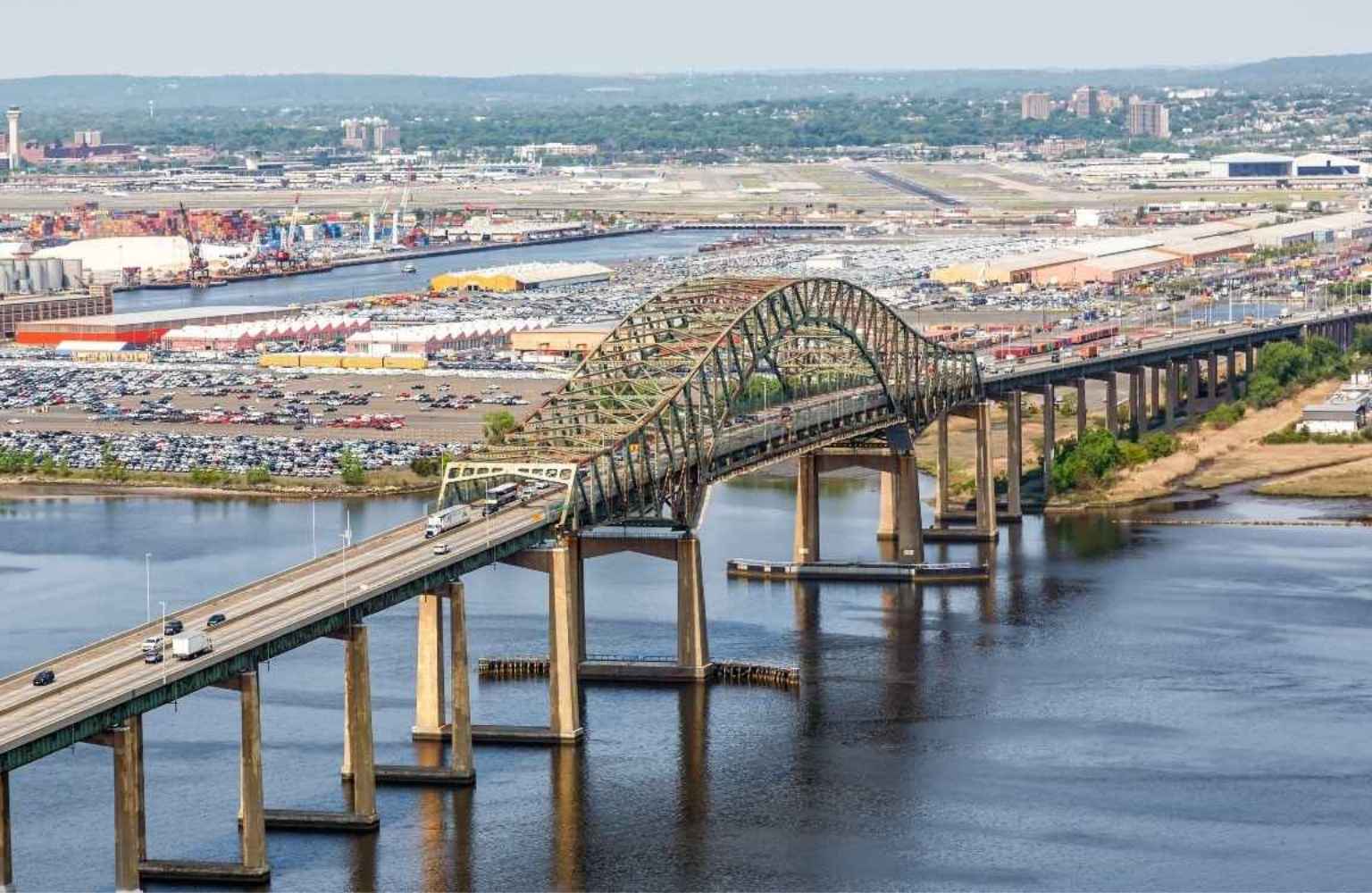
Gov. Mikie Sherrill said March 3 she is scaling back the New Jersey Turnpike Authority’s controversial Newark Bay Bridge expansion project, a decision supported by environmentalists and Hudson and Essex counties’ political leaders who raised environmental and traffic concerns over the project and claimed the process failed to include all stakeholders.
“This $6.7 billion investment will be the largest single project the New Jersey Turnpike Authority has ever advanced. It involves the immediate construction of a four-lane bridge with shoulders and improvements,” said Sherrill in a statement. “I am also recommending that the Turnpike Board continue to advance design and permitting work on the roadway structures leading to the Holland Tunnel for safety improvements only, without expanding capacity.”
Sherrill’s decision upends the Turnpike Authority’s original $10.7 billion plan to widen the Hudson County extension to and from the Holland Tunnel and replace the 70-year-old bay bridge with twin spans. That plan was supported by the Murphy administration.
In the original proposal, the Newark Bay Bridge project was the first in a multiphase program to reconstruct the highway with 29 bridges over 8.1 miles between Jersey City, Newark and Bayonne.
Opposition to the original plan came from grassroots neighborhood and environmental groups, mass transit advocates and public officials in Jersey City, Hoboken and Newark. They were concerned that widening the Hudson County extension to and from the Holland Tunnel would increase air pollution from additional traffic.
“I am also recommending that the Turnpike Board continue to advance design and permitting work on the roadway structures leading to the Holland Tunnel for safety improvements only, without expanding capacity,” Sherrill said.
Sherrill’s decision to scale back the project was met by opposition from Samantha Roman, president of Associated Builders and Contractors New Jersey. “This will undoubtedly increase the cost of this project for all taxpayers, as Project Labor Agreements have been proven to do in study after study. Moreover, this move would effectively shut out 98% of local women and minority-owned firms who are non-union. For someone who’s championed the importance of diversity during her campaign, it’s disappointing that Governor Sherrill is putting politically connected labor unions ahead of taxpayers, local construction workers, and minority and women-owned businesses.”
Sherrill’s decision comes just as the first contract for bridge reconstruction was expected to be awarded in early 2026, with construction starting in the spring.
“The project will also allow traffic to shift off the aging existing bridge by 2031, consistent with [National Transportation Safety Board] concerns,” she said. “This project will support approximately 19,000 jobs, including thousands of union construction jobs. It will generate economic activity across the region and create opportunities for small and minority-owned businesses in our state. These are good-paying jobs that support families and local communities.”
The project will also allow traffic to shift off the aging existing bridge by 2031, consistent with National Transportation Safety Bureau concerns, she said.
Utility and Transportation Contractors Association Chief Executive Officer David Rible used an interesting reference point to underscore how old and outdated the Newark Bay Bridge is. “The Newark Bay Bridge is older than the New York Mets and we cannot allow millions of people to rely on this kind of outdated structure,” he said. “The advancement of the Newark Bay Bridge Program will ultimately create more efficient, modern and safer infrastructure. Our members stand ready, willing and able to get to work on building New Jersey’s future.”
