

The basics:
- $2.3B Portal North Bridge officially enters full service Nov. 16
- 50-foot-high fixed-span bridge eliminates need to stop trains for marine traffic
- Approximately 450 trains travel this section of the Northeast Corridor daily
- Bridge is the first of 11 Gateway Program projects to be completed
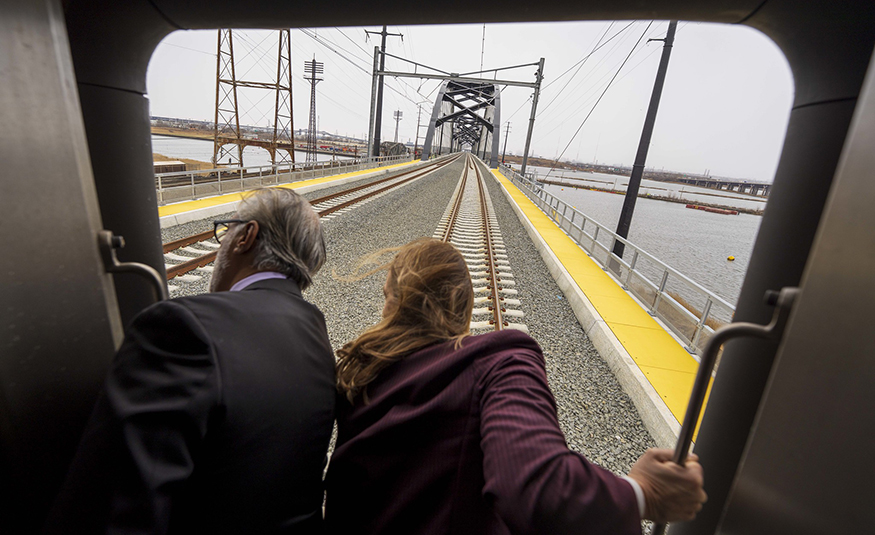
The $2.3 billion Portal North Bridge officially entered full service Nov. 16. The new structure replaces a 116-year-old swing bridge over the Hackensack River that has long caused delays for NJ Transit and Amtrak commuters along the Northeast Corridor.
Gov. Mikie Sherrill joined state, federal and transportation officials in Kearny to mark the completion of the new two-track bridge following a five-week transition that temporarily disrupted rail service throughout the region.
The new bridge stands 50 feet above the Hackensack River, allowing marine traffic to pass underneath without interrupting train service. Its opening marks the first of 11 projects completed under the larger Gateway Program. The multibillion-dollar effort aims to modernize rail infrastructure between New Jersey and New York.
“New Jersey commuters deserve to get to work on time and get home to their families without a century-old bridge holding up the entire Northeast Corridor,” Sherrill said. “With both tracks of the Portal North Bridge now in service, we are eliminating a major source of delays and delivering the reliable transportation our residents and economy depend on.”
After 116 years, a brand new 21st Century Portal North Bridge is ready to carry all rail traffic faster and more reliably!
We’ve completed the transfer from the old bridge, delivering a more dependable trip for the tens of thousands of New Jerseyans who rely on this critical connection every day.
Because New Jersey deserves infrastructure it can count on.
— Governor Mikie Sherrill (@GovSherrillNJ) November 16, 2026
A bridge too far
The original Portal Bridge opened in 1910 and required its swing span to rotate to accommodate marine traffic. Mechanical failures and difficulties closing the bridge frequently caused delays for NJ Transit and Amtrak passengers traveling between New Jersey and New York City.
The new fixed-span structure eliminates the need to open the bridge for passing vessels. The feature addresses one of the longstanding infrastructure bottlenecks along the nation’s busiest rail corridor.
Welcome aboard the new Portal North Bridge!
The new Portal North Bridge is now in service, marking a major milestone in the modernization of the Northeast Corridor and delivering lasting benefits for NJ TRANSIT and Amtrak customers.
Learn more about your new bridge at https://t.co/bbdMYVZpF1
A Better Bridge. A More Reliable Commute.
— NJ TRANSIT (@NJTRANSIT) November 16, 2026
The Portal North Bridge project represents a multibillion-dollar investment supported by the U.S. Department of Transportation, New Jersey, New York and Amtrak.
In January 2021, former Gov. Phil Murphy announced a federal funding agreement securing $766.5 million from the Federal Transit Administration to support its construction. Later that year, NJ Transit approved a nearly $1.56 billion construction contract. Awarded to the Skanska/Traylor Bros PNB Joint Venture, it marked the largest construction contract in the agency’s history.
The project covers approximately 2.44 miles of the Northeast Corridor. It includes new rail infrastructure, retaining walls, concrete foundations, structural steel spans as well as related improvements.
By the numbers
According to NJ Transit, construction of the Portal North Bridge required:
- Approximately 45 million pounds of steel
- 219,000 cubic yards of concrete
- More than 35 miles of pipe piles
Federal investments
Federal officials highlighted the investments behind the project during the Nov. 16 announcement.
Federal Railroad Administration Administrator David Fink credited the Trump administration with a $771 million investment. Federal Transit Administration Region 2 Administrator Michael Culotta said the FTA provided $926 million toward construction.
The figures reflect funding commitments described by federal officials and should not be added together as separate contributions without accounting for potential overlap.

The project also represents a significant investment in organized labor and construction jobs across the region.
“This remarkable achievement in construction and engineering is further proof that our members are building the infrastructure that America will rely on for the next 100 years,” Hudson County Building & Construction Trades Council President Patrick Kelleher said.
Making progress
The completion follows two major construction phases that transferred rail service from the original bridge to its replacement.
Work to move the first track began Feb. 13 and concluded March 15, allowing trains to begin using the new bridge while the original structure remained operational. The second phase began Oct. 9 and concluded Nov. 16, completing the transition of both tracks to the new crossing.
During the final phase, NJ Transit temporarily modified service across much of its rail network, including diverting weekday Midtown Direct trains to Hoboken as well as reducing service along portions of the Northeast Corridor and North Jersey Coast Line.
The temporary adjustments affected thousands of commuters traveling between New Jersey and New York City, with some passengers required to transfer to PATH trains, ferries or buses to reach Manhattan.
Regular weekend service resumed Nov. 15, followed by the return of regular weekday schedules Nov. 16. Weekday Midtown Direct diversions to Hoboken and temporary cross-honoring arrangements also ended.
Commuting concerns
NJ Transit President and CEO Kris Kolluri said the new infrastructure will eliminate a recurring source of disruptions for commuters.
“The new Portal North Bridge permanently removes a chronic source of delays, allowing marine traffic to pass beneath the bridge without interrupting the trains carrying our customers to work, home and everywhere in between,” Kolluri said.

Approximately 450 trains travel along this portion of the Northeast Corridor daily, making the crossing a critical connection for commuters and intercity rail passengers.
The former Portal Bridge is officially retired from rail service and scheduled to be dismantled in 2027.
Major milestone for the Gateway Program
Beyond improving daily rail reliability, the bridge is a key component of the Gateway Program. The broader infrastructure initiative is designed to modernize and eventually double rail capacity between Newark and New York City.

The program includes the Hudson Tunnel Project, which will construct a new two-track rail tunnel beneath the Hudson River and also rehabilitate the existing North River Tunnel.
The Portal North Bridge addresses one of the longstanding infrastructure bottlenecks along the Northeast Corridor, which connects major economic centers throughout the northeastern United States.
U.S. Sen. Cory Booker, D-N.J., said the bridge’s completion represents the first finished project among the Gateway Program’s 11 project, and follows more than a decade of efforts to secure federal funding.

Booker pointed to the 2021 Bipartisan Infrastructure Law and American Rescue Plan as key measures supporting the investment.
“The completion of the Portal North Bridge project – the first of the Gateway Program’s 11 projects completed – means fewer delays, more reliable service, and a better commute for the thousands of New Jerseyans who depend on our trains every day,” Booker said.
Making progress
Gateway Development Commission CEO Tom Prendergast said the completed project demonstrates progress toward improving transportation reliability across the region.

“Together with the Hudson Tunnel Project, we are … proving that we can deliver on the promise of a new day for American infrastructure,” Prendergast said.
For New Jersey businesses and commuters, the bridge is expected to provide more predictable rail service, reducing disruptions that can affect employee travel, business operations and regional connectivity.
While the new crossing removes a major source of delays, broader capacity improvements will depend on the completion of additional Gateway projects, including the Hudson Tunnel Project.
The opening marks a major step in the state’s ongoing transportation infrastructure improvements, ending more than a century of reliance on the original Portal Bridge while laying the groundwork for future rail investments throughout the region.
