

The basics:
- 16 industrial rooftop projects will generate more than 10 MW of solar capacity
- Nine projects have received notice to proceed; construction underway in Fair Lawn
- At least 50% of each project’s capacity reserved for low- and moderate-income households
- 400 MW of New Jersey community solar projects reportedly face grid interconnection constraints
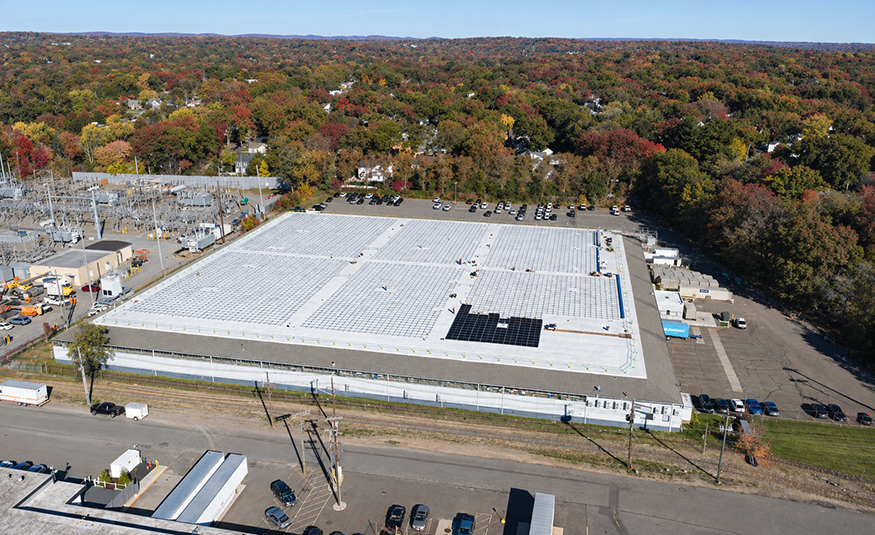
With construction underway in Fair Lawn on its first community solar installation, Hoboken-based Faropoint is embarking on a project activate 16 of its industrial rooftops across New Jersey.
The covering of 19-05 Nevins Road in the Bergen County borough will support 1.6 megawatts of the more than 10-megawatt capacity the overall package will generate.
Teeing up the rest of the work, the New Jersey Community Solar Energy Program has also accepted the remaining 15 projects, according to a Nov. 4 announcement from Faropoint and commercial solar advisory SolarKal. Nine have received notice to proceed, which will allow additional construction to begin.
For Faropoint, the endeavor will expand access to renewable energy, particularly in underserved communities. The company said at least half of each project’s capacity will be reserved for low- and moderate income households.
For New Jersey, the output could help alleviate energy generation issues and promote clean options to individuals in the community who may not be able to install solar panels, etc.
Taking responsibility
The 16 projects are expected to generate approximately 12.7 million kilowatt hours of power.
“We aim to create positive community impact, increase access to clean energy, and become a responsible long-term owner in the markets where we operate,” said Brian Nave, vice president of asset management and renewable energy at Faropoint. “As one of the top-five small-bay industrial owners in New Jersey, we believe our scale comes with a responsibility to drive meaningful sustainability initiatives.
“Utilizing previously unused portions of our buildings allows us to support the communities where we invest,” Nave said.
SolarKal serves as Faropoint’s independent solar advisor. Altogether, the partners say the work will keep an estimated 8,500 metric tons of carbon dioxide emissions out of the atmosphere. Based on Environmental Protection Agency greenhouse gas equivalencies, that equals the annual electricity use of more than 1,700 homes.
“Managing solar across a large real estate portfolio takes persistence, coordination, and a lot of work behind the scenes,” said Yaniv Kalish, CEO of SolarKal.
The firm says it has advised Faropoint on dozens of projects across its entire portfolio. Its services include financial analysis, competitive procurement, developer evaluation and selection, and ongoing project management. The partners have additional community solar projects at work in Illinois, New York and Maryland.
SolarKal said it has also helped Faropoint select developers able to use available federal clean energy incentives before they are phased out.
Approaching an impasse?
In March, the New Jersey Board of Public Utilities approved a 3,000 megawatt-expansion of the state’s community solar program. The enhancement marked the largest capacity allocation in state history and set a precedent as the biggest expansion of a state-run community solar program nationwide. The increase will provide clean energy savings for about 450,000 subscribers, NJBPU said at the time.
New capacity distribution to major electric utilities, from March 2026:
- PSE&G – 1,555 MW
- Jersey Central Power & Light – 787 MW
- Atlantic City Electric – 324 MW
- Rockland Electric – 51 MW
- Reserved for landfill projects – 300 MW
Project registrations will remain open through Dec. 31, 2029, or until all 3,000 MW are subscribed.
However, the output could contend with bottlenecks when it comes to interconnection.
A recent analysis from community solar developer Dimension Energy found there are 400 MW in community solar projects throughout the state that cannot connect to the grid due to capacity restraints. According to Politico, the report found NJBPU accepted 91 projects totaling 125 MW into the state community solar program in 2024, or earlier, that have not come online.

Additionally, 307 projects totaling 285 MW received interconnection approval from PSE&G, but were not approved by the Board for the community solar program, Politico noted.
A recent NJBIZ panel on energy highlighted electric grid capacity restraints as a major challenge when it comes to supporting new developments. Former New Jersey Senate President Steve Sweeney serves as chair of Natural Allies New Jersey. During the discussion he pointed to a proposed $50 million South Jersey solar project forced to reduce its size due to grid limitations.
“So, we need energy. We want to generate energy. We’re going to generate clean energy. And guess what? We can’t,” Sweeney said.

Building bigger impact
The state reports a total solar pipeline of 10,628 projects, as of Sept. 30. Of that, 362 represent community solar initiatives and 654,913 kilowatts, or more than 50% – the largest share – of New Jersey’s overall pipeline capacity.
When it comes to installations, community solar tallies 251 of 247,657 total state projects, representing 337,661 kw and just 5.86% of installed capacity. Behind the Meter interconnections lead here, representing more than 78% of all installed capacity.
In October, the state Senate approved (39-0-1) a measure that seeks to promote community solar projects by easing geographic restrictions.
Senate Bill 4729 would expand qualifying community solar projects on landfills, brownfields, or contaminated/mining sites to include additional parcels associated with the primary property. The legislation would also prohibit NJBPU from limiting these projects based on the amount of additional land included.

Senate President Nicholas Scutari, D-22nd District, and Sen. Jon Bramnick, R-21st District, co-sponsor the bipartisan legislation.
“New Jersey needs more energy and should make better use of the land we already have to expand our clean energy footprint,” said Bramnick. “This legislation would give community solar projects more flexibility to use additional land, creating more opportunities to generate energy right here in New Jersey.”
To date, New Jersey community solar has delivered more than $70 million in bill credits and $14 million in net savings to more than 37,000 subscribers, NJBPU said. The 162 operation projects total 228 MW.
The post Faropoint advances first of 16 NJ community solar projects appeared first on NJBIZ.
