

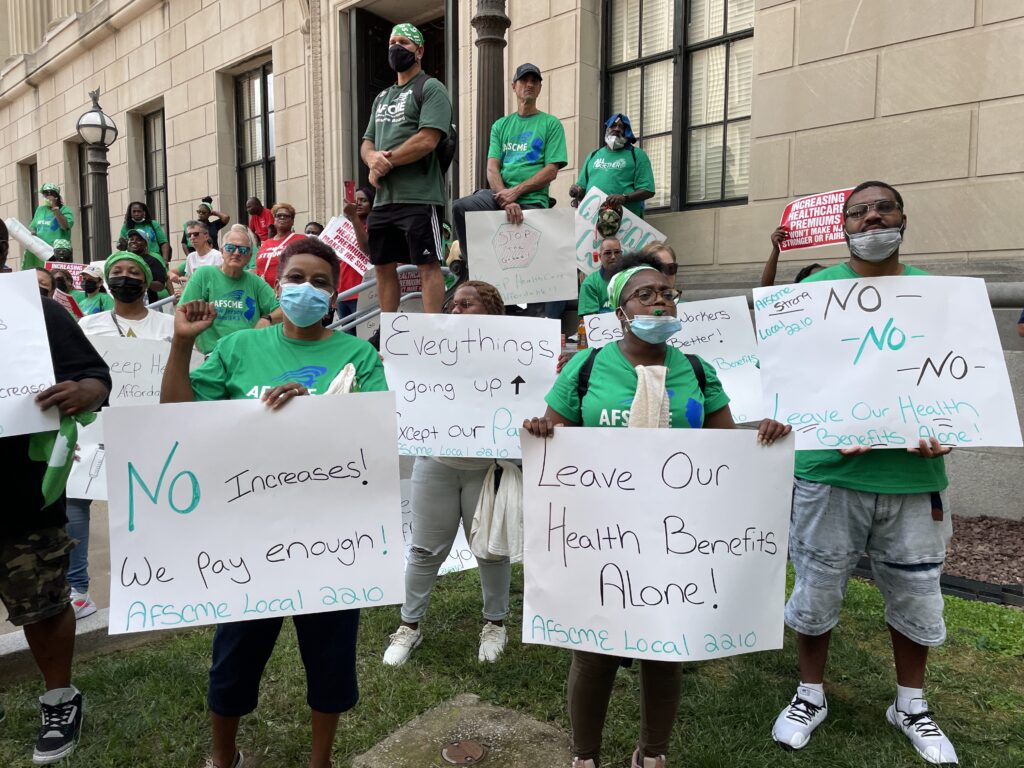
Hundreds of union workers rallied outside the Statehouse in Trenton on Sept. 13, 2022, to protest healthcare premium increases. The State Health Benefits Commission approved the increases on Sept. 14, 2022, despite the protest. (Dana DiFilippo | New Jersey Monitor)
State and labor officials have reached an agreement to cut costs for New Jersey’s distressed state worker health plan after months of protests and negotiations, officials announced Thursday.
The deal would reverse a $100 million cut state lawmakers signed off on when they passed a new $58.8 billion state budget in June, which would have been borne by state employees covered by the State Health Benefits Program.
While workers still will see their out-of-pocket costs rise, those increases will be “modest,” and the agreement bars any increases in member contributions next year, according to Communications Workers of America District 1, which represents more than 140,000 state workers.
It also requires reforms intended to identify the root causes of runaway medical costs and contain costs going forward, and urges state legislators to ensure future budgets respect existing health care agreements, union officials said.
Gov. Phil Murphy in a statement characterized the deal as one that would implement one of the most significant updates to state health benefits plans in nearly 15 years. The changes must be approved by a state committee, which is expected to review the agreement later this month.
“I am committed to working with the unions until the end of my Administration to provide solid recommendations to future State leaders on how the State can adopt best practices and get the best deals in the health care market on medical care and drug pricing,” said Murphy, a Democrat whose two terms as governor are ending in January.
Billy Gallagher, the union’s assistant to the vice president, called the agreement “a hard-won victory for the 100,000 state workers and retirees who were facing catastrophic health care cost hikes.”
“It proves that when we sit down at the table through the proper channels, we can find solutions that protect working families and control costs for the state,” Gallagher said in a statement.
According to Murphy’s office, the agreement includes some of the following changes:
- A $110 in-network deductible for individuals and $220 in-network deductible for families for all plans that currently have lower deductibles.
- A $750 out-of-network deductible for individuals and $1,500 out-of-network deductible for families for all plans that currently have lower deductibles.
- A $2,500 out-of-network, out-of-pocket maximum for individuals and $6,000 out-of-network, out-of-pocket maximum for families for all plans that currently have lower out-of-network, out-of-pocket maximums.
- New co-pays on anti-obesity GLP-1 drugs like Wegovy, plus generic, brand, nonpreferred brand, and specialty medications across all plans.
- New co-pays on lab visits and imaging across all plans.
- Limits on out-of-network physical therapy visits across all plans.
Under the deal, the state and union officials will create a working group to draft a roadmap for the next administration that will recommend ways to stem soaring health care costs, including by reducing provider prices. Republican former Assemblyman Jack Ciattarelli and Democratic Rep. Mikie Sherrill are vying in November to succeed Murphy.
Officials also will examine overpayments to providers and work to recoup those funds, promote in-network providers over costly out-of-network options, and steer employees to ambulatory surgery centers instead of hospitals for common procedures like colonoscopies and lumpectomies, the union said.
They’ll also implement a reverse auction, or online bidding process, to cut pharmaceutical costs and incentivize healthy lifestyles to manage costs associated with employees on pricy weight-loss medications, officials said.
“This deal not only rescinds a dangerous precedent of bypassing our contracts but also establishes a collaborative path forward to tackle the root causes of rising health care costs,” Gallagher said. “It is a powerful testament to what we can achieve through collective bargaining and good-faith dialogue, and it ensures our members’ voices are heard in shaping the future of their healthcare.”
Assembly Speaker Craig Coughlin (D-Middlesex) in a statement said he is pleased by the agreement.
“We have always believed that the best way to make public health benefits affordable for taxpayers and public employees is by working collaboratively with workers and their unions,” he said. “We look forward to reviewing the agreement and continuing our efforts to protect taxpayers from rising costs while providing affordable health care options to public workers.”
While union leaders and Democrats celebrated, the New Jersey Legislature’s Republican leader and budget officer lamented the news, saying the deal just defers problems with the health benefits program to a later date.
“It’s clear the Democrats’ health insurance plan means increased property taxes and big premium increases for public employees,” Sens. Anthony Bucco (R-Morris) and Declan O’Scanlon (R-Monmouth) said in a joint statement. “Meanwhile, the local benefits death spiral is being left to the next governor to fix.”
The Treasury said in a May report that the side of the State Health Benefits Program that covers local government workers has become “structurally unstable” and “financially unsustainable” after years of sharp premium increases and a dwindling subscriber pool.
GET THE MORNING HEADLINES.
