


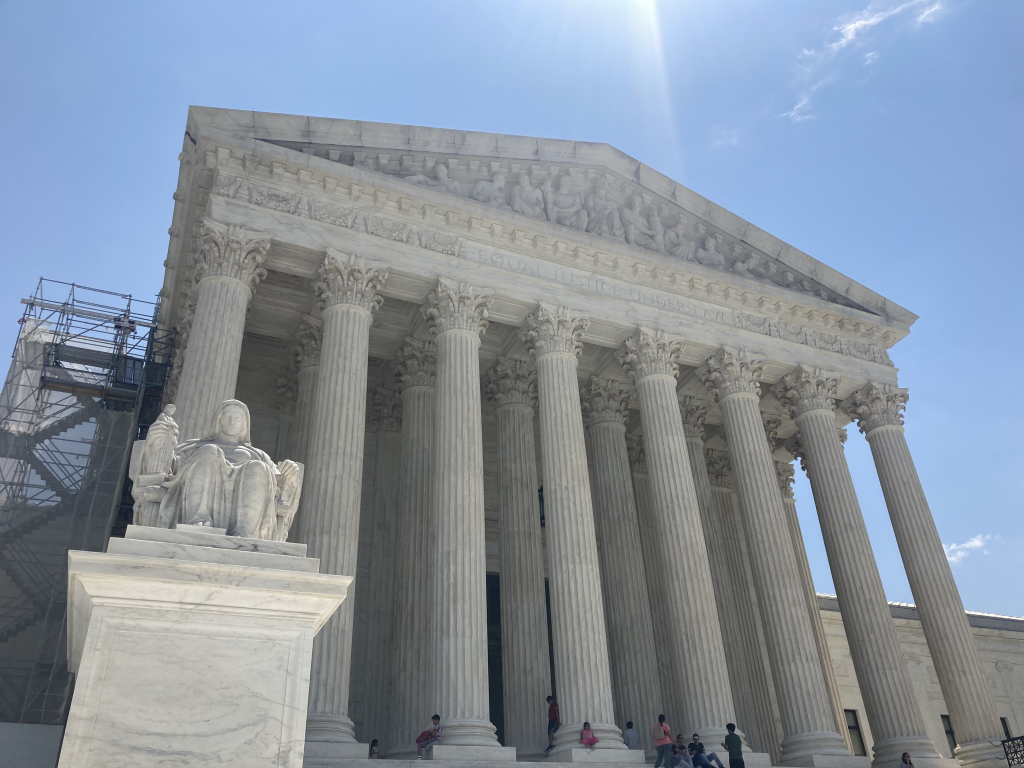
The Supreme Court’s so-called “shadow docket” is not a new phenomenon. The justices have long considered cases on an emergency basis. However, the practice has gained greater significance since Donald Trump’s Presidency.
What Is the Shadow Docket?
The Supreme Court’s emergency docket is separate from its regular merits docket. It is generally reserved for emergent matters that require immediate Court intervention, such as staying an execution, halting a deportation, or preventing implementation of a lower court order. For instance, cases often involve emergency requests for a stay, which is a temporary suspension of a lower court order and is intended to prevent irreparable harm while a case proceeds through the courts.
Unlike a typical Supreme Court case, emergency matters are decided without full briefing and oral argument. In many cases, they are decided without a written opinion explaining the Court’s reasoning. Summary orders also typically don’t list how each justice voted. Hence, the term “shadow docket,” which University of Chicago law professor William Baude coined in 2015.
Rise in Emergency Matters Before the Court
The Supreme Court’s shadow docket has come under scrutiny in recent years, largely because of its exponential growth and the role it has played in deciding controversial issues like voting rights, abortion, and immigration. In the 2023-24 term, there were 44 matters on the emergency docket. In the 2024-25 term, the list grew to 113 matters.
While executions and deportation orders still comprise a large portion of the Court’s emergency matters, the shadow docket has been increasingly used to address challenges to presidential orders and actions. Since the end of the term, the justices have issued several rulings concerning legal challenges to actions by President Donald Trump. The majority have been 6-3 rulings, with Justices Sonia Sotomayor, Elena Kagan, and Ketanji Brown Jackson dissenting.
- In Trump v. American Federation of Government Employees, the Court stayed a preliminary injunction preventing the firings of government employees in many federal agencies.
- In McMahon v. New York, the justices lifted a district court’s preliminary injunction preventing mass terminations at the Department of Education.
- In Trump v. Boyle, the Supreme Court overturned a preliminary injunction halting the firing of three members of the Consumer Product Safety Commission who were protected from removal except when there was “cause” for firing.
The rise in emergency rulings is also fueling confusion regarding whether shadow docket rulings should be regarded as binding precedent. Merits decisions issued by a majority of the Court carry precedential weight, which means that they determine the outcome of future cases involving the same issues. However, non-merits orders have traditionally not been treated as binding on the lower courts.
Critics have also raised concern about the Court abandoning long-standing precedent without full briefing or oral argument. Justice Kagan wrote a dissent in Trump v. Wilcox, joined by Justices Sotomayor and Jackson, lamenting that “[o]ur emergency docket, while fit for some things, should not be used to overrule or revise existing law.” She explained that the Court’s ruling “allows the President to overrule Humphrey’s by fiat.”
Critics also contend that the shadow docket allows the justices to make consequential (and often controversial) decisions without the public scrutiny typically associated with its merits cases. The lack of oral arguments and written decisions also makes it challenging for the public and legal scholars to analyze the Court’s reasoning. As Professor Erwin Chemerinsky wrote on SCOTUSblog, “’Because I said so’ never is persuasive or satisfying. And it certainly should not be regarded as acceptable when it is the Supreme Court resolving important issues – even matters of life and death – without the slightest explanation.”
So, what’s the solution, assuming there is one?
To start, the Court could be more transparent by issuing full opinions, particularly when significant legal issues are at stake or precedent is being reconsidered. If justices can write lengthy dissents, writing a majority opinion doesn’t seem like a particularly big ask. The justices could also be more restrictive when considering what cases to decide on an emergency basis. In many recent matters brought before the Court by the Trump Administration, critics of the shadow docket contend that the harm to the government in delaying Supreme Court relief until the case can be heard on the merits would be minimal.
While legislation has been introduced to address the shadow docket, it has failed to advance. Congressional action remains unlikely in today’s political climate. Accordingly, the Court would likely have to impose these restrictions on itself. With the emergency docket poised to continue to play a significant role next term, all eyes will be on the justices.
