


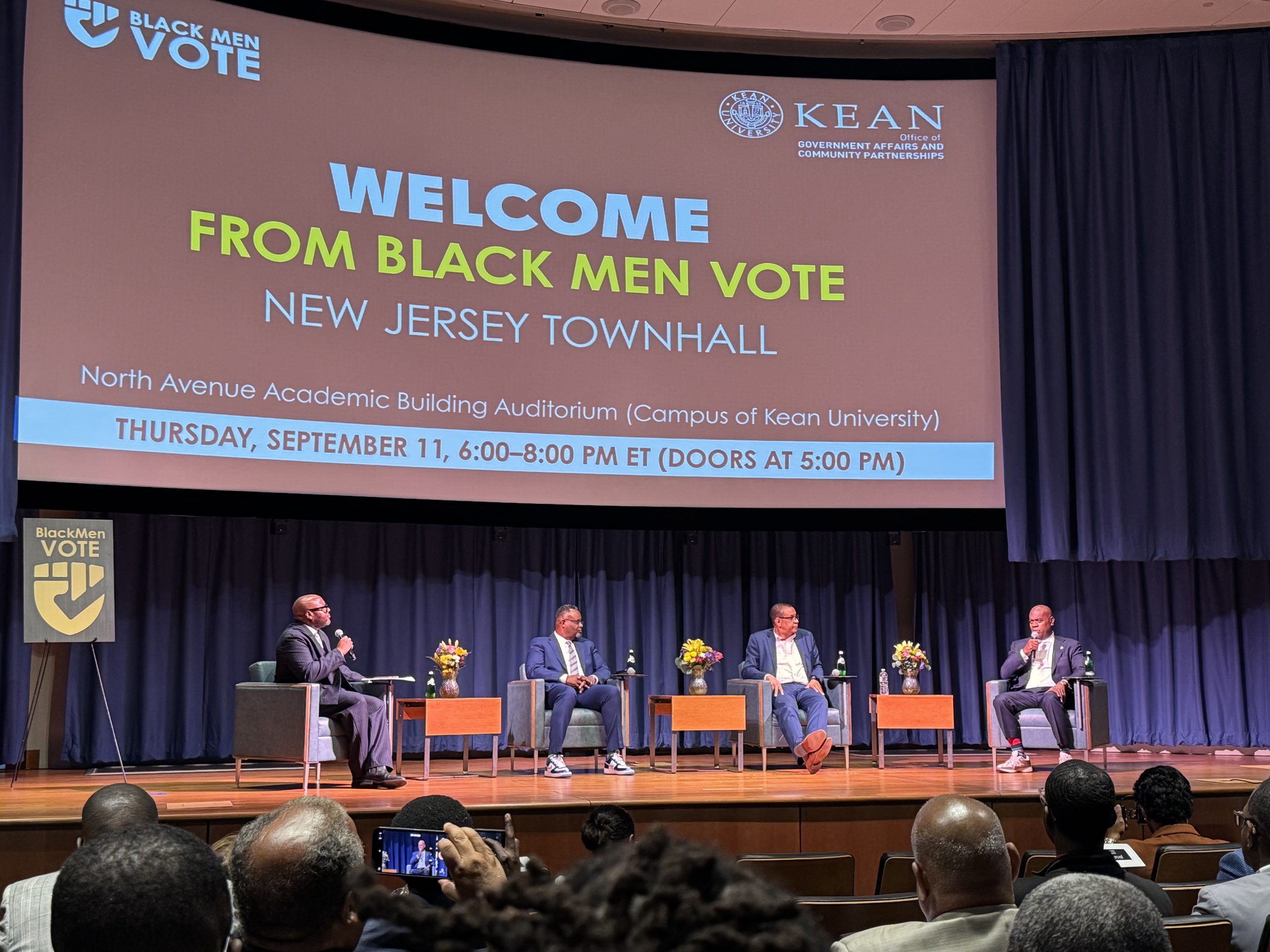
Dale Caldwell, the Democratic nominee for lieutenant governor, looked out from the stage. He was at Kean University with other Black leaders on Thursday to discuss an inescapable challenge of today’s politics: low turnout from Black male voters.
As he looked into the seats, he acknowledged the irony of the evening: two-thirds of the auditorium was empty.
“One of the things that has troubled me is the apathy,” Caldwell said. “You know, this room should be filled. Folks should be coming out, seeking out, ‘Is there something for me?’”
The town hall, hosted by the nonprofit group Black Men Vote, sought to discuss ways to increase the civic engagement of Black men, which they deem one of New Jersey’s “most decisive but under-engaged voting blocs.”
The panelists — Caldwell, Newark Mayor Ras Baraka, and Kean University President Lamont Repollet, as well as moderator Nii-Quartelai Quartey — were each left-leaning Black men, though the ideological tilt of the panel wasn’t by design. Mike Bland, the executive director of Black Men Vote, said an invitation to the panel was extended to Republican Jack Ciattarelli’s campaign for governor, but nobody came.
“We are not partisan,” Bland told reporters. “I know you’re like, ‘Mike, you have three Democratic guys up there.’ Well, we extended an invitation to everybody, and we still talk to you whether you’re a Black male Republican or whether you’re a Black independent. Doesn’t matter who you are.”
Bland, who worked on Kamala Harris’ campaign for president, said his group’s goal is to increase turnout among Black men, an issue that has proven intractable. The organization has hosted meetings and town halls nationwide and plans to hold more events in the Garden State before Election Day. Bland said that with Black voters moving rightward and Democrats seeking to keep the governorship of a state with 1.5 million Black residents, this is a chance for both parties to invest in Black communities.
“I think this is a great opportunity for either party to present themselves with an agenda for Black men,” Bland said. “I think it’s a great opportunity for even Jack, right? But it takes more than a photo op.”
New Jersey shifted 10 points toward Republican Donald Trump in last fall’s presidential election, one of the country’s most dramatic shifts. Black voters proved to be a key force behind that change. Analysis from the New Jersey Globe found the state’s eleven predominantly Black towns voted for Joe Biden by a 79-point margin in 2020, a number that dropped to 66 points for Kamala Harris last year. National analysis from the Pew Research Center determined 12% of Black men voted for Trump in 2020 before a spike to 21% in 2024.
Pew analysis also determined Black voters were one of the blocs with the highest drop in turnout rate from 2020 to 2024.
Caldwell, the president of Centenary University, was asked about his interactions with Black voters on the campaign trail. He said he runs into three types of voters. First, those who agree that democracy is at risk under Trump and support Democrats (“preaching to the choir,” Caldwell said). He said the second group includes people who openly care about themselves or their families instead of their communities writ large, while the third group includes the state’s admittedly apathetic voters.
“The second group, and I’m really disturbed that this group is so open, are people saying, ‘I only care about my family. I don’t care about anything.’ And they’re not smart enough to understand that we’re all integrally connected,” Caldwell said. “There’s a saying in Africa called Ubuntu. ‘I am because you are.’ And that is so true in American society.”
The Sherrill campaign’s most consistent criticism of Ciattarelli is that he would essentially be a Jersey version of Trump. They criticize the former assemblyman for aggressively angling for the president’s endorsement, and they regularly repeat Trump’s assertion that Ciattarelli is “100% MAGA.” Caldwell said the election could rest on whether Democrats can convince voters — particularly the second and third groups he described — that Trump and Ciattarelli pose a threat to their well-being and to democracy.
“I’m realizing that we have to really change the discussion in a way that’s very personal, to say how this is going to affect you and your family,” Caldwell said. “And so I’ve been very, very, very disappointed in how many people will openly say, ‘I don’t care about anybody else but my family.’”
Baraka was frank throughout the discussion — he joked that he’s unable to hide disagreements on his face, no matter how hard he tries. In an indirect response to Caldwell, the mayor said he understood why people expressed a desire to put themselves and their families first. Warning about the ills of Trump isn’t enough to convince voters who have suffered since before Trump arrived in the Oval Office, he said.
“How are you going to help me get out of this place where I’m at [and get] to where I need to be?” Baraka asked on behalf of those residents. “What are you going to do for me specifically? And that’s what I think people are really getting at when they say ‘my family’ or ‘me.’ They’re getting at the fact that we help everybody but us. … I’m putting my body in front of people, and while I’m taking the blows, they’re eating.”
Baraka finished second in this summer’s Democratic primary for governor, about 13% behind Sherrill. He was perhaps the race’s most progressive candidate, proposing a sweeping platform that he said would create an “opportunity economy.” Last week, Baraka said defeating Republicans is a necessity and endorsed the congresswoman, even while acknowledging their many policy disagreements.
“I’d rather argue with the congresswoman about [civilian complaint review boards] than debate about whether the National Guard should be on our streets,” the mayor said last week. “I would rather have a discourse about very specific issues that I think are important to me, than them thinking that the police should have the ability to do whatever they want, whenever they want, to whomever they want.”
Baraka’s endorsement of Sherrill wasn’t necessarily a shoo-in. In April, when Sherrill was clearly the front-runner in the primary and the rest of the field sought to claw their way to contention, he visited her hometown of Montclair and called on the Democratic Party to embrace policies that increase racial equity. During that visit, he said Sherrill might not be able to inspire Black voters to turn out, and implied he might not even vote for her if she didn’t strengthen her stances against issues harming New Jerseyans of color.
On Thursday evening, Baraka criticized the electoral system and the candidates who have succeeded under it. He said financial influence in elections means candidates back away from substantive proposals out of fear of losing donors. This, he said, leads to empty promises and governance.
“[These] candidates win without saying anything, because they’re told not to say anything by these advisers who tell them, ‘You shouldn’t say anything, stay away from this, stay away from that, be as moderate as possible.’ Because you’re trying to win specific votes, but you also are not trying to chase the money away,” Baraka said.
He said Black communities don’t possess the same capital as other political blocs, meaning they’re often the first to be left behind.
“I ran into a Black woman in Maplewood who was waiting for me on the porch just to cuss me out and tell me she left the Democratic Party and she don’t know why I’m running as a Democrat,” Baraka said. “But at the end of the day, I think people honestly, at this stage, want somebody to do for them what crazy ass Donald Trump is doing for those crazy people. They want somebody to take care of them and protect them.”
Like last week, after discussing what he expects out of a Sherrill-Caldwell administration, he endorsed the Democratic nominees in their suit for the governorship.
“We want you to win, brother,” Baraka said. “We hope that you do. We need you to win. I can’t imagine National Guard on the streets of Newark.”
Repollet, the president of Kean University, offered similar sentiments. He attended the Democratic National Convention last summer, even giving remarks before the convention’s Black Caucus, but he returned dissatisfied, feeling the platform didn’t offer enough.
“I was at the Democratic National Convention, and I came back from the convention and I told my wife that it was great, a good experience. But I wasn’t moved,” he said. “There wasn’t policies that were set for Black men. Some of the folks that are running for governor and mayor and stuff like that, they have plans in place, but we’re not seeing those plans materialize.”
Caldwell said he understood those concerns and wants to be part of the solution. He pointed to projects like Entrepreneur Zones and workforce development grants to prove he has the experience and know-how to build opportunities for New Jerseyans. But, he said, he can’t do it alone.
“This is our time,” he said. “And so you can either sit on the sideline and complain, or you can jump in and do it. We’re all jumping in and doing it.”
