


 Listen to this article
The basics:
This article is the last in a three-part series. The first, “Missing-Middle Solutions for Achieving State-Mandated Affordable Housing Requirements,” was published May 19, 2025. The second, “Designing Context-Appropriate Midrise Solutions,” was published Aug. 18, 2025.
Fourth-round obligations for creating affordable housing units under New Jersey’s Fair Housing Act are soon to impact municipalities across the state, totaling a seemingly astronomical 84,000 units. But while developing and building this number of units by the 2035 deadline will be challenging, architects are positioned to help make this aspirational goal a reality.
As discussed in earlier articles in this series, innovations in design, both in mid-rise residential and in missing middle housing approaches, can help developers get municipalities over the finish line by proposing solutions to guide zoning and gain approvals even from the most skeptical agencies, boards and communities.
Importantly, architects also have the knowledge and experience necessary to guide their clients in identifying properties and sites that show promise for development.
By consulting with architects about locations and acquisition, developers and municipalities can increase the likelihood of successful project completion while also pushing the boundaries of what is possible in the design of affordable housing.
To address the Fourth Round, the state will require multiple paths, including 100% affordable developments, mixed-income developments and inclusionary housing (20% affordable). New Jersey municipalities will need to use many tools to successfully navigate the goals of the Fourth Round, including areas in need of rehabilitation, redevelopment zones and affordable housing overlays. These different paths can incentivize investment and provide towns with the means to accomplish their goals.
Location, location, location
Princeton’s innovative affordable housing overlays offer an example of how cities and towns can exercise some control over where they grow and add density. Municipal leaders will also look to other tools mentioned above and where they go, such as transit hubs and retail corridors, for opportunities to allow large-scale developments, mid-rise construction and smaller-scale approaches, such as adding stories to existing buildings and converting underutilized upper-story commercial space and adaptive use.
Another consideration is the affordability of acquiring the land, according to Jak Inglese, senior partner with Inglese Architecture + Engineering in Cedar Grove, who adds that the site also has to be appropriate for any developer incentives sought. “We look for sites that are large enough to support a project of 60 units or more to make LIHTC [Low Income Housing Tax Credit] funding more viable,” says Inglese, who notes that it’s best if the municipality offers payment in lieu of taxes (PILOT) since that is a requirement for LIHTC funding.

The location is the most important thing, for a host of reasons. Stephen Schoch, principal with Collingswood-based Thriven Design, suggests, “What you want is what makes any location desirable to live in — if it’s a location that you would like to live in, the likelihood it is a great location for affordable housing is pretty strong.”
Among the qualities and adjacencies to look for are the following — and the more of these nearby, the better: shopping, transit option, good schools, job centers, and recreation and green space.
Schoch adds that for a mixed-use development, the site must support the proposed commercial tenancy as well. With a nod to Inglese’s insight about finding a property at the right price, Schoch notes, “The challenge is that locations with these qualities are also highly desirable in the marketplace, and their cost can be a premium that affordable housing projects cannot afford.”
Working with municipalities
The question then becomes how to meet Fair Housing Act mandates without pushing affordable development into areas that have few or none of these livability factors. According to Inglese, things really come together when the municipality is on board with helping developers to find sites for affordable housing that check the boxes on the “daunting list” of livability and affordability requirements.
“This is why affordable housing moves at a rate that cannot keep up with demand for it,” he notes.
Schoch adds that all too often “municipalities will simply identify an available or underutilized piece of municipally owned property without much consideration of these livability factors, presuming that the project will somehow overcome any problems or concerns.”
As solutions-oriented building professionals, architects want the rental properties we design to have value for owners, tenants and the community at large. Opportunities for affordable development tend to present themselves, according to Inglese, when municipalities introduce zoning changes and overlays that allow for medium- and high-density development.
But as Schoch points out, this is a big challenge in suburban and rural areas where zoning rules place limits on height and density. “To the point that compliance for a typical 60-unit tax credit project is either physically or economically impossible – even when a project is clearly identified in the local Fair Share Plan,” he says.
Schoch continues: “One possible fix is to have the project description of any affordable housing project in an adopted Fair Share Plan serve to automatically override the zoning on the location in question. The project would still need to go through engineering review and technical compliance, but the most challenging issues of density, height, bulk standards and parking would be considered as settled.”
Whatever [Not In My Backyard]ists feel the community will lose by permitting development of affordable housing, an architect’s design can respond by minimizing or replacing their loss and showing them what they stand to gain.
Architects can move the process forward by helping to identify properties with lots of potential. For example, some uses that created or modified zoning, such as golf courses, corporate campuses and shopping malls, may provide perfect opportunities for increased density without a robust impact on infrastructure. Properties owned by religious congregations may be ripe for redevelopment, as well, by collaborating with the institutions – a proposition that can shore up the worship institution’s financial stability by creating partnerships with municipalities and developers while creating a unique mixed-use community that can promote the social goals of the religious institution by providing affordable and inclusionary housing.
While people tend to be familiar with how things have been for decades – that is, battles over pushing affordable dwellings to the outer fringes of towns – that kind of NIMBYism (Not In My Backyard) can be disarmed by designing to answer their objections. Whatever NIMBYists feel the community will lose by permitting development of affordable housing, an architect’s design can respond by minimizing or replacing their loss and showing them what they stand to gain.
The world changes whether we want it to or not, and if we participate in the change, we can make sure it serves us all. As an example, the memory among Princeton residents of a nine-story medical office tower and associated feelings of loss and “not in my backyard” has faded with the construction of a four-and-a-half-story mid-rise multifamily apartment development on that site.
Adaptive reuse
Finally, we should take a moment to recognize the valuable opportunity available in many locations where sites in good locations feature existing structures. While there may be limitations on the potential for their reuse, such as brownfield conditions or outdated MEP (mechanical, electrical and plumbing) infrastructure, there are good reasons why converting a non-residential building into affordable or mixed-income housing is strategically wise.
Preserving history. Aware that NIMBY-minded residents primarily resist development because they do not understand the change, the story of rescuing a piece of iconic architecture from demolition can help the architect and developer push plans through the approvals process, even in neighborhoods considered to be historic. While not every adaptive reuse project doubles as historic preservation, those that can do so offer a unique opportunity to get locals excited about adding density.

According to Al DeLuca, associate principal and director of project services with Thriven Design, “In the case of those existing buildings that have been regarded well by the public, the community is rewarded with ‘new life’ at an abandoned or underutilized building, while maintaining what many consider an integral piece of their town’s fabric.”
Cost savings. The architect and development team must be careful not to overpromise on this front when speaking with investors, but the more an existing structure can be reused, the greater the potential for reduced materials cost – an important consideration for those times when lumber, concrete and steel prices spike. Nothing is so simple, of course, and adaptive reuse can come with its own challenges in terms of finance, including the unexpected.
DeLuca points to Thriven Design’s reuse of the West Orange Library as a gathering space for a new affordable housing development for seniors, recalling, “Once selective demolition was underway, issues were uncovered and the team had to work together to resolve quickly to stay on track.” Planning for these surprises is key, and some margin for grappling with unexpected delays and cost overruns should be factored into budgets and schedules.
Sustainability. While not always a primary consideration in developing affordable housing, it is worth noting that adaptive reuse presents opportunities for doing so while optimizing for triple bottom line and cradle-to-cradle calculations. While saving on the cost of concrete, for example, the reuse of existing structural masonry means that your project is not contributing to demand for the carbon-intensive resources that go into concrete production – and the same goes for steel, lumber and stone.
Not only are these resources not extracted, they are also not processed or transported to the project site, thereby reducing the carbon output up and down the supply chain. In many communities, environmentally responsible development has enormous appeal, which means it can help move a design past approvals and on track toward construction.
Design challenge. As architects, we relish adaptive reuse as an opportunity to be creative while doing good and important work. Taking on this kind of challenge is uniquely stimulating. Milton Smith, senior associate in Thriven Design’s Asset Preservation Studio, concurs. “As an architect, when walking through an existing building, you can immediately start to visualize how a new group of users will experience the existing structure and thrive in their new community. Envisioning how the new occupants will make this their home becomes the background voice when documenting the design.”
For municipalities pursuing their affordable housing obligations, identifying appropriate sites for development is one of the biggest challenges. As partners in this pursuit, architects offer a range of expertise and support. In addition to designing projects that respect a community’s history and existing fabric in ways that disarm NIMBYist critiques, architects can assist developers with balancing requirements to make each project financially viable, with an appealing pro forma for investors in the case of for-profit development.
Architects are also a critical asset and partner for assessing challenging sites, and for maximizing value by leveraging opportunities like transit-oriented development.
Perhaps most importantly, architects are equipped to look beyond what exists currently and help envision solutions for contextual challenges that are balanced with requirements for the specific type of multifamily structure under consideration. Municipalities seeking out the experience and knowledge of architects with respect to identifying workable sites brings everyone one step closer to solving N.J.’s affordable housing crisis.
Case studies
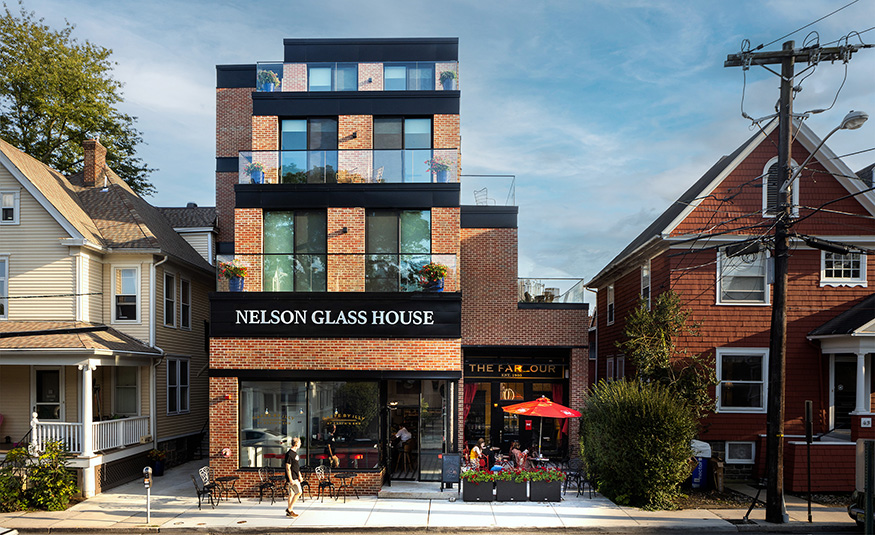
Nelson Glass House, Princeton; Joshua Zinder Architecture + Design LLC. Located in a part of the municipality being considered for historic district designation, a transitional block where the Central Business District meets a residential neighborhood, the six-unit mixed-use Nelson Glass House sits on an underused site previously occupied by the now relocated, family-owned fabrication business Nelson Glass & Aluminum, a one-story light-industrial operation.
The Nelson family believed it could be appropriate and potentially profitable to redevelop as a mixed-use rental property, taking on the role of owner-developer. JZA+D designed a four-story apartment building at scale with the residential context, incorporating ground-level retail (currently a coffee shop) to activate the neighborhood socially and economically – a prime example of good missing-middle housing strategy.
Massing setbacks at each successive level create terrace features for all units with views of Princeton, while maintaining light and air for adjacent property and street and creating connections to the street. An elevator ensures accessibility for this sustainably designed multifamily, which includes both market-rate and affordable units.
Several aspects of the site made it ideal for this type of development.
First, existing density in the neighborhood suggested an extant demand for additional rental units. That density, combined with the neighborhood’s walkability and nearness to the town center, indicated support for new ground-level retail amenities. Additionally, requirements for 20% of inclusionary affordable housing units in new developments are paired with incentives that help optimize the amount of developable floor area.

Vermella Broad Street, Newark; Minno & Wasko. Vermella Broad Street has a total of 299 units in two buildings. There are 21% studios, 55% one-bedroom, and 24% two-bedroom units. Amenities include a clubroom, coworking center, fitness center, yoga room and a top-floor residential lounge. Outdoor amenities include a roof deck with panoramic views, a resort-style pool and courtyard, and a dog park. The development offers security through controlled building access, AI security camera monitoring and recording, security guard service and gated access, and a secure covered parking garage.

Littleton Avenue, Newark; Inglese Architecture + Engineering. A partnership between L+M Development Partners and University Hospital in the Central Ward of Newark featuring 78 low-to-moderate-income affordable rental units and a ground-level ambulatory care unit.
As an update to the information above and the previous two articles, many of the methods described here have been used by municipalities in creating their housing plans.
Over 90% of the 452 municipalities in New Jersey submitted their affordable housing plans before the June 30 deadline. The state is currently reviewing the submitted plans. Some towns sought exceptions due to ongoing negotiations with the state.
Some municipalities, such as West Orange, missed the deadline, which will put them at risk for a Builders’ Remedy Lawsuit. Other municipalities, such as Cranbury, face community backlash over the sites identified for affordable housing development.
The next big hurdle is for towns to create new ordinances to implement their plans, which must be adopted before March 15, 2026. These plans will outline the landscape for affordable housing in N.J. over the next 10 years, completing the fourth round of the Fair Share Housing Act in 2035.
Joshua Zinder is the founder and managing partner of JZA+D, and a past-president of AIA-New Jersey. His portfolio includes office, hospitality, institutional, government and mixed-use environments.
