


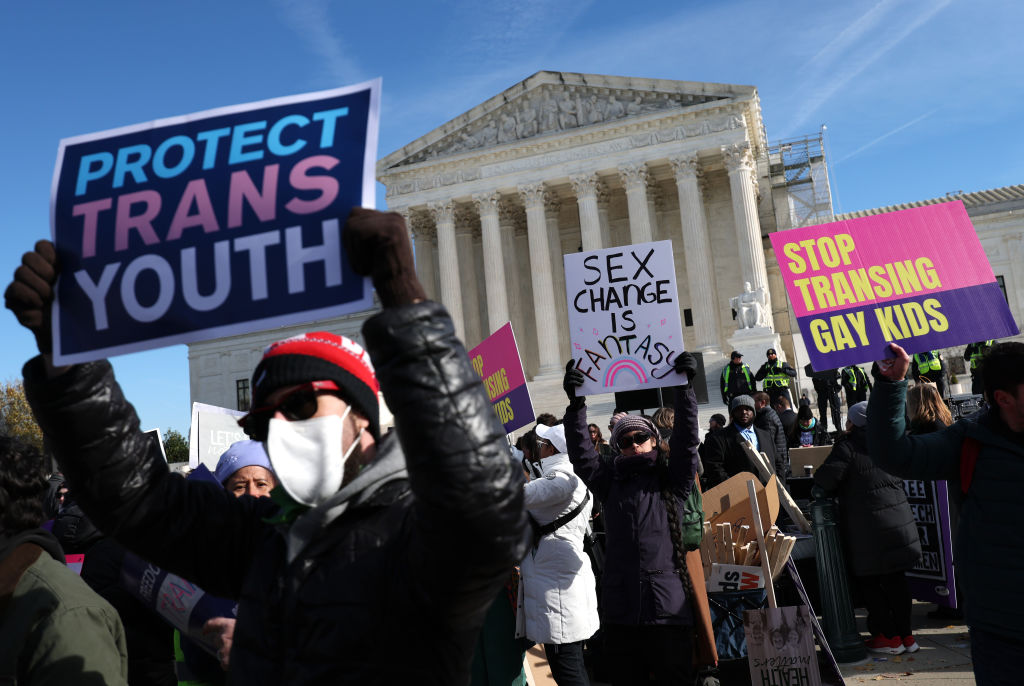
Transgender rights supporters and opponents rally outside the U.S. Supreme Court in December. The fight over health care for trans youth has come to New Jersey, with parents saying medical providers are denying needed care to their children. (Photo by Kevin Dietsch/Getty Images)
Parents of children who receive gender-affirming care in New Jersey are urging the state attorney general to protect access to those services, as medical providers increasingly yield to the Trump administration’s pressure to cut such care for people under 19.
It’s unclear how many medical providers are taking this route. RWJBarnabas Health, the largest academic health care system in New Jersey with 15 children’s hospitals statewide, told the New Jersey Monitor that it recently stopped accepting new pediatric patients for gender-affirming care.
And in a letter earlier this month, seven parents told Attorney General Matt Platkin that Atlantic Health providers have alerted patients and their guardians that the system also might end or scale back gender-affirming care in response to President Donald Trump’s January executive order that threatened funding cuts for noncompliance.
Jane Buchanan of Maplewood said she signed the letter because the gender-affirming care her son, now 18, received at Atlantic Health over the past four years helped him overcome “very serious mental health issues.”
“Once he started receiving very supportive, very professional care, it just really helped him be a healthy, happy kid and get through high school,” Buchanan said. “This care is utterly crucial for our kids. The idea of it disappearing is terrifying.”
Gender-affirming care for youth typically involves mental health counseling and medications like puberty blockers and hormone therapy. It can include surgery, but a 2023 study found surgical intervention is rare for transgender youth.
Atlantic Health did not respond to the New Jersey Monitor’s requests for comment. Buchanan said the health care system, which oversees seven hospitals, also has not responded to a letter demanding answers that she and more than 500 other parents and advocates signed and sent earlier this month to Saad Ehtisham, who became Atlantic Health’s president and CEO in July.
Platkin’s office declined to answer questions and referred the New Jersey Monitor to a joint statement he and 14 other state attorneys general issued in February that says: “No federal law makes gender-affirming care unlawful. President Trump cannot change that by Executive Order.”
Since January, hospitals around the country have paused or ended such care, with 27 states enacting laws that limit gender-affirming treatment for minors. A judge temporarily blocked Trump’s executive order in response to lawsuits filed by both LGBTQ advocates and a coalition of states, including New Jersey.

In New Jersey, RWJBarnabas Health officials decided to limit gender-affirming care to patients age 19 and older, although current pediatric patients receiving hormone therapy or blockers may continue to do so “pending further updates from the federal government,” spokeswoman Carrie Cristello said.
“After careful consideration of the current federal landscape, including executive orders, administrative and enforcement actions, and U.S. Supreme Court rulings, and in alignment with other academic health systems across the country, we recently made the decision to update our gender-affirming care policy,” Cristello said. “Our physicians and care teams are working directly with patients and their families to provide resources and support as needed.”
In July, Attorney General Pamela Bondi said the Department of Justice sent more than 20 subpoenas to pediatric providers of gender-affirming care, vowing to hold accountable “medical professionals and organizations that mutilated children in the service of a warped ideology.”
Bondi did not specify which providers, and Cristello declined to say whether RWJBarnabas Health received a subpoena. The Children’s Hospital of Philadelphia, whose Gender and Sexuality Development Clinic is a go-to provider for many New Jersey transgender youth, was among those subpoenaed.
The uncertainty and cutbacks in care have distressed New Jersey’s transgender community.
Parents are afraid not only that children may not receive needed care, but they also fear a loss of privacy, getting dragged into legal fights between the government and health care providers, and getting prosecuted by — and possibly losing custody to — authorities who regard gender-affirming care as criminal abuse, said Del Sasso, a clinical psychologist in Middlesex County who specializes in such care.
“People in the community are very frightened that they’re compiling lists of trans kids and their families, and trans adults,” Sasso said. “All of my patients who are transgender, or have a transgender family member, have a plan to leave the country. Some of those are emergency plans that they’re hoping not to act on. But they range from that to people who have a plan that they’re leaving ‘in four months to X place.’ And I know many, many, many families who have left.”
Aisling MacDonald of LGBTQ rights group Garden State Equality said health care institutions should not let fear dictate care.
“We understand that health care systems are under immense pressure, navigating unclear federal guidance, media scrutiny, and real fear of political backlash,” MacDonald said. “But let us be clear: evidence-based, lifesaving gender-affirming care for youth remains legal in New Jersey. The long-term financial and ethical complications from ceasing such care far outweigh the short-term benefit of early compliance with federal whims.”
Sasso seconded that sentiment, saying ending this care for transgender youth is “extraordinarily dangerous.”
“This is absolutely deadly for our community. I don’t think that that’s hyperbolic. Perhaps that’s the goal,” Sasso said.
Calls to codify care
In their February joint statement, the 15 attorneys general pledged to “continue to enforce state laws that provide access to gender-affirming care, in states where such enforcement authority exists.”
That’s not New Jersey.
Gov. Phil Murphy, a Democrat, issued an executive order in 2023 that protected access to gender-affirming care and decreed that denial of such care constitutes discrimination, saying denial of gender-affirming care violates the Law Against Discrimination, which bars discrimination based on sexual orientation, gender identity, and gender expression.
But New Jersey does not explicitly protect gender-affirming care by law. Several other states do, including Massachusetts, where Gov. Maura Healey last month signed a law shielding parents of transitioning pediatric patients from claims of abuse, neglect, or maltreatment.
Similar legislation that would essentially codify Murphy’s executive order and shield transgender patients and their parents from liability is already in the Statehouse pipeline in Trenton. It has widespread support, with 32 Assembly members and 18 senators — including Senate President Nicholas Scutari — listed as sponsors, but it hasn’t moved since it was introduced in June 2024. Scutari (D-Union) and Assembly Speaker Craig Coughlin (D-Middlesex) did not respond to the New Jersey Monitor’s requests for comment.
Legislators are not expected to return to Trenton until after the general election in November, when all 80 Assembly seats and the governor’s race are on the ballot. Advocates like Louise Walpin have lobbied hard for lawmakers to come back earlier to act on the bill.
Walpin successfully led New Jersey’s fight to legalize same-sex marriage in both the Statehouse and the courts more than a decade ago. She finds legislators’ inaction on the gender-affirming care bill a frustrating missed opportunity, given that the state now has a “blue trifecta” with Democrats in control of the governor’s office and both legislative chambers.
“This isn’t business as usual this year. We’re living in a five-alarm fire, and with a five-alarm fire, you don’t wait to call the troops in,” Walpin said. “We should have the most power right now that we could ever have to fight back against the MAGA, Trumpian, authoritarian rule, and we’re not exercising it. We’re failing groups of people who are really most at risk.”
The protections Murphy ordered “could be erased by the next governor,” Walpin added.
“We don’t know who the governor is going to be or what their stance is going to be on it,” Walpin said.

Jack Ciattarelli, the Republican former assemblyman now running to replace Murphy, told the New Jersey Monitor that he supports parents’ rights to “do whatever they think is in the best interest of their children.”
Yet he said he’s “greatly” concerned about “life-altering surgery performed at a very young age.”
“I think the medical literature is starting to show us that people that may have had those surgeries eight, nine, 10 years ago are now feeling as though they wish they hadn’t,” Ciattarelli said. “I respect parental rights. But I think if the medical literature is showing us that there have not been good outcomes for people that had life-altering surgeries, eight, nine, 10 years ago, that’s something we need to take a look at.”
Rep. Mikie Sherrill, Ciattarelli’s Democratic rival, did not respond to the New Jersey Monitor’s requests for comment. She has said she supports gender-affirming care but in December voted for a defense bill that bars such care for children of military families.
To Christian Madera of Millburn, politicians who profess to respect parental rights should have no say about the puberty blockers his 10-year-old son recently began taking under Atlantic Health’s care.
“In some states today, I have the right as a parent to withdraw my child out of a school lesson because I disagree with the content, but I don’t have the right to consult with a medical expert and follow protocols that are endorsed and supported by a number of major medical associations,” Madera said.
The American Medical Association, which represents more than 250,000 U.S. doctors, in June 2023 passed a resolution that calls for protection for this type of care.
Madera signed both letters, to Platkin and to Ehtisham. He said he publicly advocates for gender-affirming care because he believes education can help its critics understand “it’s not anything crazy or mentally ill.”
The puberty-blocking treatment his son is on is reversible and buys the family time for the child to decide at an older age if he wants to continue transitioning, Madera said.
“He has been very clear for a long time that he is a boy. He wants to grow up and have a beard and have a wife and be a man,” Madera said. “These are just normal kids who happen to have a brain that doesn’t match their anatomy. And medicine has always been there to help people when their bodies don’t serve them the way they need to, whether they need hormone therapy because they’re in menopause or they need IVF because they can’t conceive a child. There are all sorts of things where medicine intervenes, and this is just another thing.”
GET THE MORNING HEADLINES.
