


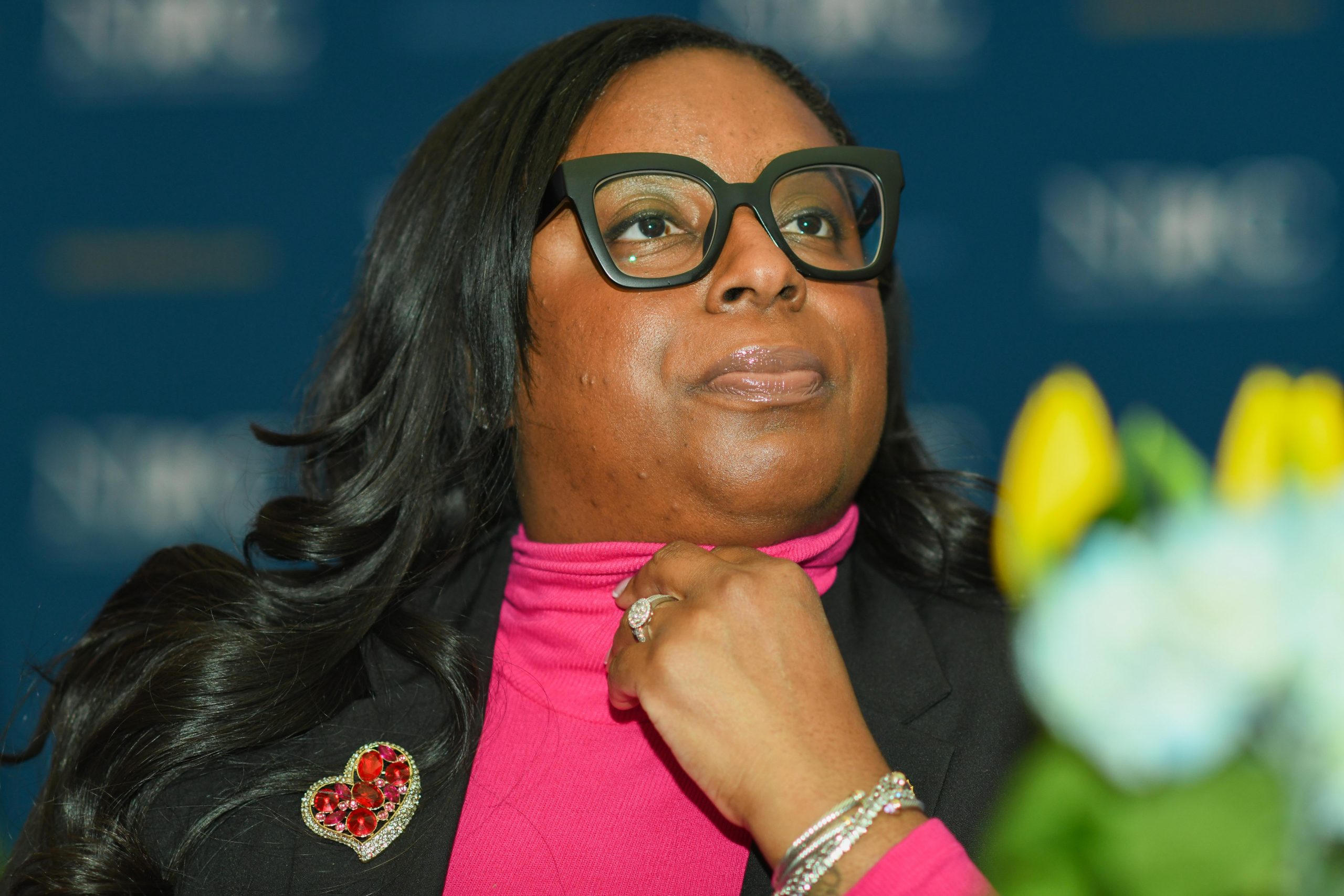
Before Rep. LaMonica McIver (D-Newark)’s trial on federal assault charges begins in November, a federal judge will hear oral arguments on whether the charges should be thrown out without going to trial at all.
According to recent legal filings, District Judge Jamel Semper has scheduled oral arguments for October 21 to hear out a series of pretrial motions made by McIver’s legal team. (That contrasts with how a different judge handled ex-Senator Bob Menendez’s case last year; Menendez also filed several pre-trial motions to dismiss, including one relying on arguments similar to McIver’s, but the judge rejected them without ever hearing in-person testimony.)
McIver was charged in May with allegedly assaulting federal immigration officers while conducting an oversight visit at Newark’s Delaney Hall immigrant detention center. The first-term congresswoman has said the charges are an attempt at political intimidation, and her legal team filed two motions to dismiss the charges in August: one focusing on McIver’s legislative immunity under the Constitution’s Speech or Debate Clause, and another arguing that the charges are vindictive and politically motivated.
In its response last week, the Department of Justice (DOJ) said that its prosecution of McIver – led by acting U.S. Attorney Alina Habba, whose own authority is under scrutiny in an appeals court – is valid and should be allowed to stay on track. Last night, McIver’s team filed its rebuttal to that response, in what may be the case’s final major briefs before October oral arguments.
The four reply briefs filed last night make few new arguments, but some do shed new light on how McIver intends to push back on the government’s characterization of her actions at Delaney Hall, when she scuffled with officers following their arrest of Newark Mayor Ras Baraka.
Read the four reply briefs: on vindictive prosecution, on legislative immunity, on extrajudicial statements, and on compelling discovery
McIver’s attorneys said in their August motion that, since the congresswoman’s visit to Delaney Hall was official congressional business, she is protected by the Constitution’s guarantee of legislative immunity for official acts; the DOJ responded that the nature of the visit is irrelevant to the alleged assault McIver committed. In their new brief filed yesterday, McIver’s team argues the opposite: scuffling with immigration officials was official business, because it was done with the intention of protecting her right to conduct oversight.
“[McIver’s] conduct during Mayor Baraka’s arrest itself served the legislative function of preventing impairment of her oversight inspection and overseeing ICE’s unsafe and unlawful arrest of the Mayor,” the reply states. “The Congresswoman’s actions were a spontaneous and proportional response to a volatile situation that ICE itself created, and any Member of Congress could find themselves in similar circumstances while conducting oversight of ICE facilities.”
McIver’s attorneys had also filed two other motions last month: one that seeks to restrain the government from making “extrajudicial statements” about McIver that may prejudice the jury, and another to compel discovery on a number of pieces of potentially key evidence.
The DOJ said in its response that, while it disagrees with McIver’s characterization of “extrajudicial statements” made by the Department of Homeland Security (DHS) and by President Donald Trump himself, it had asked DHS officials to take down five specifically offending statements. Those five statements have indeed since been removed, but McIver’s lawyers said that’s not a sufficient remedy, and that the Trump administration must proactively identify and retract any other prejudicial remarks.
“A criminal prosecution is not a game of whack-a-mole that requires a defendant to police the conduct of the prosecution team and other Executive Branch personnel to receive a fair trial,” the reply states. “To the contrary, that responsibility falls in the first instance on the prosecution team, and the Court should direct them to search for, identify, and disclose any other instances in which such statements have been published.”
The two sides also remain at odds on the issue of body camera footage. The DOJ stated last week that footage from some officials present at the incident – including those identified as Victim-1 and Victim-2 – is not available because those individuals were not wearing body cameras for a variety of reasons; McIver’s attorneys expressed skepticism of those claims, and have asked for more details about the reasons for the lack of footage.
Oral arguments in October may provide more clarity about how Semper is approaching the case, but it’s possible that outside factors will complicate his timeline. A federal government funding deadline is approaching on September 30, and if the government shuts down for an extended period of time, the federal judiciary could be affected; the ongoing Third Circuit appeal over Habba’s legitimacy has also cast a shadow over the entire New Jersey judicial system, with many cases being put on pause until her authority is either affirmed or nullified.
