


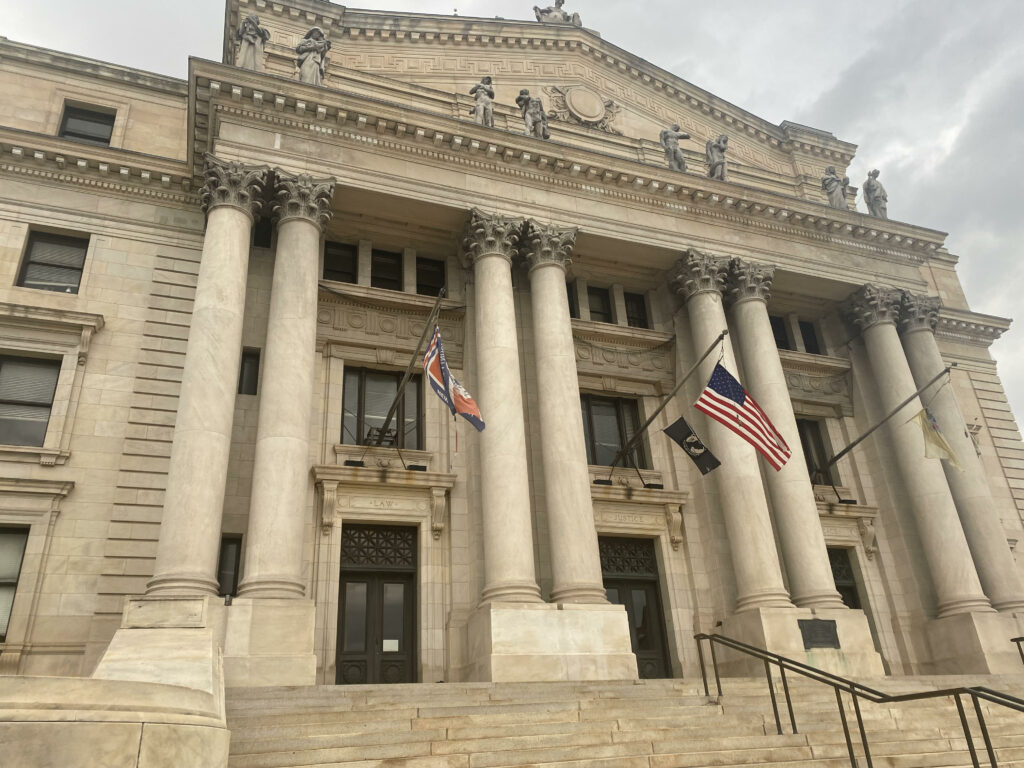
The state public defender and Essex County prosecutors reached an agreement to cut down on a backlog of expungement requests over the next five months. (Photo by New Jersey Monitor)
A new consent order issued by the New Jersey Supreme Court on Monday will require the Essex County Prosecutor’s Office to speed processing of expungement petitions that often stretch past the 60-day review called for by state law.
The agreement will require Essex prosecutors to reduce their expungement backlog over the next five months, alongside some other concessions. State Public Defender Jennifer Sellitti praised the agreement as one that will allow Essex residents who have earned a second chance to “no longer face indefinite delays.”
“It is a significant step toward making the promise of New Jersey’s expungement laws a reality,” Sellitti said.
Trump admin sues NJ activists, pro-Palestinian groups over synagogue scuffle
The consent order resolves litigation the Office of the Public Defender filed over the expungement backlog in Essex.
New Jersey has multiple expungement programs, but most often, individuals can have their records cleared after 10 years — and sometimes sooner — if they have completed their sentences, paid any fines, and have not reoffended.
Once an offense is expunged, authorities by law cannot share that information except with law enforcement, corrections, or court officials, though persistent delays throughout the expungement system have led to the disclosure of convictions for some expungable offenses.
Those delays were greatest in Essex County, which in February accounted for a quarter of the state’s expungement backlog. The 501 expungement applications backlogged there then more than doubled the number in any other county. Passaic County had the next most, at 244.
“As always when the Essex County Prosecutor’s Office recognizes an area which can be improved, we address it promptly and seek appropriate resolution. We are pleased that this matter was resolved amicably,” Essex County Prosecutor Theodore Stephens said in a statement.
The consent order will require the prosecutor’s office to cut its backlog so that no more than 20% of petitions are pending after 60 days by February 2026. Beginning next March, the office will be required to reduce its backlog to below 20% of cases and keep it there through at least March 2027.
The prosecutor’s office also agreed not to object to expungement petitions based on missing probation documentation when the courts have already confirmed a person is eligible.
“By establishing clear benchmarks and removing unnecessary barriers, this consent order ensures that the process is fair, timely, and accessible for everyone,” said Fletcher Duddy, an assistant public defender. “It’s about giving people the ability to move forward with their lives without being held back by outdated administrative hurdles.”
Expungement delays are not new to New Jersey, nor are they unique to the state.
The New Jersey State Police in March settled a lawsuit over yearslong delays to thousands of expungements. The terms of that settlement include the creation of an online portal allowing individuals to track the progress of their expungement requests.
In March 2024, Gov. Phil Murphy signed bipartisan legislation to bar the State Police from releasing information about to-be-expunged offenses during background checks.
GET THE MORNING HEADLINES.
