

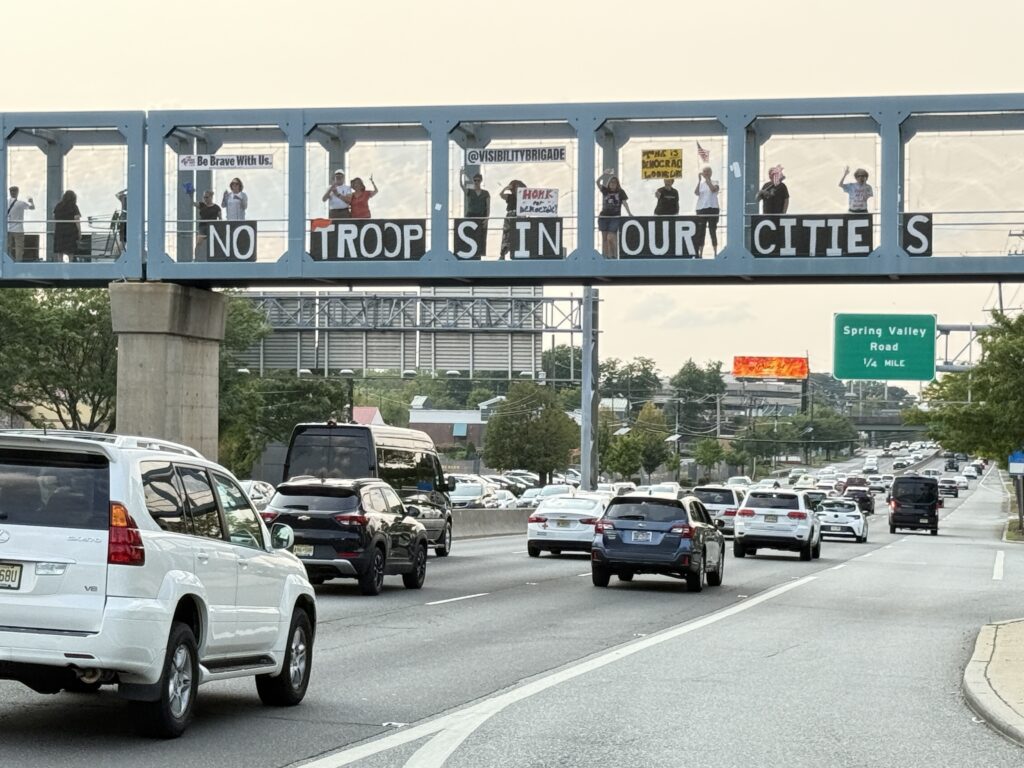
The Visibility Brigade began in 2020 in Paramus. Members of the Paramus Visibility Brigade often show their messages from an overpass on Route 4. (Photo courtesy of Paramus Visibility Brigade)
Robert Quinlan used to vent his frustration with the Trump administration at political rallies.
“The demonstrations were always energizing, maybe cathartic. But I realized that after a while, it’s the same 100 people walking around in circles, carrying their signs, showing them to each other,” the Readington retiree said. “I didn’t feel it was reaching very many people.”
Then he heard about the Visibility Brigade, in which protesters seeking a bigger impact take their dissent on the road — literally. They line highway overpasses with giant letters to form messages for the thousands of motorists hurtling by underneath. After attending one earlier this year, Quinlan was hooked, so he helped organize a brigade in Hunterdon County whose 280 members have held 24 actions since spring, usually over Route 78.
“We average about 4,000 vehicles per hour. Sometimes we’re out there for up to two hours, that’s 8,000 people,” Quinlan said. “We reach a lot more of an audience. It’s just more effective.”
Since it first formed in 2020 in Paramus, the brigade has grown into a bona fide movement — with about 270 chapters around the country — because of opposition to President Donald Trump, said Dana Glazer, one of its founding organizers. He calls the group’s actions “rush-hour resistance” and a “defibrillator for democracy.”
“There are, unfortunately, a lot of very misguided people who have been manipulated, primarily by billionaires, to do their bidding,” Glazer said. “But we’re not there for them. We’re there purely for the people who haven’t lost their minds — and are deeply concerned but maybe aren’t doing enough about it or are pretending like it’s not happening — to remind them that A, they’re not alone, and that B, we all have a role to play in this.”

Recent messages have addressed everything from Trump’s military deployments (NO TROOPS IN CITIES! in Cape May) to immigration crackdowns (STOP ICE CRUELTY in Newton, Massachusetts) to comedian Jimmy Kimmel’s suspension (BAN FASCISTS NOT COMEDIANS in Spokane, Washington).
Chapters come up with their own messages.
“I think of this as a giant creative art project,” Glazer said. “There’s a degree of poetry involved. Words have power. They have a magic to them. We only have a very few words to put forth, and we debate them very vigorously.”
Sometimes, participants aim to educate, as the Paramus group did in July in alerting motorists that the Trump administration plans to detain migrants at Fort Dix with the message “STOP FORT DIX CONCENTRATION CAMP.”
Occasionally, they go for humor in messages Glazer dubs “laughterism,” like May’s “MAKE NAZIS AFRAID AGAIN” and April’s “HEGSETH LEAK NEEDS PLUMBER” after Defense Secretary Pete Hegseth shared classified material in an unsecured group chat.
One popular message riffs on German theologian Martin Niemöller’s famous “First They Came” quote condemning the complicity of those who failed to challenge the Nazis during the Holocaust. “1ST THEY CAME FOR IMMIGRANTS,” Ann Arbor, Michigan, participants messaged in May. “THEN THEY CAME FOR A MAYOR,” the Paramus group messaged the same month, after federal authorities arrested Newark Mayor Ras Baraka outside a migrant jail in his city.
The group prohibits profanity or any calls for violence.
“The idea is to activate people and engage them, not to repel them,” Glazer said.
The overpass signs aren’t exclusively about Trump. Earlier this year, the group in Paramus touted its support of Jersey City Mayor Steve Fulop, who was one of six Democrats seeking his party’s nomination for governor in June. Last week, the groups announced they would launch a statewide effort supporting Democrat Mikie Sherrill’s gubernatorial bid.
Their activism occasionally irks opponents, who sometimes report them to police or more often shout things like “get a job!” as they pass. Organizers hold regular de-escalation trainings, urging participants to avoid confrontations with critics by seeking help from police if they persist, Glazer said. He said the brigade actions require courage as political violence escalates, a theme that shows up in some messaging like “BE BRAVE WITH US.”
“What we’re doing on the overpass, every time, is an act of bravery,” he said. “There’s a targeting aspect to this, a degree of safety that’s involved. It’s a paradox — this is the Visibility Brigade, and we’re trying to be as visible as possible. At the same time, we have families. We have to be thoughtful about their safety.”

Despite such fears, a majority of New Jersey residents support people taking their political concerns to the street in protests and rallies, with 80% of voters surveyed last fall regarding them as “always” or “sometimes” justified, said Ashley Koning, director of the Eagleton Center for Public Interest Polling at Rutgers University.
She does not think they move the needle much at the ballot box.
“They really are much more about symbolism and participating in the political process in some way, more than they are about really convincing voters,” Koning said.
Richard Krasney of West Orange said the bridge actions give him an outlet for his fears that Democratic leaders haven’t done enough to oppose Trump’s actions.
“My parents had Vietnam, and my grandparents had World War II. My generation really has never faced a war before. I’ve never ‘served my country before,’ so to speak, quote, unquote,” he said. “I felt like this was my country needing me to step forward to do something, and this was what I felt like I was drawn to do.”
For Pamela Lynn Brause of Hunterdon County, it’s how the administration carries out its policy priorities that really rankles. Brause, who’s an attorney, said Trump has an unacceptable contempt for courts and the rule of law. She regards many of his actions as “an authoritarian power grab.”
“I don’t want you taking somebody off the street because they have to ask for a glass of water in Spanish,” Brause said. “If you believe that a person is here illegally and that there should be deportation proceedings, file the proceedings in court. Give the person due process and have a judicial determination. Snatching people off the street and leaving their little kids behind is not what we want.”
Quinlan, a retired police chief, seconded that sentiment. He pointed out that Trump vowed during his campaign to deport “the worst of the worst,” such as undocumented immigrants who commit crimes.
“I don’t think many people would oppose that. Instead, masked ICE agents have aggressively pursued hard-working, decent people with no criminal record, leaving their families without the breadwinner. It’s just all so un-American,” Quinlan said.
He has friends from various marginalized groups who have felt unsafe and even fled the country as anti-immigrant rhetoric ramps up, he said.
“My parents had close personal friends who were Japanese Americans. They were naturalized citizens, yet they were rounded up and placed in internment camps near the West Coast during World War II. What we’re witnessing now is no different. The country is just demonizing a different group of people,” he added.
As more people join the brigade, members have experimented with expanding the idea of visibility, including with “Crush ICE” car caravans to condemn Trump’s deportation policies. In Hunterdon, Quinlan plans to stick with overpass messaging.
Holding a sign on a bridge might not convert those passing by, as politics becomes increasingly polarized, he conceded. But that’s not the point, he said.
“People drive along the highway, listening to often terrible news from around the country, from the White House, from different places, and they look up and they see us — and we give them hope,” he said. “That’s our real mission.”
GET THE MORNING HEADLINES.
